Using Annuities to Fund a Special Needs Trust
Explore annuity payout structures, trust ownership considerations, liquidity, taxes, and benefits eligibility when evaluating a funding strategy.
Yes, an annuity can help fund a special needs trust, but the outcome depends entirely on who owns the contract, who receives the payments, and how the trust itself is written.
Families exploring strategies for funding a special needs trust with annuities often assume that naming a trust as a beneficiary automatically solves the problem of providing long-term financial support without risking Supplemental Security Income (SSI) or Medicaid.
That assumption can be costly. An annuity is a contract, not a magic wrapper, and its tax treatment, payout schedule, and effect on public benefits shift depending on whether the trust owns it, is named as its beneficiary, or has no legal connection to it at all. Before purchasing a new annuity, transferring an existing one, or changing a beneficiary form, it helps to understand exactly how these pieces fit together.
Key Takeaways
- Funding a special needs trust with annuities requires matching ownership, annuitant, payee, and beneficiary roles to the trust’s actual legal structure — not just naming the trust on a form.
- An ordinary revocable living trust is not automatically a qualifying special needs trust, even if it’s well-drafted for general estate planning.
- Annuity payments made directly to a person with a disability can create countable income or resources that jeopardize SSI and Medicaid eligibility.
- Liquidity matters: surrender charges, fixed payout schedules, and irrevocable elections can clash with a trustee’s need for flexible cash flow.
- Later sections walk through a full funding checklist, a side-by-side hypothetical comparing three annuity arrangements, and the tax questions worth raising with a qualified professional.
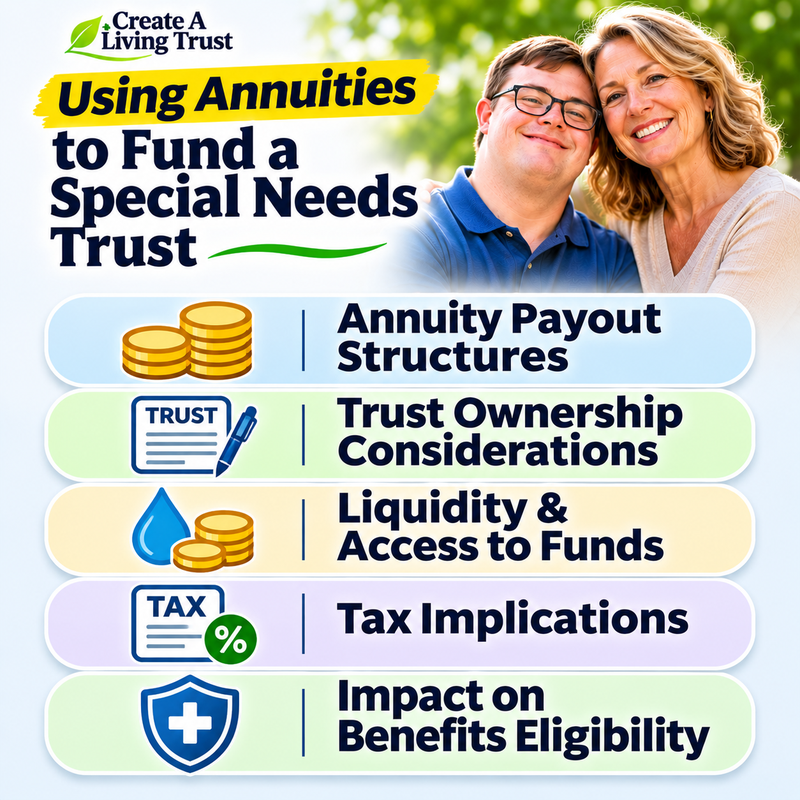
Explore annuity payout structures, trust ownership considerations, liquidity, taxes, and benefits eligibility when evaluating a funding strategy.
The Short Answer: Can an Annuity Fund a Special Needs Trust?
An annuity can provide scheduled payments or other financial resources to a properly structured special needs trust, but it isn’t a one-size-fits-all solution. The contract’s terms, who legally owns it, how the trust is drafted, and which public benefits the beneficiary receives all determine whether the arrangement actually works as intended. Some annuities integrate smoothly with a special needs trust. Others create tax headaches, liquidity gaps, or benefit disqualification risks that could have been avoided with different planning.
There are three distinct arrangements worth separating in your mind right away:
- An annuity legally owned by a properly structured special needs trust.
- An annuity owned by another person or entity that names a special needs trust as its beneficiary or designated recipient.
- An annuity personally owned by, or payable directly to, the individual with a disability.
These three setups are not interchangeable. Each carries different consequences for taxes, creditor protection, probate, and most importantly, public-benefit eligibility. Simply naming a trust as an annuity beneficiary does not guarantee that SSI or Medicaid eligibility will be preserved, that the arrangement will be taxed favorably, or that the money will avoid probate. Every one of those outcomes depends on the specific contract and trust language involved.
Why Ownership Structure Matters More Than the Annuity Itself
It’s tempting to think the type of annuity — fixed, variable, immediate, deferred — is the most important decision in this process. It isn’t. The ownership structure typically matters more than the product type. An annuity is defined by four contractual roles: the owner, the annuitant, the payee, and the death beneficiary. These roles can belong to four different parties, and each one carries separate legal and tax implications.
Think of it this way: two families could buy the exact same annuity contract from the exact same insurer, yet end up with completely different outcomes for Medicaid eligibility, income tax reporting, and trustee control simply because they structured ownership and beneficiary designations differently. That’s why families considering special needs trust funding with an annuity need to slow down and map out each role before signing anything.
What It Means to Fund a Special Needs Trust With an Annuity
How Annuities Work as a Financial Product
An annuity is a contract with an insurance company. In exchange for a lump sum or a series of payments, the insurer promises to make payments back to someone — either immediately or at a future date. That’s the basic mechanics of it, but the details matter a great deal for special needs planning. Depending on the contract, payments might last for a set number of years, for the annuitant’s lifetime, or according to some other formula written into the policy.
Several features typically show up in annuity contracts used for trust planning:
- A stated owner who controls the contract and can usually change beneficiaries or request withdrawals.
- An annuitant whose life expectancy or other characteristics may determine the payout formula.
- A payee who actually receives the periodic payments.
- A death beneficiary who receives remaining value or benefits after a triggering death occurs.
Because these roles can be split among different people or entities, a single annuity contract can be structured many different ways. That flexibility is useful, but it also means mistakes are easy to make without careful review.
Why Families Consider Annuities for Special Needs Planning
Families often turn to annuities because they want predictable, scheduled income rather than a lump sum that a trustee has to manage and invest indefinitely. A monthly or annual payment stream can simplify budgeting for recurring expenses like housing support, caregiving costs, or therapies not covered by Medicaid. This is especially common when a structured settlement from a personal injury claim is already part of the picture, since structured settlement annuities are specifically designed to deliver payments over time rather than all at once.
Consider the difference between receiving a $500,000 lump sum and receiving $2,500 a month for life. The lump sum demands active investment management and carries market risk; the monthly payment offers predictability but locks in a fixed schedule that may not flex with changing care needs.
That tradeoff — predictability versus flexibility — sits at the center of nearly every decision about whether an annuity belongs in a special needs trust funding strategy.
How This Differs From Funding a Trust With Cash or Real Estate
Funding a trust with cash or a brokerage account is relatively straightforward: retitle the account, and the trust owns it. Annuities don’t work quite the same way. Ownership transfers may require insurer approval, could be restricted by contract provisions, and sometimes trigger tax consequences that wouldn’t occur with a simple bank account transfer. This is one of the reasons funding a special needs trust with annuities deserves separate, careful analysis rather than being lumped in with general trust funding steps.
It’s worth noting that how to fund a living trust generally involves retitling bank accounts, deeds, and investment holdings into the trust’s name — a process that’s conceptually different from establishing annuity ownership, payment rights, or beneficiary designations. An ordinary living trust funding checklist won’t address insurer-specific transfer rules, annuitant designations, or the public-benefit consequences unique to annuity contracts. Special needs trust funding with annuities requires its own due diligence process layered on top of standard trust funding mechanics.

Federal Rules and State Variations You Need to Know
SSI and Medicaid Asset Rules at the Federal Level
SSI is a federal, means-tested program with strict income and resource limits. Historically, the individual resource limit has been set at $2,000 for an eligible individual, though families should confirm current figures directly with the Social Security Administration since program rules can be updated. Medicaid, on the other hand, isn’t a single program — it’s a collection of programs with eligibility and financial rules that vary by category and by state. SSDI is different still: it’s a disability insurance program tied to work history, and it doesn’t use the same resource test that SSI does.
These distinctions matter enormously for annuity planning because:
- An annuity’s surrender value, assignability, and ownership rights may determine whether it counts as a resource under SSI rules.
- Scheduled annuity payments received directly by an individual may count as income in the month received, potentially reducing or eliminating SSI benefits.
- Medicaid eligibility categories tied to SSI often borrow those same resource and income tests, while other Medicaid eligibility pathways may apply different standards.
Even when a properly structured trust is excluded as a countable resource, certain distributions from that trust can still affect SSI or Medicaid eligibility depending on how and what the trustee pays for. That nuance trips up a lot of well-intentioned families.
Why State Medicaid Programs Apply Rules Differently
Medicaid is a joint federal-state program, and each state administers its own version within federal guidelines. That means trust administration rules, Medicaid payback requirements, creditor protections, and even certain annuity-related insurance regulations can vary from state to state. A strategy that works cleanly in one state might require adjustments in another. This article offers general, nationwide guidance, but any state-specific example should be treated as just that — an example, not a universal rule. Readers should verify current Medicaid rules with their state’s Medicaid agency before finalizing any annuity-funded trust strategy.
When to Bring in a Special Needs Attorney or Benefits Counselor
Given how much ownership structure, state law, and program-specific rules can shift the outcome, this is not the kind of decision to make from a general internet search alone. A qualified special needs planning attorney can review the actual trust document, the annuity contract’s language, and the family’s specific benefit situation before any ownership change, assignment, or beneficiary designation is finalized. A benefits counselor familiar with SSI and Medicaid rules in the relevant state adds another layer of protection against costly mistakes.
Why Beneficiary Designation Errors Can Disqualify Benefits
A beneficiary form might seem like a minor administrative detail, but it carries enormous weight in special needs planning. The form must identify the exact legal name of the trust, not the individual, and it must match the trust’s actual provisions — not an outdated draft or a trust that was later amended.
Common errors include listing an old trust name after the document was restated, accidentally naming the individual with a disability directly instead of the trust, or forgetting to update the designation after the trust was revised. Any of these mistakes can unravel years of careful planning, so every beneficiary form deserves a second look from someone who has actually read the current trust document.

Annuities Owned Personally by the Beneficiary
Of the three arrangements discussed throughout this guide, personal ownership by the individual with a disability carries the highest risk for means-tested benefits. When an annuity contract is owned by, or pays benefits directly to, a person receiving SSI or Medicaid, those payments and the contract’s value may be treated as countable income or a countable resource. That’s often the opposite of what families intended when they purchased the annuity in the first place.
This doesn’t mean personal ownership is always disastrous. Someone who doesn’t currently receive means-tested benefits, or who relies solely on SSDI (which uses work history rather than a resource test), may not face the same immediate consequences. But circumstances change. A person’s benefit status today doesn’t guarantee their status five or ten years from now, and an annuity contract is a long-term commitment that’s hard to unwind once it’s in place.
Direct ownership also removes the layer of trustee oversight that special needs trusts are designed to provide. Without a trustee managing distributions, there’s no buffer between the money and the individual’s eligibility for public programs. That buffer is often the entire point of using a trust in the first place.
Before any family member purchases an annuity payable directly to a loved one with a disability, it’s worth pausing to ask a few questions:
- Does the beneficiary currently receive SSI, Medicaid, or another means-tested program?
- Could that eligibility status change in the foreseeable future?
- Would a third-party special needs trust better protect the same financial goal?
- Has a benefits counselor reviewed how the specific contract’s payout structure would be treated?
Why Personal Ownership Can Jeopardize SSI and Medicaid
SSI counts most unearned income in the month it’s received, which can reduce or eliminate a monthly benefit check. Medicaid eligibility categories tied to SSI often apply the same standard. An annuity payment landing directly in a beneficiary’s bank account, even a modest one, can trigger exactly the kind of income reporting that puts benefits at risk.
Countable Asset Risks With Direct Annuity Ownership
Beyond income, the annuity contract itself — particularly its surrender value and whether it can be assigned or cashed out — may be evaluated as a resource. If that value, combined with other countable resources, pushes the individual over SSI’s resource limit, benefits can be suspended until the excess is spent down.
Situations Where Personal Ownership Still Happens by Mistake
This outcome often happens unintentionally: a grandparent names a grandchild directly as a death beneficiary without knowing about the special needs trust, or a workplace retirement annuity defaults to a named individual because no one updated the paperwork after the trust was created. These aren’t signs of bad planning so much as signs that beneficiary designations need to be reviewed every time a family’s estate plan changes.
Liquidity, Surrender Charges, and Access to Funds
Predictable income is one of the biggest selling points of an annuity, but predictability has a cost: reduced flexibility. Most annuity contracts include a surrender period, typically several years long, during which early withdrawals trigger a penalty known as a surrender charge. For a trustee managing a special needs trust, that penalty can be a serious obstacle if an unexpected expense arises before the surrender period ends.
Disability-related expenses rarely follow a predictable calendar. A wheelchair might need urgent replacement. A housing situation might change on short notice. Medical equipment not covered by Medicaid might need to be purchased immediately. An annuity’s fixed payout schedule doesn’t always bend to meet these moments, which is why financial professionals generally caution against using an annuity as the sole funding source for a trust that needs to stay flexible.
It helps to think through a few practical scenarios before committing funds to an annuity:
- What happens if the trust needs $10,000 for an emergency during the surrender period?
- Does the contract allow partial withdrawals without full surrender?
- Is there a secondary source of liquid funds the trustee can draw on instead?
- How does inflation affect the purchasing power of a fixed payment over 10 or 20 years?
How Surrender Periods Limit Early Withdrawals
Surrender charges typically decline over a period of years before disappearing entirely, but during that window, pulling money out ahead of schedule can mean losing a meaningful percentage of the contract’s value. Trustees need to know these dates and percentages before they’re ever in a position where they need the cash.
Matching Payout Schedules to the Beneficiary’s Needs
A monthly payment that covers rent and groceries works well until a major one-time expense shows up. That’s why payout timing should be discussed and mapped against anticipated expenses before the contract is purchased, not after. Immediate annuities begin payments right away, while deferred annuities wait through an accumulation phase before distributions start — and that timing choice should reflect the beneficiary’s actual, current financial picture.
Life expectancy and changing care needs also deserve consideration. A young beneficiary with decades of potential care ahead faces very different planning challenges than an older beneficiary with a shorter expected timeline, and payout elections made today may be irrevocable once locked in.
What Happens If the Trust Needs Cash Before Payout Starts
This is precisely why financial professionals often recommend holding at least some liquid assets outside the annuity — cash reserves, a brokerage account, or another accessible fund — so the trustee isn’t forced to trigger surrender charges or wait out a deferral period during a genuine emergency.

Tax Implications of Annuity-Funded Trusts
Annuity taxation is not one-size-fits-all. It depends on the type of contract (qualified versus nonqualified), the tax basis, who funded it, how it’s owned, and how distributions are structured. None of this is automatically resolved just because a special needs trust is involved, and no one should assume that payments flowing into a trust are tax-free simply because the recipient is a trust established for benefits planning.
How Trust Tax Rates Differ From Individual Rates
Trusts are often taxed on undistributed income at compressed tax brackets, reaching higher marginal rates at much lower income thresholds than individuals do. Whether income is taxed at the trust level or passed through to the beneficiary depends on the trust’s specific distribution provisions and applicable tax rules — another reason a tax professional needs to review the actual trust language before funding decisions are finalized.
Taxable Portions of Annuity Payments Explained
Nonqualified annuities purchased with after-tax dollars generally return a portion of each payment as a tax-free return of principal and a portion as taxable earnings, calculated using an exclusion ratio. Qualified annuities, funded with pre-tax retirement dollars, are typically taxed differently, often with the entire distribution treated as ordinary income. Death benefits may also carry separate tax treatment compared to lifetime payments. For families working through a broader special needs trust funding process, it’s worth remembering that annuities add a layer of tax complexity that cash or real estate funding typically doesn’t involve.
Why Professional Tax Review Matters Before Funding
An ordinary living trust package, including offerings like the eState Living Trust plan, is designed for general estate planning — organizing assets, naming successor trustees, and avoiding probate. It is not built to analyze annuity exclusion ratios, qualified versus nonqualified tax treatment, or trust income tax brackets specific to special needs planning. Those calculations call for a tax professional who understands both annuity contracts and trust taxation, reviewed alongside the special needs attorney handling the trust document itself.
Funding Decision Checklist for Annuity-Based Trusts
Before purchasing an annuity, changing ownership, or updating a beneficiary form, it helps to walk through a structured checklist. Treat this as preparation for a conversation with your attorney and tax professional, not a substitute for their review. When it comes to planning the financial future of a loved one with disabilities, it’s crucial to make informed decisions.
1. Confirm the Annuity Owner
Who legally owns the contract, and what rights does that create? Ownership typically includes the power to change beneficiaries, request withdrawals, or surrender the contract — powers that may conflict with a trust’s intended structure if held by the wrong party.
Verify this directly with the insurance carrier’s current contract documentation, not just the original application paperwork.
2. Identify the Annuitant
Whose life or circumstances determine the payment terms? The annuitant isn’t always the same person as the owner or the payee, and payout calculations typically hinge on this designation.
3. Designate the Correct Payee
Who actually receives the payments, and can those payment rights be assigned to someone else, such as a trustee? Some contracts restrict assignment entirely.
4. Name the Death Beneficiary Carefully
Is the designation consistent with the trust’s current legal name and provisions? Cross-check this against the most recently signed trust document, not an earlier draft.
5. Align Income Timing With Benefit Eligibility Reviews
When do payments begin, how often are they made, and can the schedule change later? Compare this timing against the beneficiary’s anticipated SSI or Medicaid review dates.
If payments could be construed as countable income, map out exactly how that might affect eligibility before the first payment arrives.
6. Schedule a Tax and Benefits Review Before Funding
What are the consequences of ownership changes, transfers, distributions, and death benefits? Bring the actual contract and trust documents to this meeting rather than relying on summaries.
Both a tax professional and a benefits specialist should weigh in separately, since their areas of expertise rarely overlap completely.
7. Confirm Benefits Eligibility Impact
Could the contract or its payments affect SSI, Medicaid, or other programs the beneficiary currently relies on? This question deserves its own dedicated review, separate from the general tax analysis.
8. Verify Trustee Oversight Capacity
Can the trustee actually administer these payments — maintaining liquidity, documenting every distribution, and coordinating with benefits requirements? A trustee without this capacity may need professional support or a co-trustee.
A few additional items round out a thorough review:
- Surrender charge schedule and remaining penalty period.
- Insurer-specific restrictions on ownership transfers or assignments.
- Successor trustee provisions in case the current trustee can no longer serve.
- Complete contract documentation stored alongside the trust’s records.
- A periodic review schedule — annually or whenever family circumstances change.
Working through this list doesn’t replace professional advice, but it does make those professional conversations far more productive. Walking into an attorney’s office with clear answers to these questions saves time and often saves money.

Hypothetical Example: Comparing Three Annuity Arrangements
Consider a parent who wants to provide long-term financial support for an adult child with a disability who currently receives SSI and Medicaid. The parent is weighing whether to purchase an annuity and how to coordinate it with an existing third-party special needs trust. Three approaches are on the table, and each carries distinct tradeoffs.
| Approach | Potential Advantage | Potential Risk |
|---|---|---|
| A. Name the adult child directly as annuity beneficiary | Simple to set up; no trust paperwork required | Payments could count as income, risking SSI and Medicaid eligibility |
| B. Name a properly drafted third-party special needs trust as beneficiary | Trustee controls distributions, helping preserve benefit eligibility | Requires the trust to be correctly named and currently valid; payout timing still needs coordination |
| C. Explore trust ownership or administration of the annuity, subject to insurer rules | Potentially tighter integration between contract terms and trust provisions | May require insurer approval; not all contracts permit trust ownership; tax treatment needs separate review |
Approach A offers simplicity but carries the highest benefits risk. Approach B is more commonly used in special needs planning because it keeps a trustee between the money and the beneficiary, but it only works if the trust document and beneficiary form are both current and correctly drafted. Approach C might offer tighter alignment between the contract and the trust’s authority, but it depends heavily on whether the specific insurer permits trust ownership and how the arrangement would be taxed.
No single approach is universally correct, and not every option is available under every annuity contract. An attorney would need to examine the actual trust instrument, the annuity’s contract terms, the original source of the funds, and the applicable public-benefit rules before recommending any one path over another. This example illustrates the kinds of questions worth asking — it isn’t a specific recommendation for any individual family’s situation.
Common Mistakes and Questions for Qualified Professionals
Several recurring errors show up again and again in annuity-funded special needs planning. Recognizing them in advance can save a family from an expensive correction later:
- Naming the individual with a disability directly as beneficiary without evaluating means-tested benefit consequences.
- Assuming a special needs trust beneficiary designation automatically protects benefits, regardless of the trust’s actual wording.
- Confusing contract ownership with payment or beneficiary rights — they are not the same thing.
- Overlooking surrender charges and underestimating how long funds will be locked up.
- Changing annuity ownership before reviewing the tax consequences of that transfer.
- Using the beneficiary’s own assets to fund an annuity without confirming first-party special needs trust requirements are met.
- Assuming every irrevocable trust automatically qualifies for favorable benefit treatment — it depends entirely on the drafting.
- Selecting a trustee without the administrative background to manage annuity distributions and benefits coordination.
- Failing to coordinate the payout schedule with the beneficiary’s actual, ongoing expenses.
- Neglecting to update beneficiary designations after the trust is amended or family circumstances shift.
A resource like overview of first-party, third-party, and pooled special needs trust structures can help families understand which type of trust applies to their situation before they ever sit down with an attorney. Coming prepared with that background tends to make professional consultations faster and more focused.
Useful questions to bring to that consultation include: Does this specific trust qualify for SSI and Medicaid protection under current program rules? Will this annuity’s payout structure be treated as income or a resource? What insurer-specific restrictions apply to transferring ownership into the trust? And who should serve as trustee given the complexity of managing annuity distributions over the long term?
Revocable Living Trust vs. Specialized Special Needs Trust
It’s worth pausing on a point that trips up many families: an ordinary revocable living trust is not automatically a special needs trust, no matter how well it’s drafted for general estate purposes. A revocable living trust is excellent for avoiding probate, organizing assets, and naming successor trustees — but it typically lacks the specific discretionary distribution language, payback provisions, and benefit-preservation drafting that means-tested programs require.
Understanding the difference between revocable and irrevocable trust structures is a useful starting point, but irrevocability alone doesn’t establish that a trust qualifies as a special needs trust. Qualification depends on the trust’s specific provisions, not simply whether it can be changed later.
How Living Trust Services Fit Into Annuity and Trust Funding Plans
General living trust packages, including the eState Living Trust plan, typically cover digital estate-planning documents, standard trust-funding assistance, a pour-over will, healthcare and financial powers of attorney, and successor-trustee guidance. These services are valuable for organizing a family’s overall estate plan, but they are not a substitute for specialized special needs trust drafting, annuity ownership review, or benefits counseling.
A standard living trust package does not guarantee SSI or Medicaid eligibility, favorable tax treatment, or a particular legal outcome for annuity-funded planning. Families pursuing the strategies discussed in this article should pair any general estate-planning service with a special needs attorney and a benefits specialist familiar with annuity contracts.

Bringing It All Together
Annuities can play a meaningful role in funding a special needs trust, but they work best as one piece of a broader strategy rather than a standalone solution, since their value depends on contract structure, funding source, tax treatment, public-benefit rules, and a trustee’s capacity to manage long-term payments.
Families serious about getting this right should sit down with a qualified special needs planning attorney, a benefits specialist, and a tax professional before changing any ownership or beneficiary designation. For those still organizing the broader estate plan around this strategy, a free consultation can be a reasonable educational next step, and Create A Living Trust’s connection to Bulletproof Legacy Financial continues to help families understand how these pieces fit into a complete plan.
Key Takeaways
- Funding a special needs trust with annuities depends on who owns the contract, who’s named as annuitant and payee, and how the beneficiary designation matches the trust’s actual legal language — not just whether a trust’s name appears on a form.
- An ordinary revocable living trust is not automatically a qualifying special needs trust, even when it’s thoughtfully drafted for general estate purposes.
- Annuity payments made directly to a person with a disability can create countable income or resources that put SSI and Medicaid eligibility at risk.
- Liquidity tradeoffs matter: surrender charges, fixed payout schedules, and irrevocable elections can clash with a trustee’s need for flexible cash on short notice.
- Later sections walk through an eight-point funding checklist, a side-by-side comparison of three real-world annuity arrangements, and the tax questions worth bringing to a qualified professional.
Can an annuity fund a special needs trust? Yes, but only under the right conditions — the answer hinges on contract ownership, beneficiary designations, trust drafting, and the specific public-benefit rules that apply to the person involved.
Families exploring funding a special needs trust with annuities often assume that naming a trust as beneficiary automatically solves the problem of providing long-term support without risking Supplemental Security Income (SSI) or Medicaid. That assumption can be expensive to unwind later. An annuity is a contract, not a protective shield on its own, and its tax treatment, payout timing, and effect on public benefits shift depending on whether the trust owns it, is simply named as beneficiary, or has no legal connection to it at all. Before purchasing a new annuity, transferring an existing one, or updating a beneficiary form, it helps to understand how these pieces actually interact.
Explore annuity payout structures, trust ownership considerations, liquidity, taxes, and benefits eligibility when evaluating a funding strategy.
There are three distinct arrangements worth separating in your mind from the start, since mixing them up is where most planning mistakes begin.
- An annuity legally owned by a properly structured special needs trust.
- An annuity owned by another person or entity that names a special needs trust as its beneficiary or designated recipient.
- An annuity personally owned by, or payable directly to, the individual with a disability.
These three setups are not interchangeable. Each carries different consequences for taxes, creditor protection, probate, and — most importantly — public-benefit eligibility. Simply naming a trust as an annuity beneficiary does not guarantee that SSI or Medicaid eligibility will be preserved, that the arrangement will be taxed favorably, or that the money will avoid probate. Every one of those outcomes depends on the specific contract and trust language involved, and that’s exactly why this decision deserves more scrutiny than a quick beneficiary-form update.
Why Ownership Structure Matters More Than the Annuity Itself
It’s tempting to focus on the type of annuity — fixed, variable, immediate, deferred — as the most important decision in this process. It usually isn’t. The ownership structure typically matters more than the product type. An annuity is defined by four contractual roles: the owner, the annuitant, the payee, and the death beneficiary. These roles can belong to four different parties, and each one carries separate legal and tax implications.
Two families could buy the identical annuity contract from the identical insurer, yet end up with completely different outcomes for Medicaid eligibility, income tax reporting, and trustee control, simply because they structured ownership and beneficiary designations differently. That’s why anyone considering special needs trust funding with an annuity should map out each role before signing anything.
Annuity Ownership, Beneficiary Designations, and Payment Rights
An annuity contract typically assigns four roles, and understanding each one is the foundation for everything else in this article.
- Owner: The person or entity possessing contractual ownership rights — usually including the power to change beneficiaries, request withdrawals, or surrender the contract.
- Annuitant: The person whose life or other characteristics determine certain contract benefits, including payout calculations in many annuity designs.
- Payee: The person or entity entitled to receive particular payments, which may or may not be the same as the owner or annuitant.
- Death beneficiary: The designated recipient of applicable benefits after a triggering death occurs under the contract.
These roles can belong to different parties, and the legal and tax consequences depend heavily on how they’re assigned. There’s also an important distinction between purchasing an annuity directly within a trust, transferring an existing annuity into a trust, and simply naming a trust as a death beneficiary. Transferring ownership of an existing contract may require insurer approval, may be restricted by the contract’s own provisions, and can trigger tax or other consequences that wouldn’t apply to a brand-new purchase.
A beneficiary designation must identify the correct legal trust by its full, current name and must coordinate with the trust’s actual provisions — not an earlier draft or an informal description of the trust. Common errors include listing an outdated trust name after a restatement, accidentally naming the individual with a disability directly instead of the trust, or forgetting to update the form after the trust was amended. It’s also worth distinguishing a beneficiary designation from an irrevocable assignment of payment rights; an assignment isn’t always permitted under a given contract, and redirecting payments doesn’t automatically change how those payments are treated for SSI purposes.
First-Party, Third-Party, and Pooled Special Needs Trusts
A conventional revocable living trust can serve general estate-planning purposes well, but it does not automatically include the specialized provisions that means-tested benefit programs require. Qualification as a special needs trust depends on specific drafting choices, not simply on whether the trust exists or is well-organized.
| Trust Type | Funding Source | Medicaid Payback |
|---|---|---|
| First-party SNT | Assets belonging to the individual with a disability (settlement, inheritance) | Generally required |
| Third-party SNT | Assets from parents, relatives, or other third parties | Generally not required |
| Pooled SNT | Managed by a qualifying nonprofit, combining resources from multiple beneficiaries | May apply to the beneficiary’s share, depending on the program |
First-party special needs trusts are funded with assets that legally belong to the individual with a disability — a personal injury settlement is a common example. Third-party special needs trusts are funded with assets supplied by someone else, such as a parent or grandparent, and generally don’t carry the same payback obligation.
Pooled trusts, administered by qualifying nonprofit organizations, offer another option, particularly for smaller estates or families without an available individual trustee. Irrevocable and discretionary trust provisions matter here too, since their legal effects depend on the entire trust structure rather than any single clause in isolation. Not every irrevocable trust qualifies as a special needs trust, and not every special needs trust follows identical payback rules.
When a structured settlement arises from a personal injury claim, it’s worth distinguishing proceeds that belong to the injured individual from assets supplied by a third party. An annuity purchased or funded with the beneficiary’s own settlement money may require different planning than an annuity a parent purchases independently for a third-party trust. Funding source, ownership, beneficiary control, distribution rights, remainder provisions, tax classification, and Medicaid payback obligations can all differ significantly depending on which category applies.

Public Benefits and Eligibility Accuracy
SSI is a federal, means-tested program with specific income and resource rules administered by the Social Security Administration. Medicaid isn’t a single program — it’s a collection of programs with eligibility and financial rules that can vary by category and by state. SSDI is different still: it’s a disability insurance program tied to work history, and it doesn’t use the same resource test that SSI applies.
These distinctions matter for annuity planning in several concrete ways:
- An annuity’s surrender value, assignability, available payments, and ownership rights may determine whether it’s treated as a countable resource.
- Scheduled payments received directly by an individual may count as income in the month received, potentially reducing or eliminating SSI benefits.
- Medicaid eligibility categories tied to SSI often apply similar resource and income tests, while other Medicaid pathways may use different standards entirely.
Even when a properly structured trust is excluded as a countable resource, certain distributions from that trust can still affect SSI or Medicaid eligibility, depending on what the trustee pays for and how. Direct cash payments to a beneficiary are generally treated differently than payments made by a trustee for the beneficiary’s benefit, and the specific classification of in-kind support can shift depending on current SSA guidance.
No annuity or trust arrangement should be assumed to automatically preserve benefits; readers should confirm current rules directly with the Social Security Administration and their state Medicaid agency, and loop in a qualified special needs planning attorney before finalizing any structure.
Annuity Types, Liquidity, and Financial Tradeoffs
No single annuity type is universally superior for special needs planning — each comes with tradeoffs worth weighing against the beneficiary’s actual needs. Immediate annuities begin payments right away, which can suit a trust that needs income flowing from day one. Deferred annuities pass through an accumulation phase before distributions start, which may fit a situation where income isn’t needed immediately.
Fixed annuities offer set payment guarantees, while variable annuities involve investment exposure and therefore carry more uncertainty about future payment amounts. Structured settlement annuities, often tied to personal injury awards, are specifically designed to deliver scheduled payments over time rather than a single lump sum.
Predictable income is one of the biggest draws of an annuity, but predictability comes at a cost: reduced flexibility. Most annuity contracts include a surrender period, often spanning several years, during which early withdrawals trigger a penalty. For a trustee managing a special needs trust, that penalty can become a real obstacle if an unexpected expense shows up before the surrender period ends.
Disability-related expenses rarely follow a predictable calendar. A wheelchair might need urgent replacement. A housing situation might change without warning. Medical equipment not covered by Medicaid might need to be purchased immediately. A fixed annuity payout schedule doesn’t always bend to meet these moments, which is one reason financial professionals generally caution against relying on an annuity as the sole funding source for a trust that needs ongoing flexibility.
Several factors deserve attention before committing funds to any annuity contract:
- Availability of emergency funds outside the annuity itself.
- Surrender charges and any withdrawal restrictions written into the contract.
- Inflation and the purchasing-power risk tied to fixed payment amounts.
- Payment guarantees and the contractual limitations attached to them.
- The insurer’s financial strength and claims-paying ability over the contract’s lifetime.
- Contract fees and any investment risk present in variable products.
- Whether payout elections, once made, become irrevocable.
- Beneficiary life expectancy and how care needs might evolve over time.
An annuity can offer meaningful predictability, but it may be a poor fit as the sole funding mechanism for a trust that needs substantial flexibility to respond to unpredictable disability-related costs.
Tax Consequences and Professional Review
Annuity taxation depends on the type of contract, the tax basis, who funded it, how it’s owned, and how distributions are structured. None of this resolves automatically just because a special needs trust happens to be involved, and no one should assume that payments flowing into a trust are tax-free simply because a trust is the recipient. Naming an SNT as beneficiary does not, by itself, eliminate income taxes or estate taxes on the underlying contract.
A few distinctions matter here. Qualified annuities, typically funded with pre-tax retirement dollars, are often taxed differently than nonqualified annuities purchased with after-tax money. Nonqualified contracts generally return a portion of each payment as a tax-free return of principal and a portion as taxable earnings, calculated using the contract’s exclusion ratio.
Trusts themselves are frequently taxed on undistributed income at compressed brackets, reaching higher marginal rates at much lower income thresholds than individuals face — whether income is taxed at the trust level or passed through to the beneficiary depends on the trust’s specific distribution provisions. Lifetime payments and death benefits can also carry separate tax treatment. Qualified retirement arrangements, inherited annuities, and structured settlements may involve additional specialized rules beyond what’s covered here.
None of these figures or classifications should be taken as a substitute for individualized review. An estate-planning attorney and a tax professional familiar with both annuities and special needs trusts should examine the actual contract and trust language before any ownership or beneficiary change is made.
Special Needs Trust Annuity Funding Checklist
Before purchasing an annuity, changing ownership, or updating a beneficiary form, it helps to walk through a structured checklist. Treat this as preparation for a conversation with your attorney and tax professional — not a substitute for their review.
- Annuity owner: Who legally owns the contract, and what rights does that ownership create? Verify this directly with the insurance carrier’s current contract documentation, not just the original application paperwork.
- Annuitant: Whose life or circumstances determine the payment terms? Confirm this designation separately, since it isn’t always the same person as the owner or payee.
- Payee: Who actually receives the payments, and can those payment rights be assigned to a trustee? Some contracts restrict assignment entirely.
- Death beneficiary: Is the designation consistent with the intended trust and estate plan? Cross-check it against the most recently signed trust document, not an earlier draft.
- Income timing: When do payments begin, how frequently are they made, and can the schedule change later? Compare this timing against anticipated expenses and benefit review dates.
- Benefits eligibility: Could the contract or its payments affect SSI, Medicaid, or other programs? This deserves its own dedicated review, separate from the tax analysis.
- Tax review: What are the consequences of ownership changes, transfers, distributions, and death benefits? Bring the actual contract and trust documents to this meeting rather than relying on summaries.
- Trustee oversight: Can the trustee actually administer these payments — maintaining liquidity, documenting distributions, and coordinating with benefits requirements?
A few additional items round out a thorough review: the surrender charge schedule and remaining penalty period, any insurer-specific restrictions on ownership transfers, successor trustee provisions in case the current trustee can no longer serve, complete contract documentation stored alongside the trust’s records, and a periodic review schedule — annually, or whenever family circumstances change. Working through this list doesn’t replace professional advice, but it makes those professional conversations far more productive.
Hypothetical Example: Comparing Three Annuity Arrangements
Hypothetical Example. Consider a parent who wants to provide long-term financial support for an adult child with a disability who currently receives SSI and Medicaid. The parent is weighing whether to purchase an annuity and how to coordinate it with an existing third-party special needs trust. Three approaches are on the table, and each carries distinct tradeoffs.
| Approach | Potential Advantage | Potential Risk |
|---|---|---|
| A. Name the adult child directly as annuity beneficiary | Simple to set up; no trust paperwork required | Payments could count as income, risking SSI and Medicaid eligibility |
| B. Name a properly drafted third-party special needs trust as beneficiary | Trustee controls distributions, helping preserve benefit eligibility | Requires the trust to be correctly named and currently valid; payout timing still needs coordination |
| C. Explore trust ownership or administration of the annuity, subject to insurer rules | Potentially tighter integration between contract terms and trust provisions | May require insurer approval; not all contracts permit trust ownership; tax treatment needs separate review |
Approach A offers simplicity but carries the highest benefits risk. Approach B is more commonly used in special needs planning because it keeps a trustee between the money and the beneficiary, but it only works if the trust document and beneficiary form are both current and correctly drafted. Approach C might offer tighter alignment between the contract and the trust’s authority, but it depends heavily on whether the specific insurer permits trust ownership and how the arrangement would be taxed.
A predictable payment stream under any of these approaches could help fund recurring expenses, but it may also create liquidity or administrative challenges if the schedule doesn’t match the beneficiary’s actual needs. No single approach is universally correct, and not every option is available under every annuity contract. An attorney would need to examine the actual trust instrument, the annuity’s contract terms, the original source of the funds, and the applicable public-benefit rules before recommending any one path over another. This example illustrates the kinds of questions worth asking — it isn’t a specific recommendation for any individual family’s situation.
Trustee Responsibilities and Long-Term Administration
Once an annuity is integrated into a special needs trust, the trustee’s job doesn’t end at funding — it’s really just getting started. A trustee needs to track payment schedules, maintain clear documentation of every distribution, and coordinate those distributions with the beneficiary’s ongoing benefit eligibility. Distributions that look harmless on paper can sometimes create unintended income or resource issues if they aren’t carefully structured around current program rules.
It’s worth distinguishing this work from the process of how to fund a living trust in a general estate-planning context, which typically focuses on retitling bank accounts, deeds, and investment holdings. Funding a special needs trust with an annuity involves additional layers: establishing the correct ownership and payment rights on the contract itself, confirming insurer-specific transfer rules, and ongoing coordination between the trustee and the beneficiary’s public-benefit caseworkers. A trustee managing an annuity-funded SNT typically needs more specialized knowledge than one managing a straightforward revocable living trust, and families should factor that into their trustee selection process.
Revocable Living Trust vs. Specialized Special Needs Trust
It’s worth pausing on a point that trips up a lot of families: an ordinary revocable living trust is not automatically a special needs trust, no matter how well it’s drafted for general estate purposes. A revocable living trust is excellent for avoiding probate, organizing assets, and naming successor trustees — but it typically lacks the specific discretionary distribution language, payback provisions, and benefit-preservation drafting that means-tested programs require.
Irrevocability alone doesn’t establish that a trust qualifies as a special needs trust. Qualification depends on the trust’s specific provisions, not simply on whether it can be changed later.
Understanding the difference between revocable and irrevocable trust structures is a useful starting point for families new to this terrain, but it’s only a starting point. A properly drafted special needs trust requires specific language addressing discretionary distributions, payback obligations (where applicable), and coordination with SSI and Medicaid rules — elements that a standard revocable living trust template simply isn’t built to provide.
What a Revocable Living Trust Can and Cannot Protect
A revocable living trust can protect a family’s privacy, streamline asset transfer at death, and give the grantor ongoing control over assets while alive. What it generally cannot do, without specific amendment, is protect a beneficiary’s eligibility for means-tested public benefits. That gap is exactly what dedicated special needs trusts are designed to close.
When a Dedicated Special Needs Trust Becomes Necessary
A dedicated special needs trust becomes necessary whenever a beneficiary currently receives, or might reasonably receive in the future, means-tested benefits like SSI or Medicaid. Waiting until a crisis forces the issue rarely produces the best outcome, since specialized drafting and funding coordination take time to get right.
National Coverage and State-Specific Variation
Medicaid is a joint federal-state program, and each state administers its own version within federal guidelines. That means trust administration rules, Medicaid payback requirements, creditor protections, and certain insurance regulations affecting annuities can vary meaningfully from one state to the next. This article offers general, nationwide guidance; any state-specific example referenced elsewhere should be treated strictly as an example, not a universal rule. Readers should verify current Medicaid rules with their own state’s Medicaid agency and confirm SSI program details directly with the Social Security Administration before finalizing any annuity-funded trust strategy.
Common Mistakes and Questions for Qualified Professionals
Several recurring errors show up again and again in annuity-funded special needs planning. Recognizing them ahead of time can save a family from an expensive correction later. For more insights, check out this article on financial future planning for loved ones with disabilities.
- Naming the individual with a disability directly as beneficiary without evaluating means-tested benefit consequences.
- Assuming a special needs trust beneficiary designation automatically protects benefits, regardless of the trust’s actual wording.
- Confusing contract ownership with payment or beneficiary rights — they are not the same thing.
- Overlooking surrender charges and underestimating how long funds will be locked up.
- Changing annuity ownership before reviewing the tax consequences of that transfer.
- Using the beneficiary’s own assets to fund an annuity without confirming first-party SNT requirements are met.
- Assuming every irrevocable trust automatically qualifies for favorable benefit treatment.
- Selecting a trustee without the administrative background to manage annuity distributions and benefits coordination.
- Failing to coordinate the payout schedule with the beneficiary’s actual, ongoing expenses.
- Neglecting to update beneficiary designations after the trust is amended or family circumstances shift.
Useful questions to bring to a professional consultation include: Does this specific trust qualify for SSI and Medicaid protection under current program rules? Will this annuity’s payout structure be treated as income or a resource? What insurer-specific restrictions apply to transferring ownership into the trust? And who should serve as trustee, given the complexity of managing annuity distributions over the long term?
A comparison of first-party, third-party, and pooled special needs trust structures can help families identify which category applies to their situation before sitting down with an attorney, which tends to make that consultation faster and more productive. It’s also worth reviewing current guidance on special needs trust funding mechanics and asset transfer steps, since annuities introduce additional contract-specific details beyond the standard funding checklist for cash, real estate, or investment accounts.
Frequently Asked Questions
Can an annuity be used to fund a special needs trust?
Yes, an annuity can provide scheduled payments or other resources to a properly structured special needs trust. The outcome depends on the contract’s ownership, beneficiary designation, and how the trust itself is drafted, so professional review is strongly recommended before purchase or transfer.
Should a special needs trust own an annuity or be named as its beneficiary?
Both arrangements are possible, but they produce different legal and tax effects. Trust ownership may offer tighter control over the contract, while beneficiary designation is often simpler to set up but depends heavily on whether the trust’s name and provisions are current and accurate.
Can annuity payments affect SSI eligibility?
Yes. SSI counts most unearned income in the month it’s received, so annuity payments made directly to an individual can reduce or eliminate benefits. Payments made to a properly structured trust may be treated differently, depending on how the trustee handles distributions.
Does receiving annuity income affect Medicaid eligibility?
It can, particularly for Medicaid categories tied to SSI’s income and resource rules. Because Medicaid eligibility varies by state and by category, families should confirm specific treatment with their state Medicaid agency before assuming any outcome.
What is the difference between first-party and third-party SNT annuity funding?
First-party trusts are funded with assets that legally belong to the individual with a disability, such as a settlement, and typically include a Medicaid payback requirement. Third-party trusts are funded with assets from parents or other relatives and generally don’t carry that same payback obligation.
Are annuity payments received by a special needs trust taxable?
Possibly, depending on the contract type, tax basis, and distribution structure. Trusts may face compressed tax brackets on undistributed income, and taxable treatment can differ between lifetime payments and death benefits, so a tax professional should review the specific contract before funding decisions are finalized.
Can an existing annuity be transferred into a special needs trust?
Sometimes, but transfers often require insurer approval and may be restricted by the contract’s own terms. Ownership changes can also trigger tax consequences, so this step should be reviewed carefully before proceeding.
What happens when an annuity names a person with a disability directly as beneficiary?
Direct ownership or payment can create countable income or resources that jeopardize SSI and Medicaid eligibility. This is one of the most common and costly mistakes in special needs planning, often happening unintentionally after an outdated beneficiary form is left unchanged.
What responsibilities does a trustee have when managing annuity payments?
Trustees must track payment schedules, maintain documentation, coordinate distributions with public benefit rules, and ensure the trust retains enough liquidity to cover needs that fall outside the annuity’s fixed schedule.
Which professionals should review an annuity-funded special needs trust?
A qualified special needs planning attorney, a tax professional familiar with annuity taxation, and a benefits specialist knowledgeable about SSI and Medicaid rules should all be involved before finalizing ownership or beneficiary changes.