How an ABLE Account Can Work Alongside a Living Trust
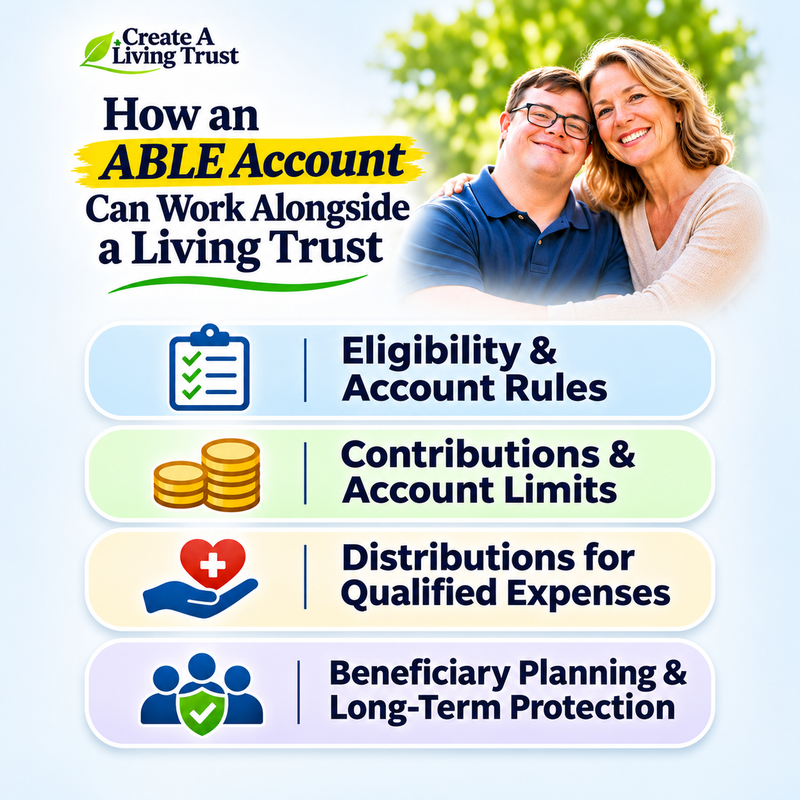
Understand how ABLE accounts and trusts serve different purposes, with attention to eligibility, contributions, distributions, and beneficiary planning.
Key Takeaways: ABLE Accounts and Living Trusts at a Glance
- An ABLE account can complement a well-structured estate plan, but it does not replace a living trust or a special needs trust (SNT) for larger asset protection.
- ABLE accounts and living trusts solve different problems: one handles everyday spending for an eligible individual with a disability, the other organizes family assets and inheritance.
- Contribution rules, spending categories, and Medicaid payback requirements differ between ABLE accounts, first-party SNTs, and third-party SNTs.
- Coordinating a trustee’s distributions into an ABLE account requires careful review of the trust document, current program rules, and the beneficiary’s specific benefits.
- Keep reading to see a practical decision matrix, a conditional trust-to-ABLE funding example, and the questions worth asking a special needs planning attorney before you act.
Families caring for a loved one with a disability often hear two phrases tossed around interchangeably: “ABLE account” and “special needs trust.” They are not the same thing, and treating them that way can create real problems with Medicaid or Supplemental Security Income (SSI) eligibility down the road.
An ABLE account can genuinely strengthen a well-built estate plan, but it is not a substitute for a properly drafted living trust or special needs trust. Educational resources like those available through Create A Living Trust can help families understand where each tool fits, though the specific legal and tax outcomes always depend on individual facts, state program rules, and current federal guidance.
How an ABLE Account Can Work Alongside a Living Trust
Think of it this way: an ABLE account is a spending and savings tool for the person with the disability, while a living trust is a planning tool for the family that owns and transfers assets. When these two work together instead of against each other, a beneficiary can gain more day-to-day financial independence without accidentally losing access to Medicaid or SSI.
The coordination question isn’t whether one replaces the other. It’s how a trustee, a parent, or the beneficiary themselves can use both tools so that routine expenses flow through the ABLE account while larger, long-term assets stay protected inside an appropriately drafted trust.
Understand how ABLE accounts and trusts serve different purposes, with attention to eligibility, contributions, distributions, and beneficiary planning.
Before getting into coordination strategies, it helps to separate the two tools entirely. An ABLE account is a tax-advantaged savings account created under the ABLE Act of 2014 and governed by Section 529A of the Internal Revenue Code. A living trust, by contrast, is a legal entity that holds title to assets like a house, investment accounts, or life insurance proceeds, and directs how those assets pass to beneficiaries.
Neither one is automatically the right fit for every family situation. The right combination depends on the size of the assets involved, the beneficiary’s specific public benefits, and how much day-to-day financial control makes sense for that individual.
What an ABLE Account Is and Who Qualifies
An ABLE account is owned directly by the eligible individual with a disability, not by a trustee. Eligibility generally depends on the age at which the disability began, and current federal guidance should always be checked through the ABLE National Resource Center or the Social Security Administration, since eligibility rules have been adjusted over time.
Each state runs its own ABLE program, even though the underlying federal law is the same nationwide. That means investment options, fees, debit card features, and even enrollment procedures can vary depending on which state program a family selects. A person isn’t required to use their home state’s program in every case, since many state ABLE plans accept out-of-state residents, but program terms differ enough that it pays to compare before enrolling.
Contributions can come from the beneficiary, parents, grandparents, friends, or anyone else who wants to help. Annual contribution limits and lifetime account balance thresholds are set by federal law and adjusted periodically, so rather than quoting a specific dollar figure here, it’s worth confirming the current numbers directly with your state’s ABLE program or the ABLE National Resource Center before making contributions.
What a Living Trust Is and What It Actually Controls
A living trust is built to manage a family’s ordinary assets during the grantor’s lifetime and direct how those assets transfer after death, often without going through probate court. It typically holds things like a home, bank accounts, and investment portfolios, and it names a successor trustee to step in if the original trust creator becomes incapacitated or passes away.
Here’s the catch: a standard revocable living trust written for general estate planning purposes is not automatically designed to protect a beneficiary’s means-tested government benefits. If a family member with a disability receives an outright inheritance through a basic living trust distribution, that lump sum could push them over SSI’s resource limits or disrupt Medicaid eligibility entirely.
Why These Two Tools Solve Different Problems
An ABLE account exists to give the beneficiary direct spending authority over smaller amounts of money for disability-related costs, without the account being treated the same way a bank account in their own name would be treated for SSI resource limits, up to current program thresholds. A living trust, or more specifically a properly drafted special needs trust, exists to manage larger sums over a lifetime without disqualifying the beneficiary from the benefits they depend on.
Mixing up these roles is one of the most common mistakes families make. A grandparent who names a disabled grandchild directly as a trust beneficiary, assuming the living trust alone will “handle everything,” may unintentionally create a benefits crisis that a specialized third-party special needs trust could have avoided.

| Feature | ABLE Account | Living Trust (General) |
|---|---|---|
| Who owns it | The eligible individual with a disability | The trust, managed by a trustee |
| Best suited for | Day-to-day disability-related spending | Family asset management and inheritance planning |
| Public benefits protection | Qualified use may avoid counting against certain resource limits, within program rules | Not automatic; requires special needs trust drafting for means-tested beneficiaries |
| Who can set it up | The beneficiary or an authorized individual acting on their behalf | The person creating the trust (the grantor) |
What a General Revocable Living Trust Is Designed to Do
A general revocable living trust is the workhorse of most estate plans. It holds a family’s home, investment accounts, and other property, lets the grantor manage everything during their lifetime, and names a successor trustee to step in without court involvement if the grantor dies or becomes incapacitated. For families without a disabled beneficiary, this structure alone often gets the job done.
The flexibility is the point. A revocable living trust can be amended or revoked at any time while the grantor is alive and competent, assets can be added or removed, and beneficiaries can be changed as family circumstances shift. That flexibility, though, is exactly what makes it a poor fit for protecting a beneficiary who relies on means-tested government benefits.
Why a Standard Living Trust May Not Protect Public Benefits
Here’s the problem: if a basic revocable living trust distributes an inheritance outright to a beneficiary receiving SSI or Medicaid, that lump sum becomes the beneficiary’s personal asset the moment they receive it. Depending on the amount and the specific program’s resource limits, that single distribution could trigger a suspension or termination of benefits until the money is spent down. A trust document that doesn’t include special needs language simply isn’t built to prevent this outcome.
First-Party, Third-Party, and Pooled Special Needs Trusts Compared
Special needs trusts come in three main varieties, and the differences matter enormously for Medicaid and SSI planning. A first-party special needs trust is funded with assets that already belong to the beneficiary, often from a personal injury settlement or an inheritance received outright before proper planning was in place. Because the funds originated with the beneficiary, federal law generally requires Medicaid payback provisions in these trusts.
A third-party special needs trust, by contrast, is funded with assets belonging to someone else, such as a parent or grandparent, specifically for the benefit of the disabled individual. These trusts are typically drafted so that remaining funds pass to other family members at the beneficiary’s death rather than reimbursing Medicaid, though the exact terms depend entirely on how the trust is written and current state and federal rules.
A pooled special needs trust is managed by a nonprofit organization that combines funds from multiple beneficiaries for investment purposes while maintaining separate accounts for each individual. This option can work well for families who don’t have a trusted individual available to serve as trustee or who are managing smaller amounts that wouldn’t justify the cost of a standalone trust.
Signs Your Family Needs a Specialized Special Needs Trust
If your family member with a disability currently receives or expects to receive SSI, Medicaid, or similar means-tested benefits, and you’re planning to leave them any inheritance, life insurance proceeds, or a personal injury settlement, a specialized special needs trust almost always needs to be part of the conversation. The same holds true if a grandparent or other relative wants to leave a gift directly to the beneficiary rather than through a trust. A properly drafted trust can prevent a well-meaning gift from accidentally disqualifying someone from the benefits they depend on.

Decision Matrix: ABLE Account, Special Needs Trust, or Both?
Not every dollar needs to go through the same vehicle. The table below walks through common categories of spending and saving, along with what to verify before deciding where the money should live.
| Need or expense | ABLE account considerations | SNT considerations | Coordination or verification step |
|---|---|---|---|
| Ordinary disability-related spending | Often well-suited for direct, frequent purchases like therapy co-pays or medical supplies | Can also pay these costs, but may involve more administrative steps through a trustee | Confirm what counts as a qualified disability expense under current ABLE program rules |
| Housing and food | May be used, but certain housing-related distributions can affect SSI’s income calculation depending on how funds are spent and retained | SNT distributions for housing have long required careful handling under SSI in-kind support rules | Review current SSA guidance on in-kind support and maintenance before large housing distributions |
| Transportation | Commonly treated as a qualified expense, including vehicle purchases or modifications | Can fund vehicles or transportation costs as well | Document the expense’s connection to the beneficiary’s disability-related needs |
| Education or assistive technology | Frequently an appropriate use of ABLE funds for tuition, training, or adaptive equipment | Equally appropriate for SNT distributions, especially for larger equipment purchases | Compare account balance against ABLE program limits before funding large purchases |
| Larger inherited assets | Generally not well-suited due to balance and contribution constraints | Typically the better long-term holding vehicle, especially for real estate or large settlements | Work with an estate planning attorney before any distribution is finalized |
| Ongoing support and long-term asset management | Useful for day-to-day liquidity and spending flexibility | Better suited for decades-long asset management and professional trustee oversight | Revisit the plan periodically as the beneficiary’s needs and benefits change |
Everyday Expenses Best Suited for an ABLE Account
Routine, smaller purchases tend to work well through an ABLE account because the beneficiary (or an authorized individual acting on their behalf) can access funds directly, often through a debit card, without routing every purchase through a trustee. Things like groceries tied to specific dietary needs, transportation costs, assistive technology, and ongoing therapy expenses fit naturally into this category, as long as they align with the account’s qualified disability expense rules.
Larger or Long-Term Needs Better Suited for a Trust
Larger sums, especially inheritances, legal settlements, or retirement account proceeds, generally belong inside a properly drafted special needs trust rather than an ABLE account. Trusts don’t carry the same balance constraints that ABLE accounts do, and a trustee can manage investments professionally over a beneficiary’s entire lifetime, which matters when planning for decades rather than years.
A Conditional Example: Moving Trust Funds Into an ABLE Account
Here’s a scenario worth walking through. A parent sets up an ordinary revocable living trust to manage the family home and investment accounts, and separately works with an attorney to establish a third-party special needs trust for a child with a disability. Years later, the SNT trustee considers whether to distribute a portion of trust funds into the beneficiary’s ABLE account so the beneficiary can have more direct spending flexibility for everyday needs.
This kind of transfer is not automatic, and it’s not guaranteed to be tax-free or benefits-neutral. Whether the trustee can and should make this distribution depends on the specific language in the trust document, the trustee’s fiduciary duties, the beneficiary’s current eligibility for the ABLE program, current contribution limits, and how the receiving state’s program treats funds coming from a trust versus funds coming from the beneficiary’s own earnings or gifts.
A trustee who moves forward without checking each of these points risks either breaching their fiduciary duty or inadvertently disrupting the beneficiary’s benefits. This is a meaningfully different situation than a beneficiary receiving an inheritance directly or through a poorly structured beneficiary designation, where there’s often no trustee oversight at all to catch problems before they happen.

Where a Living Trust Fits in a Broader Special Needs Estate Plan
A living trust and a special needs trust aren’t competitors in a family’s estate plan. They typically work side by side, each handling a different piece of the puzzle, as long as someone takes the time to make sure the pieces actually connect.
Using a Living Trust for Family Asset Organization
Most families use a revocable living trust to hold the house, bank accounts, and other property during the parents’ lifetimes, then direct how those assets pass to children or other beneficiaries at death. This works fine for beneficiaries who don’t receive means-tested benefits. For a beneficiary with a disability, the trust document itself needs to redirect that beneficiary’s share into a separate special needs trust rather than distributing it to them outright.
Real estate adds another layer of complexity. Placing a parent’s home into their own living trust is a separate action from transferring that home, or the proceeds from its sale, to a beneficiary or into a special needs trust after the parent’s death. Families handling the process of placing a house in a living trust should also think ahead about what happens to that property, or its sale proceeds, when it’s time to distribute assets to a beneficiary with a disability.
Deed preparation, mortgage considerations, and insurance updates all carry state-specific nuances that go beyond the scope of ABLE and trust coordination alone. A title company, lender, or real estate attorney can help confirm those details are handled correctly in your state before any transfer takes place.
Why Properly Funding Assets Still Requires Careful Coordination
A trust only controls assets that have actually been retitled or assigned into it. A living trust that owns nothing in practice provides no protection at all, regardless of how well it’s drafted. This is why trust funding, the process of actually transferring account titles, deeds, and beneficiary designations into the trust’s name, matters just as much as the trust document itself.
Reviewing Trust Language for Public Benefits Compatibility
Even a well-funded trust can cause problems if its distribution language doesn’t account for a beneficiary’s public benefits. An attorney reviewing the trust should specifically check how the document treats distributions to any beneficiary receiving SSI, Medicaid, or similar programs, and whether a separate special needs trust is referenced or needs to be created to receive that beneficiary’s share.
Medicaid Payback and Estate Recovery Rules to Watch
Medicaid’s recovery rights work differently depending on which vehicle holds the funds at the time of the beneficiary’s death, and getting this wrong can surprise families who assumed all disability-related accounts work the same way.
How Medicaid Estate Recovery Applies to ABLE Accounts
Many state ABLE programs require that remaining funds in the account be used to reimburse Medicaid for benefits paid during the beneficiary’s lifetime, before any remaining balance passes to heirs. This payback requirement isn’t identical across every state program, so verifying the specific terms through your state’s ABLE plan documentation matters before assuming how remaining funds will be handled.
According to an overview of ABLE account rules and Medicaid considerations, this estate recovery feature is one of the clearest distinctions between ABLE accounts and third-party special needs trusts, which generally aren’t subject to the same payback obligation.
How Third-Party Special Needs Trusts Can Avoid Payback
Third-party special needs trusts, funded entirely with assets that never belonged to the beneficiary, are typically drafted so remaining funds pass to other named beneficiaries at the disabled individual’s death rather than reimbursing Medicaid. First-party special needs trusts, funded with the beneficiary’s own assets, generally do carry a Medicaid payback requirement under federal law. Not every third-party trust is drafted identically, though, so the actual document language and state requirements always control the outcome.

Building Your Family’s Coordinated Planning Checklist
Coordinating an ABLE account with a living trust and, where appropriate, a special needs trust isn’t a one-time task. It benefits from a structured review, especially any time the beneficiary’s benefits, health, or family circumstances change.
- List every asset the family owns, noting which are titled in a living trust and which aren’t
- Identify which beneficiary receives means-tested benefits like SSI or Medicaid
- Confirm whether a special needs trust already exists, and if not, whether one is needed
- Check current ABLE program rules in the beneficiary’s state of residence, including contribution and balance limits
- Name a successor trustee and, if relevant, an authorized individual to manage the ABLE account
- Schedule a periodic review with a special needs planning attorney and benefits specialist
Document Your Goals and List Asset Ownership
Start by writing down, in plain language, what you actually want to happen for your family member with a disability. Do you want them to have more day-to-day spending freedom? Are you trying to protect a future inheritance? Naming the goal first makes it much easier to figure out which tool, or combination of tools, actually gets you there.
Next, make a complete list of assets: the family home, retirement accounts, life insurance policies, savings, and anything the beneficiary might inherit or already owns. Note which assets are currently titled in a living trust, which pass through a will, and which transfer by beneficiary designation. Gaps here are where plans tend to fall apart later.
Finally, write down every public benefit the beneficiary currently receives or may need in the future, including SSI, Medicaid, and SSDI. This list becomes the foundation your attorney uses to recommend whether an ABLE account, a special needs trust, or both make sense for your situation.
Identify Trustee and Caregiver Roles
Someone has to manage the special needs trust, and someone has to manage the ABLE account, and those don’t have to be the same person. A trustee for the SNT should understand fiduciary duties, distribution rules, and how to avoid jeopardizing benefits with an improper disbursement. The ABLE account, by contrast, may be managed directly by the beneficiary if they’re capable, or by an authorized individual acting on their behalf if they’re not.
Successor trustees and guardians matter just as much as the people serving today. Name backups for every role, confirm they understand the beneficiary’s benefits situation, and make sure they have access to account documentation, trust paperwork, and contact information for the family’s attorney and benefits specialist.
Questions to Ask a Qualified Special Needs Attorney
Bring a short list of specific questions to your planning meeting rather than a vague request to “look everything over.” Ask whether your current living trust language properly redirects the beneficiary’s share into a special needs trust, whether a first-party or third-party SNT fits your situation, and whether the SNT trustee has authority to fund the beneficiary’s ABLE account under the trust’s existing terms.
It’s also worth asking how your specific state’s ABLE program handles qualified expenses, since program features like debit card access, investment menus, and even which types of purchases qualify can differ meaningfully by state. A broader look at how qualified disability expenses and state ABLE programs are structured can help you come prepared with the right questions before your attorney meeting.

How eState Can Support Your Living Trust Planning
Create A Living Trust connects families with Bulletproof Legacy Financial’s eState Living Trust offering, which includes digitally accessible estate planning documents, ordinary trust-funding assistance, a pour-over will, powers of attorney, and successor-trustee guidance. This offering is built for general estate planning needs and does not include specialized special needs trust drafting, ABLE account opening or administration, or benefits counseling, so families navigating disability-related planning should pair this resource with a qualified special needs attorney for those specific pieces.
Take the Next Step in Protecting Your Family Member’s Future
A coordinated plan that respects both your family’s broader estate goals and your loved one’s benefits eligibility starts with the right conversation. Schedule a free consultation to talk through how your living trust and your family member’s long-term needs can work together.

Frequently Asked Questions
Can someone have both an ABLE account and a living trust?
Yes. A beneficiary can have an ABLE account for everyday spending while also being named in a family’s living trust, provided the trust properly directs that beneficiary’s share into a special needs trust rather than an outright distribution. The two tools are designed to work at different scales and for different purposes.
Does a revocable living trust replace an SNT?
No. A general revocable living trust organizes family assets and manages inheritance for most beneficiaries, but it doesn’t automatically include the protective language a special needs trust needs to preserve means-tested benefits like SSI or Medicaid. Families need to specifically draft or incorporate special needs provisions if a beneficiary receives these benefits.
Who qualifies for an ABLE account?
Eligibility generally depends on when the individual’s disability began, and current federal and state program requirements should be confirmed directly with the ABLE National Resource Center or the Social Security Administration, since onset-age rules and documentation requirements are set by federal law and may be updated over time.
Can a trust contribute to an ABLE account?
A special needs trust’s trustee may be able to distribute funds into a beneficiary’s ABLE account, but this depends on the specific trust document’s language, the trustee’s fiduciary obligations, current ABLE contribution rules, and the beneficiary’s account eligibility. This isn’t automatic for every trustee or every trust, and it should be reviewed individually before any transfer happens.
What expenses can ABLE funds pay for?
ABLE funds are generally meant for qualified disability expenses, a broad category that can include things like:
- Education and job training costs
- Housing-related expenses
- Transportation and vehicle modifications
- Assistive technology and personal support services
- Health, wellness, and basic living expenses tied to the disability
The exact scope of what qualifies should be confirmed with current IRS and state ABLE program guidance, since interpretations can vary.
Can an ABLE account affect SSI or Medicaid?
It can, depending on account balance, how distributions are spent, and whether funds are retained in a way that affects SSI’s resource or income calculations. Housing-related distributions in particular can interact with SSI’s in-kind support rules, so it’s worth checking current SSA guidance before making large housing-related withdrawals from an ABLE account.
Does SSDI use the same resource rules?
No. SSDI is not a means-tested program in the same way SSI and many Medicaid eligibility categories are, so SSDI generally doesn’t apply the same resource limits. That said, someone can receive SSDI and still separately qualify for Medicaid or SSI under different eligibility rules, so it’s important to review each program individually rather than assuming SSDI rules apply across the board.
How do Medicaid payback rules differ for ABLE accounts and SNTs?
Many state ABLE programs require that remaining account funds reimburse Medicaid after the beneficiary’s death, though the specifics vary by state. First-party special needs trusts generally carry a similar Medicaid payback requirement under federal law, while properly drafted third-party special needs trusts are typically structured so remaining funds pass to other beneficiaries instead. Not every trust is written the same way, so the actual document controls.
What happens to an ABLE account or trust when the beneficiary dies?
For an ABLE account, many state programs apply Medicaid estate recovery to remaining funds before any balance passes to heirs. For a special needs trust, the outcome depends on whether it’s a first-party trust (which often has a payback requirement) or a third-party trust (which is often drafted to pass remaining assets to other family members). Reviewing the specific trust document and state ABLE program rules is the only reliable way to know the outcome in a given situation.
Who should review the coordinated plan?
A qualified special needs planning attorney should review the trust documents and overall structure, a benefits specialist should confirm how any proposed distributions interact with SSI, Medicaid, or SSDI, and a tax professional can address how contributions and distributions are reported. Revisiting this team periodically, especially after a benefits change, inheritance, or family event, helps keep the plan aligned with current rules.