Five Special Needs Trust Planning Mistakes to Avoid
Review common mistakes involving eligibility, trust language, funding, trustee duties, and coordination with public benefits.
Article at a Glance
- The five biggest special needs trust planning mistakes involve flawed trust structure or language, incorrect funding sources, risky distributions, poor trustee selection, and failure to coordinate the trust with other benefits and estate documents.
- A standard revocable living trust is not automatically a special needs trust, and calling something “irrevocable” does not by itself protect SSI or Medicaid eligibility.
- Direct cash payments, unmanaged personal property, and casual gifts from trust funds can all trigger benefit reductions or disqualification if handled incorrectly.
- Families exploring ordinary living trust services, such as those offered through Our Living Trust Plan from Create A Living Trust, should understand that specialized special needs trust drafting is a distinct service with its own requirements.
- Later sections walk through exactly how trustee discretion, benefit coordination, and documentation practices separate a trust that works from one that backfires.
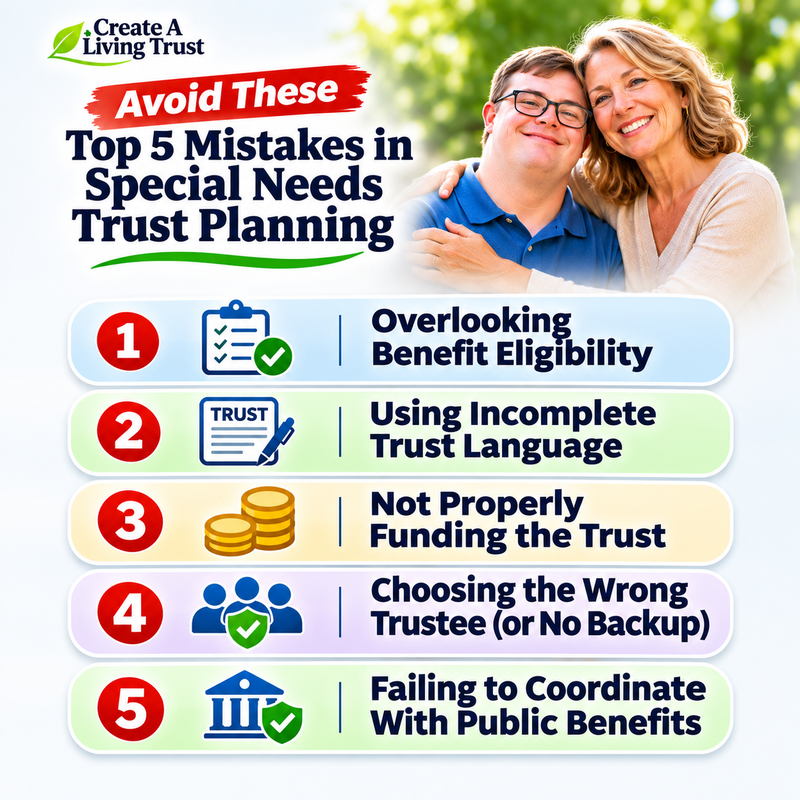
A single wrong word in a trust document, or one poorly timed cash gift, can cost a loved one their Medicaid coverage for months.
That’s the uncomfortable truth families learn the hard way when special needs trust planning goes sideways. The stakes are high because the trust isn’t just about leaving money behind; it’s about protecting access to healthcare, housing assistance, and income support that a person with a disability may depend on for life. Families working through ordinary estate planning tools, including services like those at Create A Living Trust, often discover that a loved one with special needs requires a fundamentally different kind of trust than a standard family trust.
Five Special Needs Trust Planning Mistakes to Avoid
Review common mistakes involving eligibility, trust language, funding, trustee duties, and coordination with public benefits.
Special needs trust planning sits at the intersection of estate law and public benefits law, and that overlap is exactly where things go wrong. A trust can be perfectly valid under state trust law and still disqualify a beneficiary from Supplemental Security Income or Medicaid if it’s drafted, funded, or administered incorrectly. The five mistakes below show up again and again in real planning situations, and each one is preventable with the right guidance.
What Is a Special Needs Trust and Why Does It Exist
Plain-English Definition of a Special Needs Trust
A special needs trust, sometimes called a supplemental needs trust, is a legal arrangement designed to hold assets for a person with a disability without counting those assets against income and resource limits tied to certain government benefits. The trust owns the money, not the beneficiary, and a trustee decides how and when funds get spent. That distinction between ownership and use is the entire reason the structure exists.
The goal isn’t to hide assets or game the system. It’s to let a family member leave an inheritance, or let a beneficiary hold settlement proceeds, without forcing that person to spend everything down to qualify for Medicaid or SSI. Done correctly, the trust pays for things benefits don’t cover, like specialized equipment, travel, or personal care items, while leaving the core benefits intact.
How SNTs Relate to SSI, Medicaid, and Other Means-Tested Benefits
SSI and Medicaid are means-tested programs, which means eligibility depends on income and resource limits set by federal and state rules. Social Security Disability Insurance, or SSDI, works differently. SSDI eligibility is based on a worker’s earnings record and disability status, not on how many assets that person owns, so it isn’t subject to the same resource test that governs SSI. Medicare similarly isn’t a means-tested program the way Medicaid is. Mixing these programs up during planning is itself a common and costly error, because what disqualifies someone from SSI may have no bearing at all on their SSDI or Medicare eligibility.
Not every Medicaid program applies identical eligibility standards, either. States administer their own Medicaid programs within federal guidelines, and specific income thresholds, resource limits, and treatment of trust distributions can vary by state and by which Medicaid waiver or program applies. That’s one reason generic online trust templates are risky for this particular purpose; they rarely account for program-specific nuances that determine whether a distribution counts as income.
First-Party vs. Third-Party vs. Pooled Trusts
Not all special needs trusts are built the same way, and the source of the money changes everything about how the trust must be structured.
- First-party special needs trusts are funded with the beneficiary’s own assets, such as a personal injury settlement or an inheritance received directly in the beneficiary’s name before a trust was in place.
- Third-party special needs trusts are funded by someone other than the beneficiary, typically a parent or grandparent, using their own assets rather than the beneficiary’s.
- Pooled trusts are managed by nonprofit organizations that combine resources from many beneficiaries for investment purposes while keeping separate accounts for each individual.
First-party trusts are generally treated as irrevocable once established, and they often carry Medicaid payback provisions requiring reimbursement to the state from remaining trust assets after the beneficiary’s death. Third-party trusts have more flexibility; they can sometimes be drafted as revocable or irrevocable, and because the funds never belonged to the beneficiary, Medicaid payback rules that apply to first-party trusts typically don’t apply in the same way. These are generalizations, though, and the actual terms depend on the trust document, applicable state law, and the beneficiary’s specific program enrollment.

The Federal and State Rules You Need to Know
Federal law establishes the basic framework for how special needs trusts interact with SSI and Medicaid, but states retain significant authority over how their own Medicaid programs apply those rules. That combination is part of why cookie-cutter approaches fail so often.
Federal Framework Governing SSI and Medicaid Eligibility
The Social Security Administration sets the rules for what counts as income and resources for SSI purposes, and those rules determine how trust distributions get treated. A properly structured special needs trust is generally excluded from a beneficiary’s countable resources, but the key word is “properly.” Trust language has to meet specific standards, including giving the trustee full discretion over distributions, for that exclusion to apply. Families should verify current SSA and Medicaid requirements directly or through a qualified professional, since program rules and interpretations can change.
Why State Rules Can Differ and Why That Matters
Because Medicaid is a joint federal-state program, each state has some latitude in how it structures eligibility rules, waiver programs, and treatment of trust assets. A trust drafted correctly for one state’s Medicaid program might need adjustments to work properly in another. This matters enormously for families who move across state lines or who have beneficiaries receiving benefits in a different state than where the trust was originally drafted.
A trust that worked perfectly for a beneficiary’s Medicaid waiver program in one state isn’t guaranteed to produce the same result if that beneficiary later moves, or if the state updates its program rules. Verifying current, program-specific treatment before relying on any trust structure is not optional.
When to Bring In a Special Needs Attorney or Benefits Counselor
Because of this federal-state interplay, special needs trust planning almost always benefits from a professional who focuses specifically on disability and benefits law, not just general estate planning. A special needs attorney typically has drafted a high volume of these trusts and stays current on how local Medicaid offices interpret distribution rules. Pairing that attorney with a benefits counselor, who understands the beneficiary’s specific program enrollment, closes gaps that a single generalist might miss.
Mistake 1: An Improperly Drafted or Funded Trust
The first and most foundational mistake is assuming any trust will do. A trust can be legally valid and still fail its entire purpose if the language inside it doesn’t meet the standards SSI and Medicaid require for resource exclusion.
Ambiguous Trust Language That Invites Disputes
Vague provisions create two problems at once: they invite family disputes over interpretation, and they give benefits caseworkers room to interpret the trust unfavorably. If a trust says funds are available for the beneficiary’s “general welfare” without defining limits, a caseworker reviewing the document for SSI purposes may read that as giving the beneficiary too much control or access, which can jeopardize the resource exclusion the family was counting on.
Trust Terms That Accidentally Give the Beneficiary Control
Some trust documents include language suggesting the beneficiary can demand distributions or access principal upon request. Even if that was never the family’s intent, those words matter. Benefits agencies look closely at whether the beneficiary has any legal right to compel distributions, and language that implies that right can undo the protective purpose of the entire trust, regardless of how the family actually intended to use it.
Why “Sole and Absolute” Trustee Discretion Matters
Special needs trusts typically need to give the trustee “sole and absolute” discretion over distributions, a specific legal standard that benefits agencies look for when evaluating whether trust assets count against SSI or Medicaid resource limits. This isn’t boilerplate language; it’s a functional requirement. Without it, the trust may not qualify for the resource exclusion families are relying on, which defeats the purpose of creating the trust at all.
| Mistake | Potential Consequence | Practical Prevention |
|---|---|---|
| Vague or non-compliant trust language | Trust assets may be counted as a resource, risking SSI or Medicaid disqualification | Work with a special needs attorney to confirm trustee discretion language meets current program standards |
| Funding with the wrong source of assets | Unexpected Medicaid payback obligations or improper trust classification | Identify whether assets are first-party or third-party before drafting, and match the trust type accordingly |
| Uninformed distributions | Reduced SSI payments or temporary loss of benefits | Route payments directly to vendors or service providers rather than to the beneficiary |
| Conflicted or inexperienced trustee | Mismanaged funds, family disputes, or improper distributions | Consider a professional trustee, co-trustee, or trust protector with oversight authority |
| Uncoordinated beneficiary designations and estate documents | Inheritance bypasses the trust and goes directly to the beneficiary, risking benefits | Audit all beneficiary designations, wills, and account titling alongside the trust |

Mistake 2: Funding the Trust With the Wrong Source of Assets
Even a well-drafted trust can run into trouble if it’s funded incorrectly. The source of the money, and how it gets into the trust, determines the trust’s classification and its tax and Medicaid payback treatment.
This is also where the difference between a special needs trust and an ordinary revocable living trust becomes critical. A conventional revocable living trust, built for general estate planning purposes like avoiding probate or managing assets during incapacity, is not automatically structured to protect means-tested benefits eligibility. Understanding the distinction between revocable and irrevocable trust structures is a useful starting point, but revocability alone doesn’t determine whether a trust qualifies as a proper special needs trust under SSI and Medicaid rules.
Families sometimes assume that because a trust avoids probate, it must also protect benefits eligibility. Those are two separate planning objectives, and conflating them is a mistake with real consequences. In fact, understanding whether a living trust avoids probate is a completely different question from whether that same trust protects a beneficiary’s SSI or Medicaid eligibility. A trust can accomplish one goal perfectly while doing nothing for the other.
Using First-Party Assets When a Third-Party Trust Would Work Better
Consider a family that wants to leave an inheritance to a relative receiving SSI and Medicaid. If the family member dies and leaves the inheritance directly to that relative by name, rather than into a properly structured trust, the inheritance becomes the beneficiary’s own asset the moment it’s received. That triggers first-party trust rules, including likely Medicaid payback requirements, even though the money originally came from someone else. Planning ahead, by naming a properly drafted third-party special needs trust as the beneficiary of the inheritance instead of the individual directly, can avoid this outcome, though results still depend on the trust’s actual terms and the beneficiary’s specific program enrollment.
Placing Personal Property Like a Home or Car Without a Clear Purpose
Real estate and vehicles can be valuable trust assets, but only when the trust document and trustee practices clearly establish how that property serves the beneficiary. A home placed into the trust without defined maintenance responsibilities, insurance arrangements, or occupancy terms creates administrative headaches and can raise questions during a benefits review about how the asset is actually being used. The same goes for a vehicle; if it’s not clearly designated and used for the beneficiary’s transportation needs, its presence in the trust can complicate an otherwise straightforward resource exclusion.
Excess Cash and Unmanaged Stocks or Bonds Inside the Trust
Holding too much uninvested cash inside a special needs trust creates a different kind of risk. Large cash balances sitting idle can tempt mismanagement, and if a trustee isn’t actively monitoring how stocks, bonds, or other securities are performing, the trust may lose value it was meant to preserve for decades of the beneficiary’s life. A trustee has a duty to manage trust assets prudently, which usually means working with a financial professional rather than letting cash sit in a low-yield account or letting an investment portfolio run on autopilot.
Mistake 3: Problematic Distributions From the Trust
Funding the trust correctly is only half the battle. How the trustee actually spends the money, month after month, determines whether the beneficiary keeps their benefits or loses them.
This is where good intentions go wrong most often. A trustee who hands a beneficiary cash to “make things easier,” or who pays a utility bill without understanding how that payment gets classified, can trigger a benefits reduction without realizing it until a notice arrives from the Social Security Administration.
Direct Cash Payments to the Beneficiary
Giving a beneficiary cash directly from the trust, even for something reasonable like groceries or a haircut, is one of the fastest ways to jeopardize SSI eligibility. The Social Security Administration generally treats cash given directly to an SSI recipient as unearned income, which can reduce or eliminate the monthly SSI payment for that period. The safer approach is for the trustee to pay vendors, service providers, or stores directly, rather than routing money through the beneficiary’s hands first.
Covering Food or Shelter and the In-Kind Income Risk
Food and shelter expenses deserve special caution. When a special needs trust pays for a beneficiary’s rent, mortgage, or groceries, that payment can be counted as in-kind support and maintenance, which may reduce the beneficiary’s SSI payment under current program rules. This doesn’t mean a trust can never help with housing, but it does mean a trustee needs to understand exactly how that category of expense is treated before writing the check.
Because these rules can be detailed and program-specific, a trustee shouldn’t guess. Confirming current treatment with a benefits counselor or the local Social Security office before making a large housing-related distribution is a small step that prevents a much bigger headache later.
Gifts or Loans to Family Members From Trust Funds
A trustee technically controls the trust, but that control doesn’t mean the money is theirs to lend out or gift to other relatives. Special needs trust funds exist solely for the named beneficiary’s supplemental needs. A trustee who loans trust money to a sibling, or gifts cash to a grandchild, isn’t just breaching fiduciary duty; they’re also inviting scrutiny during any benefits eligibility review or family dispute, since those transactions rarely have a clear paper trail tying them back to the beneficiary’s actual needs.
What Counts as a Permissible Trust Expense
Special needs trusts are built to supplement government benefits, not replace them, which means trustees should think in terms of what SSI and Medicaid don’t already cover. Common permissible expenses include:
- Medical and dental care not covered by Medicaid or other insurance
- Education, tutoring, or vocational training programs
- Transportation, including a vehicle purchased and maintained for the beneficiary’s use
- Personal care attendants or specialized caregiving services
- Recreation, hobbies, electronics, and computers
- Home modifications that improve accessibility, such as ramps or widened doorways
Even within this list, context matters. A computer purchased for the beneficiary’s use is typically fine; cash handed over so the beneficiary can “buy whatever they want” is not. The distinction almost always comes down to whether the trustee maintained control over the purchase and can document that it served the beneficiary directly. Creating a Special Needs Trust is an essential step in ensuring these needs are met.
Trustees who keep this distinction in mind save themselves enormous headaches later. A distribution that technically benefits the beneficiary but was handled sloppily, without receipts or documentation, can still cause problems during a benefits redetermination, even if nothing improper actually happened.
That’s why the next mistake on this list, choosing the wrong trustee, so often compounds every mistake that came before it. A thoughtful trust document and correctly sourced funding can still fail in the hands of a trustee who doesn’t understand these distribution rules.

Mistake 4: Trustee Conflicts and Mismanagement
Choosing a trustee is one of the most consequential decisions in special needs trust planning, and it’s often treated as an afterthought. Families frequently default to the most available relative rather than the most qualified one, and that shortcut can undo years of careful drafting.
Why a Sibling Trustee Often Creates Family Tension
Naming an adult sibling as successor trustee feels natural; they know their brother or sister, they’re invested in the outcome, and they’re usually willing to serve. But that closeness can become a liability. A sibling trustee may feel guilty saying no to a request, may face pressure from other family members about how funds get spent, or may simply lack the financial and legal knowledge to navigate SSI and Medicaid distribution rules correctly.
These tensions don’t always show up immediately. They tend to surface years into the trust’s administration, often around major expenses like a vehicle purchase or a move to a new residence, when the sibling trustee has to make a judgment call under pressure from other relatives who disagree with the decision.
Alternatives: Professional Trustees, Trust Advisors, and Trust Protectors
Families don’t have to choose between “family member” and “stranger” when selecting a trustee. A few structures can soften that tradeoff. A professional trustee, such as a trust company or an attorney experienced in special needs administration, brings expertise but less personal connection to the beneficiary. A hybrid approach names a family member as trustee alongside a professional trust advisor who handles investment decisions and benefits compliance. Another option appoints a trust protector, an independent party with authority to remove and replace a trustee who isn’t meeting fiduciary standards, giving the family a built-in check without requiring day-to-day professional management.
According to guidance on special needs trust administration, trustees are expected to maintain detailed records and communicate directly with beneficiaries and caregivers about what the trust can and cannot cover, a standard that applies regardless of whether the trustee is a family member or a professional. guidance on trustee recordkeeping obligations underscores just how central documentation is to defending trust decisions later.
Recordkeeping and Documentation Trustees Must Maintain
Good recordkeeping isn’t bureaucratic overkill; it’s the trustee’s best protection against both government scrutiny and family disputes. That means keeping receipts, invoices, and expense logs tied to every distribution, along with records of deposits, withdrawals, and any communication with the beneficiary or caregivers about spending decisions. Organizing these records digitally, with consistent file naming and regular backups, makes it far easier to respond quickly if a benefits agency requests documentation during an eligibility review.
Setting Clear Distribution Policies to Avoid Disputes
A written distribution policy, even an informal one, gives a trustee something to point to when a family member questions a decision. Spelling out what categories of expenses the trust will and won’t cover, and how requests get evaluated, takes emotion out of individual decisions and replaces it with a consistent standard. This doesn’t require legal language; it just requires the trustee to think through common scenarios in advance rather than improvising under pressure.
None of this works, though, if the trust itself isn’t coordinated with the rest of the family’s estate plan. A perfectly managed trust can still be undermined by a will or beneficiary designation that sends assets around it entirely, which brings us to the final mistake on this list.
Mistake 5: Failing to Coordinate Benefits and Estate Documents
A special needs trust doesn’t exist in isolation. It has to work alongside wills, beneficiary designations on life insurance and retirement accounts, and any other estate planning documents the family has in place. When these pieces aren’t coordinated, even a well-drafted trust can get bypassed entirely.
Disinheritance Versus a Properly Structured Trust
Some families, worried about jeopardizing benefits, consider simply leaving a loved one with a disability out of the will altogether. That approach can protect eligibility for SSI, Medicaid, and housing assistance, but it also means the beneficiary receives nothing extra beyond what those programs already provide. A properly structured special needs trust offers a middle path, allowing the family to provide for discretionary spending needs without interfering with the beneficiary’s public benefits eligibility, though the actual outcome always depends on how the trust is drafted, funded, and administered.
Estate Tax Language That Can Drain Trust Funds
Estate planning documents need to specify exactly how estate taxes get allocated among beneficiaries and trusts. If a will or trust document doesn’t clearly state whether the special needs trust is responsible for a share of estate taxes, that trust could end up funding part of the tax bill, reducing the very funds meant to support the beneficiary. This is a detail easy to overlook, but it has a direct dollar-for-dollar impact on what actually ends up available for the beneficiary’s supplemental needs.
Aligning the SNT With Wills, Beneficiary Designations, and ABLE Accounts
Here’s a scenario that plays out more often than families expect: A grandparent updates their will to leave an inheritance into a properly drafted third-party special needs trust for a grandchild receiving SSI and Medicaid. Years later, that same grandparent opens a new investment account and names the grandchild directly as a payable-on-death beneficiary, forgetting that the trust exists. When the grandparent passes away, that account bypasses the trust entirely and lands directly in the grandchild’s name, instantly creating a first-party asset issue and threatening the benefits the family worked so hard to protect.
This kind of oversight happens because beneficiary designations operate outside the will and trust; they’re a separate layer of planning that needs its own periodic review. An ABLE account can play a complementary role here, allowing a beneficiary to hold limited funds in their own name for certain qualified expenses without affecting SSI or Medicaid eligibility, but an ABLE account is not a substitute for a special needs trust. Research summarized by an overview of common special needs trust distribution errors points out that unmanaged cash, undefined personal property, and disqualifying trust language all create compounding risks when they aren’t caught during a coordinated estate plan review.
The fix isn’t complicated, but it does require discipline. Every time a family updates a will, opens a new account, or changes a beneficiary designation, that change needs to be checked against the special needs trust to confirm nothing accidentally routes assets directly to the beneficiary.
Mistake, Consequence, and Prevention at a Glance
Seeing these five mistakes side by side makes the pattern clear: none of them are exotic legal problems. They’re practical, preventable errors that stem from treating a special needs trust like an ordinary estate planning tool instead of the specialized instrument it actually is.
The table earlier in this article lays out each mistake alongside its potential consequence and the practical step that prevents it. Reviewing that table with a special needs attorney, before finalizing any trust document or beneficiary designation, is one of the simplest ways to catch an error before it becomes expensive to fix.

Revocable Living Trust vs. Special Needs Trust: Which Do You Need
Families often come into estate planning already familiar with revocable living trusts, since they’re a common tool for avoiding probate and managing assets during incapacity. That familiarity sometimes leads to an assumption that a revocable living trust can simply be adapted to serve a family member with a disability. It can’t, at least not without specific special needs provisions built in from the start.
The core issue is purpose. A revocable living trust is designed around flexibility and control for the person who created it. A special needs trust is designed around restricting access and control precisely so that a beneficiary’s government benefits remain intact. Those two goals pull in opposite directions, which is why a trust built for one purpose rarely serves the other well without substantial modification.
What a Standard Revocable Living Trust Covers
A standard revocable living trust typically holds a person’s assets during their lifetime, allows them to act as their own trustee, and directs how those assets get distributed after death, often without going through probate court. It’s a flexible tool built for the trust creator’s own benefit and control, which is exactly why it isn’t automatically suited to protecting a beneficiary’s SSI or Medicaid eligibility. The trust creator can amend or revoke it at will, and that same flexibility, so useful for the creator, becomes a liability when the goal is restricting a beneficiary’s access to principal for benefits purposes.
When a Specialized Special Needs Trust Becomes Necessary
A specialized special needs trust becomes necessary the moment a beneficiary with a disability stands to receive, or already owns, assets that could interfere with SSI or Medicaid eligibility. That trigger might be an inheritance named directly in a will, a personal injury settlement, a life insurance payout, or even savings the beneficiary accumulated before anyone realized it would affect benefits. The common thread is timing: the earlier a family recognizes this risk, the more planning options remain on the table.
- A beneficiary is set to inherit money or property through a will, trust, or beneficiary designation
- A personal injury or wrongful death settlement is payable to someone currently receiving SSI or Medicaid
- A beneficiary has accumulated savings approaching the resource limits for their benefits program
- Parents or grandparents want to leave a financial legacy without disrupting existing government support
Once any of these situations applies, a generic revocable living trust no longer fits the job. The trust needs language specifically addressing trustee discretion, distribution standards, and, where applicable, Medicaid payback provisions that satisfy both state and federal requirements.
Waiting until after a windfall arrives makes the fix harder, not easier. If an inheritance lands in a beneficiary’s name before a first-party trust is established, the family may need to move quickly to set one up and transfer the funds in, often under a limited timeframe set by the relevant benefits program.
This is exactly why proactive families name a properly drafted special needs trust as the designated beneficiary on wills, life insurance policies, and retirement accounts well before any funds are expected to transfer. It removes the scramble and keeps the beneficiary’s monthly benefits uninterrupted while the trust takes over the asset management role instead.
Using Both Together as Part of a Complete Estate Plan
Most families don’t actually choose between a revocable living trust and a special needs trust; they end up using both as part of a layered estate plan. A revocable living trust can hold and manage the broader family’s assets, direct how property passes to other heirs, and help the estate avoid probate delays. A special needs trust, meanwhile, handles the specific portion of the estate earmarked for the family member with a disability. Keeping these structures distinct, while making sure they’re coordinated so that distributions flow correctly from one into the other, gives families the benefits of both tools without compromising either one.

Other Risks Families Should Weigh Before Setting Up an SNT
Special needs trusts solve a real problem, but they’re not without tradeoffs. Families should go in with clear eyes about the costs and limitations involved, rather than assuming the trust is a one-time task that never needs revisiting.
Costs, Fees, and Limited Beneficiary Control
Setting up and administering a special needs trust typically costs more than a basic estate planning document, reflecting the specialized drafting and ongoing compliance work involved. Trustee fees, whether paid to a family member or a professional, add an ongoing expense on top of the initial drafting cost. Beneficiaries also give up a degree of control; since the trustee holds sole discretion over distributions, the beneficiary can’t simply withdraw funds whenever they want, which is the entire point of the structure but can still feel restrictive in daily life.
How Changing Laws Can Affect Long-Term Planning
Benefits programs don’t stay frozen in time. SSI resource limits, Medicaid waiver rules, and program administration can shift over the years, sometimes significantly. A trust drafted a decade ago under one set of rules may need updates to reflect current program requirements, which is why periodic review isn’t optional for a trust meant to last a beneficiary’s entire lifetime.
This uncertainty isn’t a reason to avoid special needs trust planning altogether; it’s a reason to build in regular check-ins with a qualified attorney or benefits specialist. A trust that gets reviewed every few years, or whenever a major life event occurs, stays aligned with current law instead of quietly drifting out of compliance.
Where eState Fits Into Your Broader Estate Plan
Create A Living Trust connects families with Bulletproof Legacy Financial for ordinary living trust creation, including digital estate planning documents, trust-funding assistance, powers of attorney, and successor-trustee guidance. That kind of plan serves a valuable purpose for the broader family estate, covering wills, general trust administration, and probate avoidance goals for assets outside the special needs context.
It’s worth being direct about scope, though. The standard eState Living Trust plan is not a substitute for a specialized first-party, third-party, or pooled special needs trust, and it doesn’t include ABLE account administration, court petitions, professional trustee services, or benefits counseling. Families with a loved one receiving SSI or Medicaid should treat the special needs trust as a separate, specialized document, built alongside the rest of their estate plan rather than in place of it.
Your Next Step: Get Guidance Before You Sign Anything
Special needs trust planning rewards families who ask detailed questions before signing anything, not after. Bring up trustee discretion language, funding sources, Medicaid payback provisions, and how the trust will coordinate with other beneficiary designations when you meet with a special needs attorney or benefits specialist. If you’re also reviewing your broader estate plan at the same time, a free consultation can help clarify where a standard living trust ends and specialized special needs planning needs to begin.

Frequently Asked Questions
These are the questions families ask most often once they start digging into special needs trust planning, covering eligibility, trustee duties, and how the trust fits with other benefits.
Can a special needs trust guarantee my child keeps their SSI or Medicaid?
No trust can guarantee benefits eligibility outcomes, because eligibility depends on the trust’s actual terms, how it’s funded, how distributions are made, and the specific rules of the program involved. A properly drafted and administered special needs trust is designed to support continued eligibility, but families should verify current SSA and Medicaid requirements with a qualified professional rather than assuming any trust structure produces an automatic result.
The gap between “designed to protect benefits” and “guaranteed to protect benefits” is exactly where mistakes creep in, which is why ongoing trustee education and periodic legal review matter as much as the initial drafting.
What’s the difference between a special needs trust and an ABLE account?
A special needs trust is a legal entity that can hold larger amounts of assets and make a wide range of distributions on a beneficiary’s behalf, typically requiring a trustee and formal administration. An ABLE account is a tax-advantaged savings account that allows a person with a qualifying disability to hold limited funds in their own name for qualified disability expenses without affecting SSI or Medicaid. The two tools can complement each other, but an ABLE account isn’t a replacement for a properly structured trust, particularly for larger inheritances or settlements.
Can I use a special needs trust to pay for a caregiver?
Yes, personal care services and caregiver support are generally considered permissible special needs trust expenses, since they supplement rather than replace government-provided benefits. The trustee typically pays the caregiver or caregiving agency directly rather than giving cash to the beneficiary to hire and pay someone independently.
Documentation matters here too. Keeping invoices and service agreements on file helps demonstrate that the payment served the beneficiary’s actual care needs if the trust’s distributions are ever reviewed.
Who should I name as trustee if I don’t trust a family member to manage the funds?
Professional trustees, such as trust companies or attorneys experienced in special needs administration, are a common alternative when no family member is well-suited to the role. Some families also use a hybrid structure, naming a family member as trustee alongside a professional trust advisor who handles investment decisions and benefits compliance, or appointing a trust protector with authority to remove a trustee who isn’t performing properly.
The right choice depends on the family’s dynamics, the trust’s size, and how comfortable any given family member is with ongoing recordkeeping and benefits rules. There’s no single correct answer, but there is a wrong one: defaulting to whichever relative is most available without evaluating their actual capacity for the role.
Is a first-party special needs trust the same as a third-party trust?
No. A first-party trust is funded with the beneficiary’s own assets, such as a settlement or an inheritance received directly in their name, and it generally carries Medicaid payback requirements after the beneficiary’s death. A third-party trust is funded by someone else, like a parent or grandparent, using their own assets, and it typically doesn’t carry the same payback obligation since the funds never belonged to the beneficiary.
Does a special needs trust affect guardianship decisions?
A special needs trust and guardianship address different legal questions, though families often plan for both at the same time. Guardianship concerns who makes personal and medical decisions for a beneficiary who may not be able to make them independently, while a special needs trust concerns financial management and benefits preservation. Families planning for a loved one’s long-term care usually need to think through:
- Whether the beneficiary needs a guardian, conservator, or less restrictive alternative for decision-making support
- Who will serve as trustee for financial matters versus who will serve as guardian for personal care decisions
- How the trustee and guardian will communicate and coordinate on the beneficiary’s behalf
These two roles can be held by the same person or split between different individuals, depending on what best serves the beneficiary and keeps appropriate checks in place. There’s no requirement that a trustee and guardian be the same person, and in some families, splitting the roles actually reduces the potential for conflict.
A family’s estate planning attorney can help map out how guardianship, if needed, interacts with the special needs trust so that both pieces work from the same understanding of the beneficiary’s needs.
Can a special needs trust pay off medical debt the beneficiary already owes?
This depends on the specific debt, the trust’s terms, and the beneficiary’s benefits program rules, since paying off existing debt can sometimes be treated differently than paying for ongoing medical care. A trustee facing this situation should confirm the treatment with a benefits specialist before making the payment, rather than assuming it falls under routine medical expense coverage.
What happens to the money left in a first-party trust after the beneficiary passes away?
First-party special needs trusts generally include a Medicaid payback provision, meaning remaining trust assets may need to reimburse the state for Medicaid benefits the beneficiary received during their lifetime, up to the amount provided. Whatever remains after that reimbursement typically passes to the remainder beneficiaries named in the trust document.
Third-party trusts usually work differently, since the funds never belonged to the beneficiary in the first place, so payback provisions often don’t apply in the same way. The exact outcome always depends on the trust’s specific language and applicable state Medicaid rules.
How often should a trustee review the trust’s spending rules?
Trustees should revisit a special needs trust’s terms and the beneficiary’s current benefits status at least once a year, or sooner if the beneficiary experiences a major life change like a move, a new diagnosis, or a shift in income. Benefits program rules can change, and a trustee who isn’t tracking those updates risks making a distribution that was fine last year but creates a problem this year.
A yearly review doesn’t need to be a formal legal proceeding. It can be as simple as the trustee checking current SSI and Medicaid guidelines, confirming the beneficiary’s program enrollment hasn’t changed, and updating any informal distribution policy accordingly. If you’re the parent of a child with special needs, you are well aware of the financial, emotional challenges involved.
Some trustees build this review into a broader annual checklist that includes:
- Confirming current SSI and Medicaid resource and income limits for the beneficiary’s state
- Reviewing trust account statements and reconciling them against receipts and distribution records
- Checking whether the beneficiary’s living situation, caregivers, or medical needs have changed
- Verifying that no beneficiary designations outside the trust have been added or changed without review
A trustee who treats this as a routine annual habit, rather than a one-time setup task, is far less likely to be caught off guard by a benefits agency’s eligibility redetermination.
Can grandparents fund a special needs trust without affecting the beneficiary’s inheritance?
Yes, grandparents can fund a third-party special needs trust directly, using their own assets, without the funds ever becoming the beneficiary’s personal property. This approach lets a grandparent leave a meaningful inheritance to a grandchild receiving SSI or Medicaid while keeping those funds outside the resource calculation that governs the grandchild’s eligibility.
The key is making sure the trust, not the grandchild personally, is named as the beneficiary on any account, will, or life insurance policy the grandparent intends to use for this purpose. A grandparent who skips this step and names the grandchild directly undoes the planning entirely, since the inheritance then becomes a first-party asset the moment it’s received.
Coordinating this with the rest of the family’s estate plan matters too. If multiple grandparents, parents, or other relatives intend to leave assets to the same beneficiary, they should align on using the same trust rather than creating multiple separate structures that complicate administration later.
- Confirm the trust is properly drafted as a third-party special needs trust before naming it as a beneficiary
- Update account and policy beneficiary designations to point to the trust, not the individual
- Communicate with other family members who may also want to contribute, to avoid creating redundant trusts
Getting this coordination right at the outset is far simpler than untangling a first-party asset problem after the inheritance has already transferred.