Category: Creating a Living Trust

Learn how to create, fund and maintain a living trust, including choosing trustees and beneficiaries, transferring assets, preparing documents, making amendments and keeping your estate plan up to date.

  • How to Choose Beneficiaries for a Living Trust

    How to Choose Beneficiaries for a Living Trust

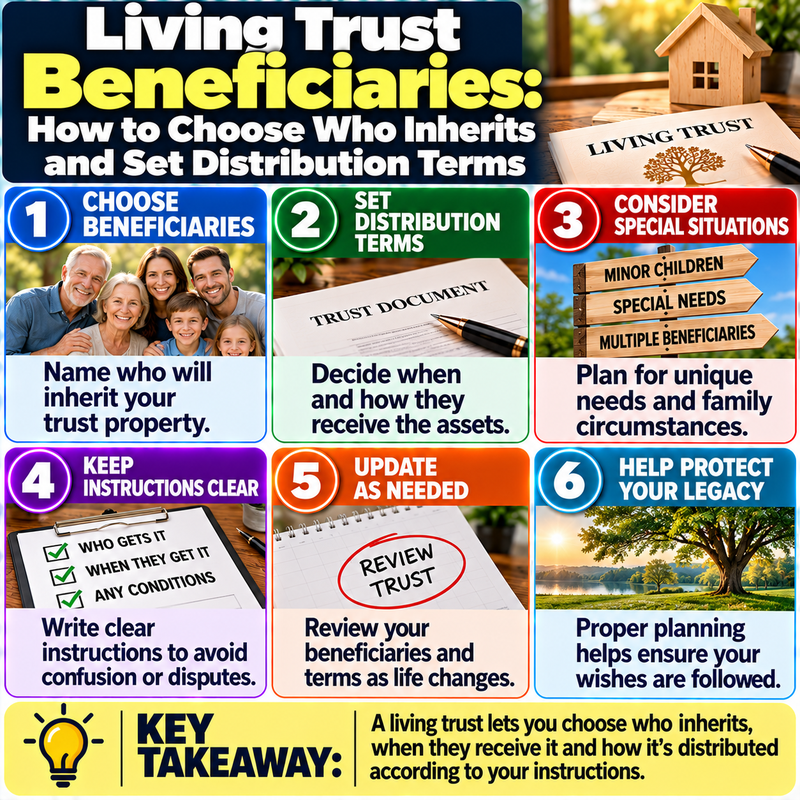
    Living Trust Beneficiaries: How to Choose Who Inherits and Set Distribution Terms

    Plan Who Receives Trust Property, When They Receive It, and How Your Instructions Should Work

    Choosing the right beneficiaries for your living trust determines who actually receives your property, when they receive it, and whether your wishes get carried out the way you intended.

    This decision touches everything from your children’s inheritance to how a charitable gift gets handled after you’re gone, and getting it right matters more than most people realize. Bulletproof Legacy’s supported digital estate-planning approach is built around helping families work through exactly these kinds of decisions with professional resources on hand, rather than guessing at them alone.

    Key Takeaways: Choosing Beneficiaries for Your Living Trust

    • Living trust beneficiaries can include individuals, charities, other trusts, or even your own estate, but each option comes with different practical consequences.
    • Naming both primary and contingent (backup) beneficiaries prevents your trust property from defaulting to state inheritance rules if your first choice can’t inherit.
    • Minor children, beneficiaries with special needs, and blended family situations each require specific planning approaches rather than generic language.
    • Beneficiary designations on retirement accounts and life insurance often override your trust instructions entirely, so these need to be coordinated separately.
    • Later in this article, you’ll find out exactly what “per stirpes” means for your grandchildren’s inheritance and why that single phrase can change who gets what.

    Naming beneficiaries is one of the most consequential steps in the entire trust-creation process, right alongside funding the trust and selecting a successor trustee. If you haven’t yet worked through the full process of setting up your trust, the guide on how to create a living trust walks through each stage from drafting to funding. This article focuses specifically on the beneficiary piece: who to name, how to structure their inheritance, and what mistakes tend to cause the most family friction down the road.
    Living-Trust-Beneficiaries

    Plan Who Receives Trust Property, When They Receive It, and How Your Instructions Should Work

    A beneficiary is simply a person or organization you’ve designated to receive trust property under the terms you’ve written. That sounds straightforward, but the real planning work happens in the details: who receives property now versus later, what happens if someone predeceases you, and whether your instructions actually hold up the way you expect them to.

    Current Beneficiaries Versus Remainder Beneficiaries

    Some trusts name current beneficiaries who receive income or distributions right away, while others name remainder beneficiaries who only receive property after an earlier interest ends. For example, a trust might provide income to a surviving spouse during their lifetime, with the remaining property passing to children only after that spouse passes away. Understanding which role each person plays in your plan helps you write instructions that match your actual intent, rather than leaving a trustee to interpret vague language later.

    Why Contingent Beneficiaries Are Your Backup Plan

    A contingent beneficiary only inherits if your primary beneficiary doesn’t survive you, can’t be located, or declines the inheritance. Skipping this step is one of the most common gaps in a trust document. Without a named contingent beneficiary, your trust may not clearly address what happens next, which can lead to delays, added expense, or a result that doesn’t reflect what you actually wanted.

    How This Fits Into Your Overall Living Trust

    Beneficiary designations don’t exist in isolation. They work alongside your trustee provisions, your funding decisions, and the broader structure of your revocable living trust, which governs how and when your trust can be changed during your lifetime. It’s worth noting that a living trust, on its own, doesn’t guarantee your estate avoids probate; that outcome depends heavily on whether assets are properly retitled into the trust, how beneficiary designations on other accounts are handled, and the requirements of your state’s law.

    Who Can You Name as a Beneficiary?

    You have more flexibility here than many people assume. A living trust beneficiary can be an individual, a charitable organization, another trust, or in some cases your own estate, though that last option usually isn’t the wisest choice.

    Individuals, Charities, and Organizations

    Most trusts name family members as beneficiaries, such as a spouse, children, grandchildren, or close friends. But you’re not limited to people. Charitable organizations, religious institutions, and nonprofits can all be named to receive a portion of your trust property, either as a fixed dollar amount or as a percentage of the overall trust.

    Naming Another Trust as a Beneficiary

    Sometimes a trust names another trust as its beneficiary rather than an individual outright. This structure shows up often in special-needs planning, in trusts created for minors, or when a beneficiary’s share needs to be managed under separate terms. It adds a layer of complexity, so this approach typically benefits from guidance from an estate planning attorney familiar with how your state treats nested trust arrangements.

    Naming Your Own Estate: Why This Usually Backfires

    Naming your own estate as a trust beneficiary is technically possible, but it tends to undercut the very reason many people create a living trust in the first place. Assets that pass to your estate generally get swept into the probate process instead of transferring directly to your intended recipients. If avoiding probate complications is part of your goal, this is usually one option worth steering clear of.

    Free Trust Consultation Banner

    How to Choose Your Primary and Backup Beneficiaries

    Once you know who you want to benefit from your trust, the next step is organizing those people into a clear hierarchy: primary beneficiaries first, contingent beneficiaries as backup. This structure is what keeps your trust functioning the way you intended, even if circumstances change between the day you sign your trust and the day it’s actually put into action.

    Naming More Than One Primary Beneficiary

    You’re not limited to a single primary beneficiary. Many trusts split property among several people at once, such as three children each receiving one-third of the trust estate. When you name multiple primary beneficiaries, it’s important to specify percentages or shares clearly rather than leaving the division open to interpretation, since vague language is one of the most common sources of family disagreement after a death.

    Layering Contingent Beneficiaries Correctly

    A well-built trust doesn’t stop at one layer of backup planning. Consider naming a contingent beneficiary for each primary beneficiary, and then think through what happens if that contingent beneficiary also can’t inherit. For example, if your trust leaves property to your child, and names your grandchild as a backup, you might also want to specify what happens if neither survives you. This kind of layered planning sounds thorough because it is, and it’s exactly the kind of detail that prevents gaps in your plan.

    What Happens If You Name No Backup at All

    Skipping contingent beneficiaries entirely leaves a gap in your instructions. If your primary beneficiary has already passed away, can’t be found, or declines their inheritance, and no backup has been named, the outcome depends on how your trust document is otherwise drafted and on your state’s default rules for undistributed trust property. This can mean delays, added legal costs, and outcomes that don’t reflect what you would have chosen yourself.

    Equal Shares Versus Unequal Shares: Documenting Your Intent

    Many people assume dividing trust property equally among children is the safest choice, and often it is. But equal isn’t always fair, and fair isn’t always equal, especially when family circumstances vary.

    When Unequal Distributions Make Sense

    You might choose unequal shares if one child has already received significant financial support during your lifetime, if one child has greater financial need, or if one child has taken on a larger caregiving role. There’s no universal rule here; it’s a personal decision based on your family’s specific situation.

    Writing Clear Language to Prevent Future Disputes

    Whatever you decide, documenting the reasoning behind unequal distributions, either within the trust itself or in a separate letter of intent, can go a long way toward preventing hurt feelings or legal challenges later. Silence tends to invite speculation, and speculation tends to invite conflict among surviving family members.

    Outright Distributions Versus Continuing Trusts

    Your trust can hand property directly to a beneficiary, or it can hold that property in a continuing trust and distribute it according to terms you set. Choosing between these two approaches depends heavily on who the beneficiary is and what kind of oversight makes sense for their situation.

    When an Outright Distribution Is the Simpler Choice

    An outright distribution transfers property directly to the beneficiary with no ongoing management or restrictions. This works well for adult beneficiaries who are financially capable and don’t need built-in protections. It’s simpler to administer and gives the beneficiary full control right away.

    When a Continuing Trust Protects Your Beneficiary Better

    A continuing trust keeps property under a trustee’s management and distributes it according to your instructions over time. This structure tends to make more sense for minors, beneficiaries with limited financial experience, beneficiaries with disabilities, or beneficiaries going through circumstances like divorce or creditor issues. The trustee manages the assets, while the beneficiary receives distributions according to the standards you’ve written into the trust.

    Age-Based and Milestone Distribution Strategies

    If you decide a continuing trust is the better fit, you’ll also need to decide how and when distributions actually happen. Two common approaches are age-based staggered distributions and milestone-based distributions.

    Staggered Distributions at Set Ages

    A staggered distribution schedule releases portions of a beneficiary’s inheritance at specific ages rather than all at once. A common example might look like this:

    • One-third of the share distributed at age 25
    • One-third distributed at age 30
    • The remaining balance distributed at age 35

    This approach gives a beneficiary time to mature financially before receiving full control, while still ensuring they eventually receive everything you intended to leave them.

    Tying Distributions to Life Milestones

    Instead of fixed ages, some trusts tie distributions to life events, such as college graduation, starting a business, or purchasing a first home. This approach can feel more personal, though it requires careful drafting so the trustee has clear standards for determining when a milestone has actually been met.

    Planning for Minor Beneficiaries

    Minor children cannot legally receive and manage trust property on their own, no matter how mature they seem for their age. This is one of the clearest cases where a continuing trust structure isn’t just helpful, it’s necessary.

    Naming a Trustee or Custodian Until Adulthood

    Your trust should name a trustee responsible for managing property on behalf of a minor beneficiary until they reach a specified age, whether that’s 18, 21, 25, or another age you choose. This trustee has a legal duty to manage the property responsibly and distribute it according to the trust’s terms.

    When selecting this trustee, think through a few practical questions:

    • Does this person have the financial judgment to manage significant assets responsibly?
    • Would they prioritize the beneficiary’s wellbeing over personal convenience?
    • Do they have the time and willingness to take on this responsibility?
    • Is there a backup trustee named in case your first choice can’t serve?

    Answering these honestly helps you avoid naming someone out of obligation rather than genuine fit.

    Why Minors Cannot Inherit Property Directly

    Without a trustee or custodian arrangement in place, property intended for a minor typically requires court involvement to appoint someone to manage it, which can mean delays and added legal costs. Building this structure into your living trust in advance avoids that outcome and keeps control over who manages the property in your own hands rather than a court’s.

    Special-Needs Beneficiaries Require Specialized Planning

    If one of your intended beneficiaries receives or may need means-tested government benefits, such as Supplemental Security Income or Medicaid, standard trust language can create serious complications. This is an area where generic planning genuinely isn’t appropriate.

    Protecting Eligibility for Government Benefits

    A direct inheritance, even a well-intentioned one, can disqualify a beneficiary from benefits they depend on for medical care and daily living support. Special-needs trusts are specifically designed to supplement rather than replace these benefits, but the rules governing them are technical and vary based on program requirements and state administration. Because an incorrectly drafted provision can jeopardize a beneficiary’s benefits entirely, this is an area where working with an attorney experienced in special-needs planning is particularly important.

    Why Generic Trust Language Can Cause Problems

    A standard distribution clause, even one that seems protective on its surface, may not include the specific language needed to preserve benefit eligibility. This is not a situation where a one-size-fits-all approach is appropriate, and it’s worth flagging clearly to whoever helps you draft or review your trust.

    Blended Families, Second Marriages, and Competing Interests

    Blended families introduce planning challenges that traditional nuclear-family trusts don’t always anticipate. A surviving spouse, children from a prior relationship, and jointly owned property can all pull in different directions if a trust isn’t drafted with these dynamics in mind.

    Balancing a Surviving Spouse and Children From a Prior Relationship

    One common structure allows a surviving spouse to use or benefit from trust property during their lifetime, with the remaining property passing to children from a prior marriage after the spouse’s death. This balances two goals that can otherwise compete: providing for a current spouse while still preserving an inheritance for children from an earlier relationship.

    Addressing Jointly Owned Assets in Your Plan

    Assets owned jointly with a spouse often pass directly to that spouse by operation of law, regardless of what your trust says. This means your trust’s beneficiary instructions may only apply to separately owned property, making it important to review how each asset is titled alongside your trust planning.

    Beneficiaries With Creditor, Divorce, or Money-Management Concerns

    Not every beneficiary is in a position to receive a lump-sum inheritance without complications. Beneficiaries facing creditor judgments, pending divorces, or a history of financial difficulty may benefit from additional structure built into their share of the trust.

    Using Trust Terms to Shield Assets From Creditors

    Keeping a beneficiary’s inheritance in a continuing trust, rather than distributing it outright, can offer a layer of protection from that beneficiary’s creditors, since the assets remain under the trustee’s control rather than becoming the beneficiary’s personal property outright. The specific level of protection depends on how the trust is drafted and on applicable state law, so this is worth discussing with an attorney if creditor exposure is a real concern for someone you’re planning to include.

    Protecting an Inheritance From a Beneficiary’s Divorce

    Similarly, property held in a continuing trust is generally treated differently than property distributed outright when a beneficiary later goes through a divorce. Keeping inherited assets separate and trust-held, rather than commingled with marital property, can help preserve their intended purpose.

    Setting Distribution Standards for Beneficiaries Who Struggle With Money

    For a beneficiary who has a pattern of financial difficulty, your trust can specify distribution standards, such as funds released only for health, education, maintenance, or support, rather than an unrestricted lump sum. This gives a trustee clear guidance for making discretionary decisions, rather than leaving every distribution open to argument.

    Naming Charitable Beneficiaries

    Charitable giving through a living trust lets you support causes you care about while still providing for family members. Many people choose to combine both approaches within the same trust document.

    Giving a Fixed Amount Versus a Percentage of Your Trust

    You can name a charity to receive a fixed dollar amount, a specific asset, or a percentage of your overall trust estate. A percentage-based gift automatically adjusts if your estate’s value changes over time, while a fixed amount stays the same regardless of how your assets perform. Each approach has trade-offs worth thinking through based on how predictable you expect your estate’s value to be by the time your trust is administered.

    How Outside Beneficiary Designations Interact With Your Trust

    Your living trust doesn’t operate alone. Many of your most valuable assets, including retirement accounts and life insurance, pass according to their own beneficiary designations, completely separate from what your trust document says.

    Retirement Accounts, Life Insurance, and Payable-on-Death Assets

    Accounts like 401(k)s, IRAs, life insurance policies, payable-on-death bank accounts, and transfer-on-death brokerage accounts all transfer based on the beneficiary forms filed directly with the financial institution. Naming beneficiaries on these accounts requires particular care, since retirement accounts in particular carry specific tax rules depending on who inherits them.

    Why These Designations Override Your Trust Instructions

    Here’s the part that catches people off guard: a beneficiary designation on one of these accounts generally overrides whatever your trust or will says, even if your trust document seems to address the same asset. If your life insurance beneficiary form still names an ex-spouse from years ago, that designation will typically control, regardless of your current intentions.

    It’s also worth noting that retirement accounts like IRAs and 401(k)s generally should not be retitled into a living trust the way a bank account or piece of real estate might be. Instead, these accounts use their own beneficiary designation forms, and naming a trust as beneficiary of a retirement account involves specific tax considerations that are worth reviewing with a financial or tax professional before making that choice.

    Coordinating Outside Designations With Your Overall Estate Plan

    Because these designations operate independently, it’s worth periodically reviewing every account that allows a named beneficiary and confirming it still matches your current wishes. This coordination is just as important as the language inside your trust document itself, and it’s a step that’s easy to overlook once the trust itself is signed.

    Per Stirpes and Other Distribution Terms Explained Simply

    Estate planning documents often include Latin terms that sound more complicated than they actually are. Two of the most common, “per stirpes” and “per capita,” directly affect how your grandchildren might inherit if one of your children passes away before you do.

    • Per stirpes means a deceased beneficiary’s share passes down to their own children, divided equally among them.
    • Per capita means the share is instead redistributed equally among the surviving beneficiaries at the same generational level.

    These two terms can produce very different outcomes depending on your family structure, so it’s worth understanding exactly which one your trust uses.

    What “Per Stirpes” Means for Your Grandchildren’s Inheritance

    Imagine you have three children and name them as equal beneficiaries. If one child passes away before you, leaving two children of their own, a per stirpes distribution means those two grandchildren would split their deceased parent’s one-third share between them, rather than that share being absorbed by their surviving aunts or uncles.

    Per Capita Distribution: The Key Difference

    Under a per capita approach, that same one-third share would instead be divided among all surviving beneficiaries at the same level, meaning the grandchildren might receive nothing directly, while the remaining two children split the full estate between themselves. Neither approach is universally right or wrong, but the difference is significant enough that it’s worth confirming which method your trust specifies, rather than assuming.

    Life Events That Should Trigger a Beneficiary Review

    A living trust isn’t a document you sign once and forget about. Your family circumstances, financial picture, and relationships all shift over time, and your beneficiary designations need to keep pace with those changes rather than lagging years behind reality.

    A good rule of thumb is to review your trust and all related beneficiary designations every few years, and immediately after any major life event. Waiting until “someday” to update an outdated plan is one of the most common and most avoidable estate planning mistakes.

    Marriage, Divorce, Births, and Deaths

    Marriage, divorce, the birth or adoption of a child, and the death of a previously named beneficiary are the clearest triggers for a review. A divorce decree, for instance, doesn’t automatically remove an ex-spouse from a beneficiary designation on a retirement account or life insurance policy, even if your trust has been updated separately. Each of these events deserves a fresh look at both your trust document and every outside beneficiary form tied to your accounts.

    Estrangement, Disability, and Major Financial Changes

    Less obvious triggers matter too. A falling-out with a previously named beneficiary, a new disability diagnosis for someone in your family, or a significant change in your own financial situation can all shift what makes sense for your plan. If a beneficiary develops a disability after your trust is signed, for example, their share may need to move into a special-needs trust structure to avoid jeopardizing benefits they now rely on.

    Free Consultation Banner 3

    Communicating Your Intentions to Avoid Family Disputes

    Even a well-drafted trust can lead to hurt feelings or legal challenges if your beneficiaries are caught completely off guard by its contents. Clear communication, while you’re still able to provide it, tends to prevent far more conflict than any amount of careful drafting alone.

    Putting Your Wishes in Writing

    Beyond the legal language in your trust itself, consider writing a separate letter of intent that explains your reasoning, especially if you’ve chosen unequal distributions or unusual conditions. This document isn’t legally binding the way your trust is, but it gives your beneficiaries context that can prevent them from assuming the worst about your intentions.

    Talking to Your Beneficiaries and Successor Trustee Ahead of Time

    Having a direct conversation with your beneficiaries and your successor trustee before anything happens to you can clear up confusion and set expectations early. Your successor trustee, in particular, benefits from knowing where your trust documents are kept, how you’d like distributions handled, and who to contact for professional guidance when the time comes to administer the trust.

    Common Mistakes to Avoid When Naming Beneficiaries

    Several patterns show up again and again in poorly planned trusts, and nearly all of them are avoidable with a bit of extra attention during the drafting process.

    Forgetting to name a contingent beneficiary tops the list, followed closely by failing to coordinate outside beneficiary designations with the trust itself. Naming a minor as a direct beneficiary without a trustee or custodian structure creates legal complications that a continuing trust could have easily prevented. Using vague percentage language, such as splitting assets “equally among my children” without clarifying how a deceased child’s share should be handled, leaves room for disputes that clearer per stirpes or per capita language would have resolved.

    Perhaps one of the most overlooked living trust mistakes is simply never updating the trust after a major life change. A trust drafted during a first marriage, left untouched through a divorce and remarriage, can create outcomes that no longer reflect the person’s actual wishes. Treating your trust as a living document that deserves periodic attention is one of the simplest ways to prevent this.

    Frequently Asked Questions

    These are some of the most common questions people ask when working through beneficiary decisions for their living trust.

    Can I change my living trust beneficiaries after I sign the trust?

    Yes, if your trust is revocable, you generally retain the right to change beneficiaries, add new ones, or remove existing ones at any time while you’re alive and have legal capacity to do so.

    This flexibility is one of the defining features of a revocable living trust, which differs from an irrevocable trust in exactly this respect.

    What happens if a beneficiary dies before I do?

    If your trust names a contingent beneficiary for that person, the contingent beneficiary typically inherits that share instead. If no contingent beneficiary was named, the outcome depends on how your trust document is otherwise drafted and your state’s default rules for distributing property when a named beneficiary predeceases the trust creator.

    Can a beneficiary also serve as my successor trustee?

    Yes, it’s common for a beneficiary to also serve as successor trustee, particularly an adult child managing a trust that benefits themselves and their siblings. It’s worth thinking through whether this dual role creates any practical conflicts, especially in situations involving unequal distributions or blended families.

    Do I need a lawyer to name beneficiaries in my living trust?

    While straightforward beneficiary designations don’t always require legal assistance, more complex situations, such as special-needs planning, blended families, or beneficiaries with creditor concerns, often benefit from an attorney’s guidance to make sure the language actually accomplishes what you intend.

    Can I leave different amounts to each of my children?

    Yes, you’re free to divide your trust property however you choose among your children. Unequal distributions are entirely legal, though documenting your reasoning can help reduce the chance of disputes or hurt feelings among your beneficiaries later.

    What happens if I don’t name a contingent beneficiary?

    Without a contingent beneficiary, your trust may not clearly address what happens if your primary beneficiary can’t inherit, which can lead to delays, added legal costs, or a distribution outcome that doesn’t match your original intent. Naming a backup beneficiary for every primary beneficiary is one of the simplest ways to close this gap.

    Should retirement account beneficiaries match my trust?

    Not necessarily in the sense of naming the trust itself as beneficiary, but your retirement account beneficiary designations should be reviewed alongside your trust to make sure your overall plan is coordinated. Because retirement accounts carry specific tax rules and generally aren’t retitled into a trust the way other property is, it’s worth discussing your specific situation with a financial or tax professional. For more guidance, you can explore this simple guide on choosing beneficiaries.

    Can I name a pet as a beneficiary of my living trust?

    A pet can’t legally own property as a beneficiary, but many states allow for a pet trust, which names a caretaker and sets aside funds specifically for your pet’s care. This is a specialized structure worth discussing if providing for an animal companion is part of your plan.

    How often should I review my beneficiary designations?

    A general guideline is to review your trust and related beneficiary designations every few years, and immediately after major life events like marriage, divorce, births, deaths, or significant financial changes.

    Staying current with these reviews is far simpler than untangling an outdated plan after the fact.

    Can creditors reach a beneficiary’s inheritance from my trust?

    It depends on how the inheritance is structured. Property distributed outright becomes the beneficiary’s personal asset and may be reachable by their creditors, while property held in a continuing trust often receives a greater degree of protection, depending on your state’s law and how the trust is drafted.

    If creditor protection is a significant concern for a specific beneficiary, this is worth discussing directly with an estate planning attorney familiar with your state’s trust laws.

    Get Professional Guidance Before You Finalize Your Beneficiary Choices

    Choosing living trust beneficiaries touches nearly every corner of your estate plan, from how your children inherit to whether a loved one with special needs keeps their government benefits intact. Getting these decisions right the first time saves your family from confusion, delay, and unnecessary expense later.

    Every family’s situation is different, and the right structure for your trust depends on factors like your state’s laws, your family dynamics, and the specific assets you’re planning to pass on. A conversation with a professional familiar with these details can help you confirm your plan actually does what you intend it to do.

    If you’d like help thinking through your own beneficiary decisions, reviewing the full process for creating a living trust is a solid next step, and scheduling a Free Living Trust Consultation can give you a clearer picture of your specific options.

    Bulletproof Legacy’s supported digital estate-planning approach is designed to pair easy digital access with professional resources and trust-funding assistance, so your plan doesn’t just get created, it gets properly put into action.

    Bulletproof Legacy helps families build and maintain living trusts with the professional support needed to keep those plans working the way they were intended.
  • How to Choose a Successor Trustee for Your Living Trust

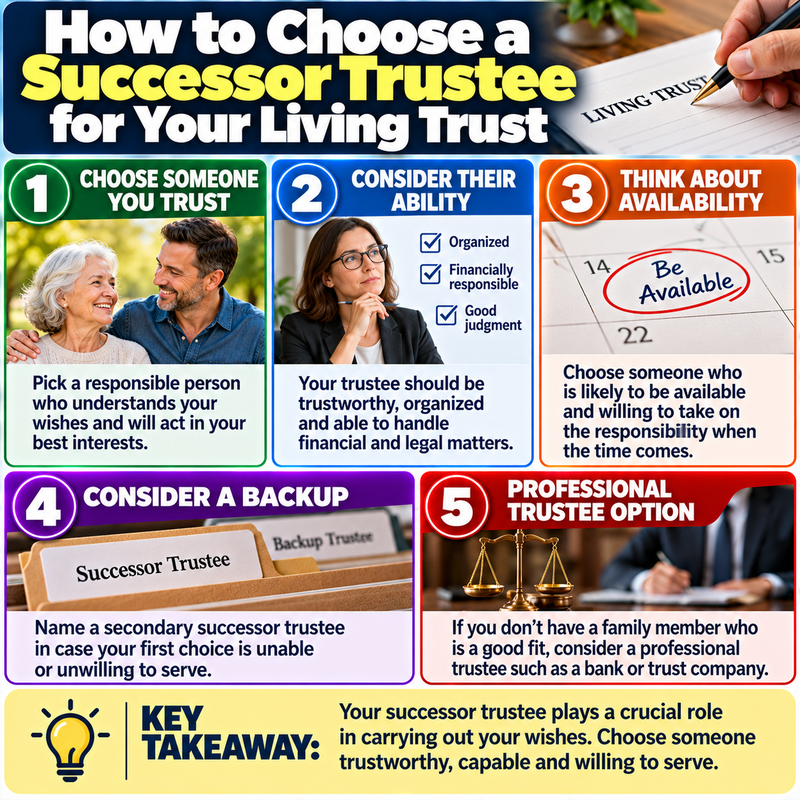
    How to Choose a Successor Trustee for Your Living Trust

    How to Choose a Successor Trustee: Key Qualities and Decisions to Consider

    What the Role Requires, Who Can Serve, and the Qualities to Consider Before You Decide

    Choosing the wrong successor trustee can turn a carefully built living trust into a source of family conflict, delay, and expense—while choosing the right one can make the entire process feel almost invisible to the people you love.

    If you’re working through how to create a living trust, naming a successor trustee is one of the handful of decisions that actually determines whether your plan works the way you intended. It’s not a box to check off quickly or an honorary title to hand to your oldest child. It’s a real job with real responsibilities, and the person you pick needs to be capable of doing it—or smart enough to get help when they need it. Bulletproof Legacy’s supported digital estate-planning approach was built around this exact gap, pairing trust documents with the kind of practical guidance that helps families actually fund and maintain their plans instead of letting them sit untouched in a drawer.

    Article at a Glance: Key Takeaways

    • How to choose a successor trustee comes down to four traits: trustworthiness, financial competence, availability, and impartiality—not simply who is closest to you or oldest in birth order.
    • A successor trustee only has authority over what’s actually inside the trust, so funding and coordination with other documents matters just as much as who you name.
    • Family members, friends, private professional fiduciaries, and corporate trustees each come with different tradeoffs in cost, objectivity, and continuity.
    • Naming backups, having a direct conversation before you decide, and reviewing your choice periodically can prevent the most common and costly mistakes.
    • Later in this article, you’ll find a practical checklist and the specific questions to ask any potential trustee before you put their name on the document.
    How-To-Choose-A-Successor-Trustee

    What the Role Requires, Who Can Serve, and the Qualities to Consider Before You Decide

    A successor trustee is the person or institution who steps in to manage your trust when you no longer can—whether that’s because of incapacity, resignation, or death. Most people serve as their own trustee while they’re alive and well, which means the successor trustee role often sits dormant for years before it’s ever activated. That delay is exactly why so many people underestimate how important the choice is: the role feels abstract until the day it suddenly isn’t.

    What a Successor Trustee Is and When the Role Begins

    In a typical revocable living trust, you name yourself as the initial trustee so you keep full control over your own assets while you’re capable of managing them. The successor trustee’s authority usually begins under one of two triggers: you become incapacitated and can no longer manage your affairs, or you pass away. At that point, the successor trustee takes over trust administration according to the instructions you’ve already written into the document.

    This handoff is designed to happen without a court proceeding, which is one of the practical advantages of using a trust-based plan. That said, a living trust doesn’t guarantee your estate will avoid probate altogether—that outcome depends on how thoroughly the trust was funded, how your other assets are titled, and what your state’s laws require. A successor trustee can only manage what’s actually been placed into the trust.

    Successor Trustee vs. Current Trustee, Executor, Power of Attorney, and Beneficiary

    These roles get confused constantly, so it helps to separate them clearly:

    • Current trustee — Usually you, while you’re alive and able to manage your own trust.
    • Successor trustee — Takes over trust management after incapacity or death.
    • Executor — Named in your will, this person typically handles probate and oversees your “pour-over will,” which moves any assets left outside the trust into it after you die.
    • Power of attorney — A separate document and separate role that may authorize someone to manage assets titled in your individual name, outside the trust.
    • Beneficiary — Someone who receives assets or benefits from the trust; this person can sometimes also serve as trustee, which raises its own considerations covered later in this article.

    You can name the same person for multiple roles, but you don’t have to. Some people split responsibilities deliberately—for instance, naming one adult child as executor and another as successor trustee—to divide the workload or sidestep a perceived conflict of interest.

    Core Duties Your Successor Trustee Will Take On

    Before you can judge who’s right for the job, it helps to know exactly what the job involves. A successor trustee isn’t just holding a title—they’re taking on a fiduciary duty, which is a legal obligation to act in the best interests of the trust’s beneficiaries rather than their own.

    DutyWhat It Involves
    Asset managementLocating, safeguarding, and managing trust property, including real estate, accounts, and investments
    RecordkeepingTracking income, expenses, and distributions with accurate, accessible records
    CommunicationKeeping beneficiaries reasonably informed and responding to their questions
    Bill payingCovering valid expenses tied to trust assets, like property taxes or maintenance
    Tax coordinationWorking with an accountant to handle any required tax filings
    DistributionFollowing your instructions for how and when beneficiaries receive assets

    Locating, Protecting, and Managing Trust Assets

    One of the first things a successor trustee has to do is figure out what’s actually in the trust and make sure it’s protected. That might mean securing a vacant house, redirecting mail, managing a rental property, or simply confirming that bank and investment accounts are properly titled in the trust’s name. If major assets were never retitled into the trust while you were alive, the successor trustee’s ability to help can be limited, since a trustee can only act on property the trust actually owns.

    Working With Accountants, Attorneys, and Financial Advisors

    A good trustee doesn’t need to be a CPA or a financial advisor, but they do need to be comfortable bringing in professionals when the situation calls for it. Trustees can hire accountants, attorneys, and investment professionals to help with technical matters, but they generally can’t hand off the ultimate decision-making responsibility. In other words, a trustee can delegate tasks, not accountability.

    Communicating With Beneficiaries and Keeping Records

    Beneficiaries are entitled to reasonable information about how the trust is being managed, and a trustee who goes silent for months at a time tends to create suspicion even when nothing improper is happening. Clear, consistent communication—paired with organized records of income, expenses, and distributions—tends to prevent most disputes before they start.

    Recordkeeping matters even more than people expect. A trustee who can’t produce a clear accounting when asked is far more likely to face pushback from beneficiaries, regardless of whether they’ve actually done anything wrong.

    Following Your Distribution Instructions

    Your trust document spells out how and when beneficiaries receive their inheritance—all at once, in staggered amounts tied to age milestones, or held in an ongoing trust for someone who needs more structure. The successor trustee’s job is to follow those instructions as written, not to improvise based on what they personally think is fair.

    This is where impartiality becomes critical, especially if the trustee is also a beneficiary. Sticking to the document, rather than personal judgment calls, is what keeps the trustee’s actions defensible if a beneficiary ever disagrees with a decision.

    Free Trust Consultation Banner

    Skills and Personal Qualities That Matter Most

    So what actually makes someone a good successor trustee? It’s tempting to default to whoever is “closest” to you emotionally, but the traits that matter most are more specific than that.

    Trustworthiness and Financial Organization

    Trustworthiness means more than “I trust this person with my feelings.” It means this person has historically been honest, careful with money, and comfortable being held accountable for their decisions. Financial organization is a separate but related skill—can this person handle paperwork, meet deadlines, and work through account statements without getting overwhelmed or simply avoiding the task?

    Judgment, Communication, and Follow-Through

    A trustee will inevitably face situations your trust document doesn’t explicitly address, and good judgment is what fills that gap. Communication matters just as much: beneficiaries who feel informed are far less likely to escalate disagreements into something more serious. Follow-through ties it all together—plenty of people have good intentions, but a trustee needs to actually complete tasks, return calls, and meet deadlines consistently.

    Red Flags That Signal a Poor Fit

    Certain patterns tend to predict trouble before it happens. Watch for these warning signs when you’re evaluating a potential trustee:

    • A history of financial problems, secrecy about money, or difficulty respecting boundaries
    • Chronic disorganization or a habit of avoiding administrative tasks and ignoring details
    • An overcommitted schedule, frequent travel, or an unstable life situation that leaves little room for new responsibility
    • Long-running family conflicts, a tendency to “settle scores,” or difficulty saying no when it matters

    If you notice more than one of these patterns in a candidate, it’s worth pausing before naming them—even if they’re the person you’d otherwise expect to choose.

    Family Member, Friend, or Professional Trustee: Weighing Your Options

    Most people start by assuming a family member will serve as successor trustee, and in plenty of cases, that’s exactly the right call. But it’s worth understanding the full range of options before you settle on one, since the “obvious” choice isn’t always the best fit for your specific situation.

    Broadly, you’re choosing between a relationship-based trustee—someone who knows your family personally, like a relative or close friend—and a process-based trustee, such as a private professional fiduciary or corporate trust company. Neither option is inherently better; the right choice depends on your assets, your beneficiaries, and how much ongoing management your trust will require.

    Naming an Adult Child or Relative

    Adult children are the most common choice for a reason: they usually know the family, understand your wishes, and will serve without charging a trustee fee. But an adult child needs to be evaluated the same way any other candidate would be—based on organization, availability, and communication skills, not birth order. The oldest child isn’t automatically the best administrator, and naming someone purely out of tradition can set up resentment among siblings who sense they were passed over for a less-qualified choice.

    It’s also worth remembering that people change. An adult child who was responsible and capable at twenty-five may be dealing with their own career demands, health issues, or family obligations by the time they’re actually called on to serve. Revisiting your choice periodically—something covered later in this article—helps account for that kind of drift over time.

    Naming a Trusted Friend

    A close friend can work well for many of the same reasons a family member does: personal knowledge of your situation and no added fee. The tradeoff is similar, too—friends take on the same administrative burden as family members, often without professional experience handling fiduciary duties, accountings, or tax coordination.

    Private Professional Fiduciaries

    When no family member or friend is a good fit—or when the trust’s value falls below what a corporate trustee requires—a private professional fiduciary can fill the gap. These are individuals who serve as trustee professionally, typically for a fee, and bring experience handling the administrative and interpersonal demands of the role. If you’re considering this route, it’s reasonable to ask directly about their succession plan: who steps in if something happens to them?

    Trust Companies vs. Traditional Trust Banks

    Corporate trustees generally fall into two categories, and the distinction matters more than most people realize. Traditional trust banks are custodial institutions, typically operating as a division of a larger bank, and they handle both trust administration and investment management. Trust companies, on the other hand, are non-custodial—they handle the fiduciary administration of the trust but leave investment decisions to a separate financial advisor, often one the family already works with.

    Fee structures and investment approaches can differ significantly between the two, and conflicts of interest are worth understanding before you commit. A tax or estate planning professional can help you evaluate which structure fits your situation, particularly if your estate includes significant assets or property across multiple states.

    Objectivity, Conflicts of Interest, and Family Dynamics

    Family dynamics have a way of surfacing during trust administration even when everyone got along fine beforehand. Money, grief, and old sibling patterns tend to combine in ways that test even a well-drafted trust, which is why objectivity deserves serious weight in your decision.

    When a Beneficiary Also Serves as Trustee

    It’s common—and generally allowed—for a beneficiary to also serve as trustee. An adult child, for example, often fills both roles simultaneously. The challenge is impartiality: can this person follow the trust’s distribution instructions evenhandedly, even when a decision benefits them directly or disadvantages a sibling? If other beneficiaries already have doubts about this person’s fairness, naming them as sole trustee can intensify conflict rather than resolve it, even if their intentions are good.

    Avoiding Birth-Order Bias and Old Rivalries

    Choosing a trustee because someone is the oldest, or because it would “hurt their feelings” not to be picked, tends to backfire more often than it helps. Age and birth order say nothing about someone’s organizational skills, availability, or ability to communicate fairly with siblings. The decision deserves the same scrutiny you’d apply to hiring someone for a job, because that’s effectively what you’re doing.

    Old family rivalries have a way of resurfacing the moment money and property enter the picture, even among siblings who’ve gotten along fine for decades. If two of your children have a long history of friction, naming one as sole trustee over the other’s inheritance can reignite that tension at the worst possible time—right when everyone is also grieving.

    • Ask yourself whether your chosen trustee can communicate calmly with a sibling they’ve clashed with in the past
    • Consider whether naming a neutral party, such as a professional fiduciary, might reduce tension if family relationships are already strained
    • Think about whether full transparency with all beneficiaries from the start would ease concerns about favoritism

    None of this means family members can’t serve well together. It simply means the decision should be based on evidence of how people actually behave under stress, not on hope that old patterns will magically disappear once real responsibility is on the line.

    If you’re uncertain whether a family candidate can stay impartial, it’s worth having an honest conversation with them directly, and possibly with other beneficiaries, before finalizing anything in your trust documents.

    Financial Competence and Willingness to Serve

    A trustee doesn’t need an accounting degree, but they do need enough financial comfort to review account statements, pay bills on schedule, and understand when a decision calls for professional help. Someone who avoids opening mail or ignores overdue notices in their own life is unlikely to suddenly develop those habits when managing someone else’s trust.

    Willingness matters just as much as competence. Serving as a trustee is unpaid work for most family members, and it can stretch across months or years depending on how the trust is structured. Someone who agrees out of obligation, without understanding the time commitment, may quietly resent the role or let tasks slip once the initial urgency fades.

    Signs Someone Can Handle the Paperwork and Deadlines

    Look at how a potential trustee manages their own financial life. Do they pay bills on time? Do they keep records organized enough to find a document when they need it? Have they handled a parent’s estate, a small business, or any other situation requiring attention to financial detail? None of these are hard requirements, but a pattern of competence in their own affairs is a reasonable predictor of how they’ll handle yours.

    Why You Must Ask Before You Name Someone

    It’s surprisingly common for people to name a successor trustee without ever telling that person they’ve been chosen. This creates an unpleasant surprise during an already difficult moment—incapacity or death—when the named trustee suddenly discovers a responsibility they never agreed to take on.

    A direct conversation ahead of time solves this. Explain what the role involves, confirm the person is willing to serve, and give them a chance to ask questions or decline. If the conversation feels tense or the person hesitates, that reaction is useful information—it’s far better to learn about reluctance now than to have your trust depend on someone who never wanted the job.

    Free Consultation Banner 2

    Age, Health, Geography, and Long-Term Availability

    A trustee candidate who looks perfect on paper today might not be the right choice decades from now, which is why age, health, and geography deserve real consideration rather than an afterthought.

    These factors don’t disqualify anyone outright, but they shape how practical the choice will be when the role actually activates—which, for many people, could be twenty or thirty years after the trust is signed.

    Why Naming a Same-Age Trustee Can Backfire

    If you’re in your fifties or sixties and you name a sibling or friend close to your own age as successor trustee, that person is aging alongside you. By the time your trust actually needs a successor trustee—often when you’re in your eighties or nineties—your chosen trustee may be dealing with their own health limitations, or may no longer be living at all. This is one of the most overlooked planning gaps, and it’s easily solved by naming at least one younger backup trustee alongside your primary choice.

    How Distance Affects Property and Administration

    Living far away from a potential trustee doesn’t automatically disqualify them, especially with how much trust administration can now be handled remotely through phone, email, and electronic document sharing. That said, distance becomes more relevant when the trust includes physical property that needs hands-on attention—a house that needs to be cleaned out, repaired, or sold, for instance.

    If your trustee lives across the country from your primary residence, it’s worth thinking through how they’d handle these logistics. Some families address this by naming a local co-trustee for property matters or by building in flexibility for the trustee to hire local help, such as a property manager or real estate agent, to handle tasks that require physical presence.

    State Residency and Trust Taxation Considerations

    Where your trustee lives can also affect how a continuing trust is taxed after your death. In some cases, a trust’s state tax treatment follows the trustee’s residency rather than the trust creator’s—meaning a trust set up to avoid state income tax could lose that advantage if the person actually serving as trustee lives in a high-tax state. This is a nuanced, state-specific issue, and if your estate plan is built around minimizing state income tax exposure for continuing trusts, it’s worth a conversation with a tax-savvy estate planning attorney before finalizing your trustee selections.

    Naming Co-Trustees: Benefits and Complications

    It’s tempting to name two or three people as co-trustees to avoid choosing a single “favorite,” especially among siblings. Shared authority can work, but it comes with a structural risk that’s worth understanding clearly before you build it into your trust.

    When Shared Authority Works Well

    Co-trustees can function well when they genuinely get along, communicate easily, and bring complementary skills to the role—one handles financial details while the other manages beneficiary communication, for example. A trust document can also specify how decisions get made among co-trustees, such as requiring majority agreement rather than unanimous consent, which helps avoid gridlock on smaller matters.

    How Deadlocks Can Delay Major Decisions

    The risk with co-trustees is what happens when they disagree, particularly on something significant like selling real estate or making a large distribution. Without a clear decision-making process built into the trust, a disagreement between co-trustees can stall action indefinitely—sometimes at the exact moment a beneficiary is depending on a timely decision.

    • Picture three siblings named as joint trustees, where two want to sell an inherited property and one refuses—the sale can stall or fall apart entirely
    • A trust with unclear co-trustee authority may require all parties to sign off on even routine transactions, slowing down simple tasks
    • Disagreements between co-trustees can sometimes escalate into the kind of conflict that requires legal intervention to resolve

    Many estate planning attorneys recommend naming a single trustee at a time, with backups in a clear order of succession, rather than co-trustees serving simultaneously. If you do want to name co-trustees, make sure the trust document spells out exactly how disagreements get resolved, rather than leaving it open to interpretation during a stressful moment.

    If you’re torn between two equally capable candidates, it may be simpler to name one as primary trustee and the other as the first backup, preserving both people’s involvement without creating a built-in deadlock.

    Naming Backup Trustees and an Order of Succession

    Even the most carefully chosen successor trustee can become unavailable—due to death, illness, relocation, or simply changing their mind about serving. A trust without backup trustees named leaves a gap that typically has to be filled by a court, which adds delay and expense right when your family needs things to move smoothly.

    Building a Clear Primary, Second, and Third Choice

    A well-drafted trust usually names at least one backup trustee, and often two, creating a clear order of succession: primary, second choice, third choice. This structure means that if your first choice can’t or won’t serve, the next person is already identified and ready to step in without requiring a new legal proceeding. Make sure contact information for each backup is current and easy for your family to locate, since outdated contact details can cause unnecessary delays even when the succession plan itself is sound.

    Using a Corporate Trustee as a Last-Resort Backup

    Some people name a corporate trustee or trust company as a final backup, in case none of the individual choices are available or willing to serve when the time comes. This approach provides a safety net without requiring you to pay ongoing corporate trustee fees while your preferred individual choices are still able to serve. It’s a practical way to make sure your trust never ends up without a trustee entirely, even decades after you’ve signed the document.

    Have This Conversation Before You Name Anyone

    Naming someone as successor trustee without ever discussing it with them is one of the most common—and most avoidable—mistakes in trust planning. This isn’t a favor you’re asking for “someday.” It’s a fiduciary role with real legal responsibility, and the person deserves a clear, upfront conversation about what you’re asking them to take on.

    This conversation also gives you valuable information. How someone responds when you explain the role—curious and engaged, or hesitant and vague—tells you a lot about whether they’re genuinely prepared to serve. If the conversation feels uncomfortable now, that discomfort usually doesn’t improve once real responsibility and family emotions are involved.

    Treat this discussion the way you would a serious job offer, because that’s essentially what it is. Be specific about expectations, timelines, and what kind of support they’d have access to, including professionals you already work with.

    Questions to Ask a Potential Successor Trustee

    Before finalizing your decision, sit down with your chosen candidate and ask questions that reveal both their willingness and their readiness for the role.

    • Are you willing to serve as successor trustee, and do you understand what that role involves?
    • If I became incapacitated, how quickly could you realistically step in and start managing things?
    • Are you comfortable working with an accountant or an estate attorney if the situation calls for it?
    • How would you handle it if a beneficiary disagreed with a decision you made?
    • Do you feel confident you could stay fair, even if you’re also a beneficiary of the trust?
    • Would you want to be paid a trustee fee, and how would you document your time and expenses?
    • What kind of support or resources would make you feel more prepared for this role?

    Pay close attention not just to the answers, but to how comfortable the person seems discussing the topic at all. Genuine willingness usually sounds different from polite agreement given just to end an awkward conversation.

    Compensation and Expense Considerations

    Whether a successor trustee gets paid—and how much—varies significantly depending on who you choose and what your trust document specifies. This is worth addressing directly in your trust rather than leaving it ambiguous, since unclear compensation terms can become a source of tension among beneficiaries later. For more guidance, you can explore who should be your successor trustee to ensure clarity and fairness.

    Family Trustee Fees vs. Professional Trustee Fees

    Family members and friends often serve without charging a formal fee, though many trust documents allow for reasonable compensation if the trustee wants it, particularly for a lengthy or complex administration. Professional fiduciaries and corporate trustees, by contrast, typically charge fees as a standard part of their service, often based on a percentage of trust assets or an hourly rate for their time.

    If you’re considering a corporate trustee, it’s worth understanding how their fee structure works and whether it includes investment management or purely administrative services, since these two models can carry very different costs. A private professional fiduciary will usually have their own fee schedule as well, which is reasonable to discuss openly during your initial conversations with them.

    Whatever you decide, spell it out clearly in the trust document itself. Ambiguity about compensation—especially when a family member serves without pay while putting in significant time and effort—can quietly breed resentment that surfaces at the worst possible moment.

    Free Consultation Banner 3

    How Incapacity Provisions Affect the Transition

    One of the most valuable features of a living trust is its ability to provide for management of your affairs if you become incapacitated, without requiring a court-supervised guardianship proceeding. But this only works smoothly if the trust is properly funded and your successor trustee actually knows how to step in when the time comes.

    Funding the Trust So Your Successor Can Actually Act

    A successor trustee’s authority only extends to assets the trust actually owns. If significant accounts or property were never retitled into the trust during your lifetime, your successor trustee may find themselves with limited ability to help, even with the best of intentions and a well-written trust document. This is one of the most common gaps in otherwise solid estate plans—the trust exists, but it was never properly funded.

    It’s also worth remembering that certain assets typically stay outside a living trust altogether, including retirement accounts like IRAs and 401(k)s, as well as life insurance and annuities. These assets pass according to their beneficiary designations rather than trust instructions, so coordinating those designations with your overall plan matters just as much as funding the trust itself. If you’re unsure whether your accounts and property are properly aligned with your trust, a financial advisor or the institution holding the account can usually confirm how a specific asset is titled or designated.

    Coordinating With Powers of Attorney and Other Documents

    A living trust rarely works alone. A durable power of attorney, for instance, typically covers decisions about assets that stay outside the trust, while healthcare directives address medical decisions that a trust document doesn’t touch at all. If these documents name different people, or if they conflict in how incapacity gets determined, your successor trustee could face confusion at exactly the moment clarity matters most.

    It’s worth reviewing all of your estate planning documents together, rather than treating the trust as a standalone solution. Confirm that your power of attorney, healthcare directive, and trust all point toward a consistent plan, with people who know they’ve been named and understand how their roles fit together.

    This kind of coordination is exactly where a supported planning approach adds value. Bulletproof Legacy’s process is designed to help families connect these pieces—trust funding, beneficiary designations, and related documents—so a successor trustee isn’t left guessing about what falls under their authority and what doesn’t.

    Safeguards Against Trustee Misconduct

    Most successor trustees do their job honestly and carefully. But it’s worth understanding, plainly, that trusts don’t come with the same built-in oversight that probate does, and that gap is exactly why your trustee selection deserves serious scrutiny rather than a quick decision made out of family obligation.

    Trustees are legally bound to follow the terms of the trust and act in beneficiaries’ best interests. In practice, though, no court or law enforcement agency routinely monitors what a trustee actually does day to day. Unless a beneficiary raises a concern or takes legal action, a trustee’s management of the trust typically goes unexamined.

    This is different from how a probate executor operates. An executor named in a will often serves under a bond and must account to the court throughout the process. A bond isn’t quite insurance, but if an executor steals from the estate, the bonding company is typically on the hook to replace the money. Trusts generally don’t come with this same bonding requirement, which means the protection has to come from your trustee selection itself.

    None of this is meant to scare you away from naming an individual trustee—most people serve honestly and take the role seriously. It simply means the decision deserves the weight it’s due:

    • If you have even a small, nagging doubt about someone’s honesty or judgment, it’s worth naming a different trustee
    • A trustee who has handled other people’s money responsibly in the past is a stronger candidate than one who hasn’t
    • Building in a trust protector, discussed next, adds a layer of protection that doesn’t require court involvement

    Why Trusts Lack the Bonding and Court Oversight of Probate

    This absence of routine oversight is a tradeoff, not an oversight in the drafting itself. Trusts are designed to avoid the cost and delay of court supervision, and that efficiency is part of what makes them appealing. The flip side is that your trustee’s integrity carries more weight than it would in a probate process with built-in checks.

    This is exactly why the trustworthiness factor discussed earlier in this article matters so much. A trustee’s honesty isn’t just a nice-to-have personality trait—it’s functioning as your primary safeguard against mismanagement, since the legal system generally won’t catch a problem until a beneficiary notices and takes action.

    If your estate or family situation involves higher risk of conflict, or if you’re naming someone you don’t know as well as you’d like, building in additional protections—like the trust protector role described below—can offer meaningful peace of mind.

    If you have the slightest doubt about whether someone will handle this responsibility honestly, it’s worth naming a different person—even if that means an uncomfortable conversation now.

    Using a Trust Protector to Remove a Problem Trustee

    A trust protector is typically an attorney or other qualified professional given limited authority to step in and make specific changes to a trust without requiring a court proceeding—including, in many cases, the power to remove and replace a trustee. This role is especially valuable for any continuing trust meant to last well beyond your death, such as one set up for a child with special needs, a beneficiary who struggles with managing money, or anyone who may become vulnerable to undue influence over time. For more information on choosing the right person for this role, consider reading about who should be your successor trustee.

    Without a trust protector in place, family members who suspect a trustee is mismanaging or misusing trust funds typically have to go to court—using their own money and time—to have that trustee removed. A trust protector can act much faster, sometimes with nothing more than a signature, stopping a problem before it compounds while the family sorts out next steps.

    When and How to Revisit Your Trustee Choice

    Naming a successor trustee isn’t a decision you make once and never touch again. People change, relationships shift, and circumstances that made sense ten years ago may no longer fit your family today. Building in a habit of periodic review keeps your trust aligned with reality rather than a snapshot of your life from years ago.

    A good rule of thumb is to revisit your trustee selection every few years, even if nothing dramatic has happened. Life has a way of shifting gradually—health changes, moves, new relationships, and evolving family dynamics—without any single moment clearly signaling that your estate plan needs a second look.

    Major Life Events That Call for a Review

    Certain events deserve a prompt review rather than waiting for your next scheduled check-in: a divorce or remarriage in the family, a falling-out between your chosen trustee and a beneficiary, your trustee relocating to a different state, a significant change in your trustee’s health, or a major shift in the size or complexity of your estate. Any of these can change whether your original choice still makes sense.

    Practical Successor Trustee Selection Checklist

    Before you finalize your trust documents, it helps to run through a simple checklist to confirm you’ve covered the key considerations discussed throughout this article:

    • Have you evaluated candidates based on trustworthiness, financial competence, availability, and impartiality—not birth order or emotional obligation?
    • Have you had a direct conversation with your chosen trustee, confirming they understand and accept the role?
    • Have you named at least one, ideally two, backup trustees with a clear order of succession?
    • Have you considered age and geography, including whether a same-age trustee might not be available decades from now?
    • Have you addressed compensation clearly in the trust document, rather than leaving it ambiguous?
    • Have you confirmed the trust is properly funded so your successor trustee can actually act when needed?
    • Have you coordinated your trust with powers of attorney, healthcare directives, and beneficiary designations?
    • Have you considered whether a trust protector makes sense, especially for any continuing trust?

    When to Involve an Estate Planning Attorney

    Many of the decisions covered in this article—trustee authority, incapacity triggers, co-trustee structures, and state-specific administration rules—can vary significantly depending on where you live and how your estate is structured. Even a straightforward estate can benefit from an attorney’s review simply to confirm the trust document says what you think it says.

    An estate planning attorney becomes especially important if you have a blended family or elevated risk of conflict among beneficiaries, a beneficiary with disabilities or ongoing care needs, significant assets or real estate spread across multiple states, a business interest that needs special handling, or a likely need for a professional or corporate trustee. These situations involve legal nuances that go beyond general guidance and deserve individualized attention.

    Frequently Asked Questions

    These are some of the most common questions people ask once they’ve worked through the core decision of who to name as successor trustee.

    Can a successor trustee also be a beneficiary of the trust?

    Yes, this is common and generally allowed. Many people name an adult child as both a beneficiary and the successor trustee. The main consideration is whether that person can stay impartial, following the trust’s distribution instructions evenly even when a decision affects their own inheritance.

    What happens if my chosen successor trustee declines to serve?

    If you’ve named backup trustees in a clear order of succession, the next person in line typically steps in. Without named backups, the court may need to appoint a trustee, which adds time and expense your family could otherwise avoid.

    Does a successor trustee get paid?

    It depends on your trust document and who you’ve named. Family members often serve without charging a fee, though many trusts allow for reasonable compensation if requested. Professional fiduciaries and corporate trustees typically charge fees as a standard part of their service.

    Can I change my successor trustee after the trust is signed?

    Generally, yes—this is one of the advantages of a revocable living trust. As long as you’re mentally competent and the trust remains revocable, you can typically amend it to name a different successor trustee if your circumstances or relationships change.

    The process for making this change usually involves a trust amendment rather than creating an entirely new document, though the specific requirements can vary depending on how your trust was originally drafted.

    What disqualifies someone from serving as a trustee?

    There’s no single universal list, since requirements can vary by state and by the trust document itself. Generally, a trustee needs to be a legal adult of sound mind, without a history that raises serious concerns about honesty or financial responsibility.

    Beyond these baseline requirements, it’s really about fit—someone who lacks organizational skills, availability, or impartiality may not be disqualified in a legal sense, but they may still be a poor practical choice for your specific trust.

    Do I need to tell my successor trustee they’ve been named?

    You’re not legally required to, but it’s strongly recommended. Telling your chosen trustee ahead of time lets you confirm their willingness, answer their questions, and avoid an unpleasant surprise during an already difficult moment.

    It also gives the trustee a chance to prepare—knowing where important documents are kept, who your other advisors are, and what your general wishes look like—long before they’re actually called on to act.

    Is a successor trustee the same as power of attorney?

    No, these are distinct roles governed by different documents. A successor trustee manages assets held inside your living trust, while a power of attorney typically authorizes someone to handle your affairs and assets that are titled in your individual name, outside the trust.

    You can name the same person for both roles, which many people do for simplicity, but you’re not required to. Some families intentionally split these responsibilities between different people based on each person’s strengths.

    • A successor trustee’s authority comes from the trust document and activates based on the terms you’ve written into it
    • A power of attorney’s authority comes from a separate document and may activate under different conditions

    Reviewing both documents together, rather than treating them as unrelated pieces of paperwork, helps ensure there are no gaps or conflicts between them.

    Can an out-of-state resident serve as my successor trustee?

    In most cases, yes, though distance can create practical challenges if your trust includes physical property that needs hands-on management. It’s also worth considering how trustee residency might affect state tax treatment for any continuing trust, which is a nuanced issue best discussed with an estate planning attorney familiar with your state’s rules.

    What if my successor trustee and executor are different people?

    This is common and can work well, especially if you’re dividing responsibilities based on each person’s strengths. Your executor typically handles probate matters and oversees your pour-over will, while your successor trustee manages the trust itself.

    The key is making sure both people understand how their roles relate to each other, so tasks don’t fall through the cracks simply because each person assumed the other was handling something.

    How many backup trustees should I name?

    Most estate planning guidance suggests naming at least one backup, and ideally two, to create a clear order of succession. This helps ensure your trust always has someone ready to step in, even if your first or second choice becomes unavailable decades after you’ve signed the document.

    A trust with no named backup trustee leaves a gap that typically has to be filled by a court-appointed trustee—adding delay and expense at a time your family can least afford either.

    Naming a corporate trustee as a final backup, discussed earlier in this article, is one practical way to make sure that gap never actually happens, regardless of how your personal circumstances change over time.

    Get Help Choosing the Right Successor Trustee for Your Trust

    Choosing a successor trustee touches nearly every other part of your estate plan, from how smoothly your family handles incapacity to how cleanly your assets transfer after you’re gone. Getting this decision right now can save your loved ones from confusion, conflict, and unnecessary expense later.

    If you’d like help thinking through your options or want a second opinion on a trustee decision you’re already leaning toward, scheduling a Free Living Trust Consultation is a low-pressure way to get clarity before you finalize your documents.

  • How to Transfer Property Into a Living Trust

    How to Transfer Property Into a Living Trust

    How to Transfer Property Into a Living Trust: The Funding Process Explained

    Understand Retitling, Ownership Changes, Documentation, and the Trust-Funding Process

    If you’ve already signed your living trust and assumed your work is done, here’s the part that actually protects your family: nothing happens automatically until you retitle your assets into the trust’s name.

    Transferring property into a living trust—often called “funding” the trust—is the step that turns a legal document into a working plan, and it’s also the step most people skip or do incorrectly. The team at Bulletproof Legacy Financial frequently hears from clients who signed trust paperwork years earlier, never realizing their house, bank accounts, or business interest were still sitting in their individual name the entire time.

    Key Takeaways: Article-at-a-Glance

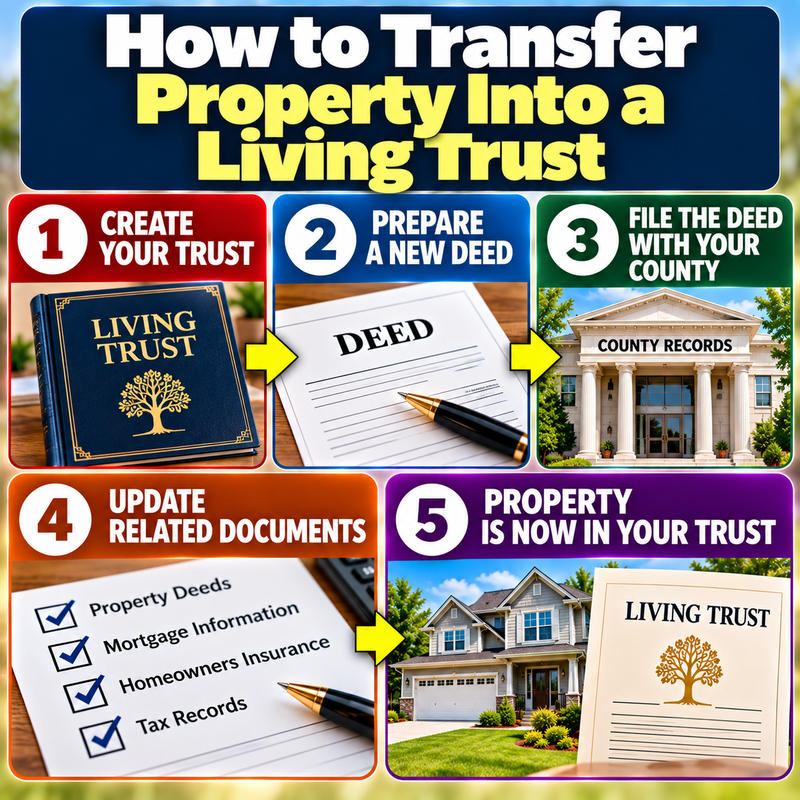
    • Learning how to transfer property into a living trust means changing legal ownership of each asset—through deeds, account retitling, or assignment documents—so the trust, not you personally, holds title.
    • Signing a trust document alone does not move any property into it; every asset requires its own separate transfer step based on what type of property it is.
    • Certain assets, like IRAs and 401(k)s, generally should not be retitled into a trust and instead get coordinated through beneficiary designations.
    • Real estate transfers typically require a new deed that gets recorded with the county, and the process can trigger questions about mortgages, taxes, and title insurance worth reviewing carefully.
    • Bulletproof Legacy’s supported digital approach is built around helping clients complete this funding process correctly, not just sign documents and hope for the best.
    How-To-Transfer-Property-Into-A-Living-Trust

    Understand Retitling, Ownership Changes, Documentation, and the Trust-Funding Process

    At its core, transferring property into a living trust means changing who legally owns an asset on paper. Instead of “Jane Smith” owning a house, bank account, or investment portfolio, the owner becomes “Jane Smith, Trustee of the Jane Smith Living Trust dated [date].” The trust itself doesn’t do anything until this retitling happens for each individual asset you want it to control.

    Why Signing the Trust Document Alone Does Not Protect Your Assets

    A living trust document is essentially a set of instructions—it names a trustee, lists beneficiaries, and explains how property should be managed and distributed. But instructions only matter for property the trust actually owns. If you create a revocable living trust and never transfer anything into it, the trust holds no assets at all, and everything you own remains subject to the same probate process as if you’d never created the trust.

    This is one of the most misunderstood parts of estate planning. People assume the attorney or document service “handles everything,” when in reality, funding the trust is often left to the individual to complete, sometimes with guidance and sometimes not.

    What “Funding a Trust” Actually Means

    Funding simply refers to the process of transferring ownership of your assets into your trust’s name, or in some cases, naming the trust as a beneficiary of an asset you can’t directly retitle. This might mean recording a new deed for your house, opening a new bank account titled in the trust’s name, or completing paperwork with a brokerage firm. Each asset type has its own method, which we’ll walk through step by step. You can also check out our full funding checklist for more specific instructions.

    What Happens If You Skip This Step

    If an asset is never transferred into the trust, it typically does not avoid probate, regardless of what your trust document says. Probate outcomes depend heavily on how each asset is actually titled, what beneficiary designations are in place, and applicable state law—not just on the existence of a trust. A properly created living trust only works as intended when it’s paired with complete and accurate funding.

    Step 1: Identify the Current Legal Owner on Every Title

    Before you can transfer anything, you need to know exactly how each asset is currently titled. This sounds obvious, but many people are surprised to find a car title still lists a deceased parent, or a bank account is jointly owned with a sibling in a way they’d forgotten about. Start by pulling together your deeds, vehicle titles, account statements, and any business ownership documents.

    How to Locate Deeds, Titles, and Account Statements

    For real estate, your deed is usually on file with the county recorder or register of deeds office where the property sits; many counties now post these records online. Vehicle titles are issued by your state’s department of motor vehicles. Bank and brokerage statements will show the account registration directly on the document, often near the account number. Creating a trust is a beneficial way for people to pass on assets while avoiding the potentially costly probate process.

    Why Ownership Form Changes Your Transfer Method

    How an asset is currently owned affects how it needs to move. A house owned solely by you transfers differently than one owned jointly with a spouse, and an account with a named payable-on-death beneficiary may need a different approach than one without. Taking inventory first prevents wasted paperwork and mismatched transfers later.

    Step 2: Confirm Your Trust’s Exact Legal Name and Date

    Every trust has a formal legal name, and it almost always includes a specific date—the date the trust was signed. This matters because every new deed, account application, or assignment document needs to reference the trust using that exact same name and date, every single time.

    Look at the first page of your trust document to find this information. It typically reads something like “The John A. Doe Revocable Living Trust dated January 15, 2024.” Write this down exactly as it appears, including punctuation and capitalization, since you’ll need to reproduce it precisely across multiple institutions and forms.

    Many people underestimate how often this detail gets requested. Banks, title companies, the DMV, and brokerage firms will all ask for this same string of information, so having it ready saves time and prevents mismatched records across your various accounts.

    • Full legal name of the trust as written on the first page
    • Exact date the trust was signed
    • Name(s) of the current trustee(s)
    • Your trust’s tax identification approach (many revocable trusts use the grantor’s Social Security number during their lifetime)

    Matching Trust Name on Every New Document

    Consistency matters more than people expect. If your deed says “The Doe Family Trust” but your bank account says “The Doe Family Living Trust,” some institutions may flag this as a discrepancy requiring clarification or additional paperwork before they’ll process transactions.

    When in doubt, bring a copy of your trust’s signature page or a certification of trust to any institution handling your transfer. This document typically summarizes key trust terms—like the trustee’s authority—without requiring you to hand over the entire trust document, which many people prefer to keep private.

    Why Small Clerical Errors Create Big Problems Later

    A misspelled name or wrong date on a recorded deed can create a cloud on title that’s expensive and time-consuming to fix, sometimes requiring a corrective deed or even court involvement. Double-checking this information before signing anything is one of the simplest ways to avoid future headaches.

    Free Trust Consultation Banner

    Step 3: Match Each Asset Type to Its Correct Transfer Method

    Not every asset transfers into a trust the same way, and using the wrong method can create confusion, delay, or in some cases, an incomplete transfer that doesn’t actually accomplish what you intended. Broadly speaking, assets fall into a few categories based on how they’re transferred.

    Understanding which category your property falls into helps you anticipate what paperwork you’ll need and which institutions you’ll need to work with.

    Assets That Transfer by Deed

    Real estate—your home, vacation property, rental units, or vacant land—generally transfers by executing and recording a new deed naming the trustee as the owner. This is one of the most common and most important funding steps, since real estate is often a person’s largest asset.

    Assets That Transfer by Retitling an Account

    Bank accounts, brokerage accounts, and some investment accounts typically transfer by working directly with the financial institution to change the account registration. The underlying account number may stay the same, or the institution may open a new account entirely in the trust’s name.

    Assets That Transfer by Assignment

    Business interests, partnership shares, and personal property without a formal title—like furniture, artwork, or jewelry—often transfer using a general assignment document. This is a written statement assigning your ownership interest to the trust, though business interests may also require additional approval under an operating agreement or partnership agreement.

    • Deed transfer: real estate, land, rental property
    • Account retitling: bank accounts, brokerage accounts, some CDs
    • Assignment: business interests, personal property without title, partnership shares
    • Beneficiary coordination: retirement accounts, life insurance, annuities

    We’ll cover each of these categories in detail throughout this guide, including the specific documentation typically required and where professional guidance tends to matter most.

    Assets That Should Not Be Retitled Into the Trust

    Retirement accounts like IRAs and 401(k)s are generally kept in the original owner’s individual name during their lifetime rather than retitled into a trust. Moving these accounts into a trust can trigger unintended tax consequences, since it may be treated as a withdrawal by the IRS. Instead, these accounts are typically coordinated through beneficiary designations, which we’ll explore later in this guide.

    Transferring Real Estate Into Your Living Trust

    Real estate is often the centerpiece of a funding plan, both because of its value and because of the paperwork involved. The living trust structure allows your successor trustee to manage or sell real property without court involvement if you become incapacitated or pass away—but only if the property was actually transferred into the trust while you were able to do so.

    Preparing and Signing a New Deed

    To move real estate into your trust, you’ll generally need to sign a new deed transferring the property from your individual name to yourself as trustee. The specific type of deed used—such as a quitclaim deed or a warranty deed—depends on your state and personal preference, and each carries different implications for title warranties. The legal description on the new deed needs to match public records precisely, since even small errors can create title problems down the road.

    State and County Recording Requirements

    Once signed, the deed typically must be recorded with the county recorder, register of deeds, or equivalent office where the property is located. Recording requirements—including notarization, witness signatures, and filing fees—vary by state and even by county, so it’s worth checking local requirements before submitting paperwork.

    Transfer Taxes, Reassessment Rules, and Homestead Protections

    Depending on where you live, transferring property into a revocable living trust may or may not trigger a transfer tax or a property tax reassessment. Many states offer exemptions for transfers into a revocable trust when the original owner remains the beneficiary, but these rules are not universal, and homestead exemptions or other property tax protections can be affected differently depending on local law. Because these rules vary significantly by state and county, it’s worth confirming the specific treatment with a local title company, tax assessor, or attorney before recording a new deed.

    Coordinating With Your Mortgage Lender and Title Insurance

    If your property has a mortgage, transferring it into a revocable living trust generally does not violate the loan terms, since federal law protects this type of transfer for many residential mortgages when the original borrower remains a beneficiary of the trust. That said, it’s still wise to notify your lender in writing once the transfer is complete, keeping a copy of your deed and any trust certification on file in case questions arise later. The mortgage itself typically stays in your name as a personal obligation, even though the property is now titled to the trust.

    Title insurance is another detail worth checking. Most title insurance policies continue to cover the property after a transfer into a revocable trust, but it’s worth confirming with your title insurer or a title company that your existing policy remains valid, or whether an endorsement is needed. This is a reasonable moment to loop in a title professional, especially if your property has unique title history or multiple owners.

    Retitling Bank and Brokerage Accounts

    Bank and investment accounts are usually more straightforward to transfer than real estate, but they still require direct action—your trust document alone won’t change anything at the bank. Each financial institution has its own internal process, and working through it typically means a visit, phone call, or online request rather than a mailed document.

    Because procedures differ so much from one bank or brokerage to another, it’s worth calling ahead to find out exactly what they’ll need before you show up expecting a quick in-and-out appointment.

    Opening a New Account in the Trust’s Name

    One common approach is opening a brand-new account titled in the name of the trust, then transferring funds from your personal account into it. The new account will typically be titled something like “Jane Smith, Trustee of the Jane Smith Living Trust dated [date],” and you’ll usually continue to have full signing authority as trustee during your lifetime if you’re serving as your own trustee, which is common with revocable trusts.

    Some institutions instead allow you to simply change the registration on your existing account rather than opening a new one, which can simplify the process if you have automatic payments or direct deposits already set up. Ask your bank which option they offer before deciding how to proceed.

    Using a Payable-on-Death Designation Instead of Retitling

    For some accounts, rather than retitling ownership, you can simply name the trust as the payable-on-death (POD) beneficiary. This means the account stays in your individual name during your lifetime, but automatically transfers to the trust when you pass away, without going through probate.

    This approach can be a practical alternative when retitling feels unnecessarily complicated for a smaller account, though it’s worth understanding that a POD designation only takes effect at death—it doesn’t give your successor trustee any authority to manage the account while you’re alive but incapacitated, the way a fully retitled account would.

    Documents Financial Institutions Typically Request

    Most banks and brokerages will ask for a certification of trust (sometimes called an abstract of trust), which summarizes key details like the trustee’s name and powers without disclosing the entire trust document. They may also request a copy of your Social Security card or tax identification information, a government-issued ID, and completed account-opening paperwork specific to that institution.

    Moving Business Interests Into the Trust

    Business ownership interests—whether an LLC membership, corporate shares, or a partnership stake—can be transferred into a living trust, but the process is rarely as simple as signing a single form. Because business interests often involve other owners, lenders, or regulatory bodies, this is an area where it pays to slow down and check the fine print before making any changes. For more detailed guidance, you might consider exploring how to fund a trust effectively.

    Reviewing Operating Agreements, Bylaws, and Partnership Terms

    Before transferring a business interest into your trust, review your operating agreement, corporate bylaws, or partnership agreement for any restrictions on ownership transfers. Some agreements require consent from other owners before a transfer can occur, while others may have specific procedures that must be followed, such as providing written notice or amending the company’s formation documents.

    When Lender or Licensing Approval Is Required

    If your business has outstanding loans, the lender’s loan agreement may contain a due-on-transfer clause or require advance written consent before ownership changes hands, even into your own revocable trust. Similarly, certain licensed professions or regulated industries may have rules about who can hold an ownership interest, which could affect whether a trust transfer is appropriate or how it needs to be structured.

    Given these variables, business interest transfers are often one of the better candidates for professional review, whether that’s your business attorney, your accountant, or both, since the consequences of an improper transfer can affect far more than just your estate plan.

    Transferring Personal Property Without a Title

    Not everything you own comes with a title document. Furniture, jewelry, artwork, collectibles, and household items generally fall into this “no title” category, which means there’s no deed or registration to formally change.

    Using a General Assignment Document

    For these items, a general assignment of property is typically used—a signed document stating that you’re transferring your ownership interest in specified (or generally described) personal property to your trust. This document doesn’t need to be recorded anywhere, but it should be kept with your trust paperwork as evidence that the transfer occurred.

    Many people use a broad assignment covering all tangible personal property at once, rather than listing every item individually, though high-value items like fine art or valuable collections are sometimes listed specifically for clarity, especially if insurance coverage depends on accurate ownership records.

    Relying on a Pour-Over Will as a Backup

    Even with a general assignment in place, many estate plans include a pour-over will as a safety net. This type of will directs that any property not already transferred into the trust at the time of death gets “poured over” into the trust through the probate process. It’s not a substitute for proper funding, but it does provide a backstop for items that may have been overlooked.

    Vehicles and Other Titled Personal Property

    Cars, trucks, boats, and other titled vehicles can usually be transferred into a living trust by visiting your state’s department of motor vehicles or equivalent agency and completing a title transfer, similar to how you’d handle selling the vehicle to someone else. Some states charge a transfer fee even for trust transfers, while others may offer an exemption since no actual sale is taking place. Because vehicles depreciate and carry liability considerations, many people choose to leave day-to-day vehicles in their individual name and instead rely on a pour-over will or beneficiary designation where available, reserving trust transfers for higher-value vehicles like boats, RVs, or classic cars.

    Why Retirement Accounts Usually Stay in Your Own Name

    Retirement accounts like traditional IRAs, Roth IRAs, 401(k)s, and 403(b)s are treated differently than almost any other asset in your estate plan, and for good reason. These accounts come with specific tax rules tied to the account owner’s identity, and transferring ownership to a trust can trigger unintended and often costly tax consequences, since the IRS may treat the change as a full withdrawal.

    Because of this, retirement accounts are generally kept in the individual’s name throughout their lifetime. This isn’t a gap in your funding—it’s the standard and expected approach for this category of asset.

    Instead of retitling these accounts, estate planning coordination happens through a different mechanism entirely: beneficiary designations filed directly with the account custodian.

    Using Beneficiary Designations Instead of Retitling

    Most retirement account custodians allow you to name both primary and contingent beneficiaries directly on the account, separate from your trust document. For many people, naming a spouse or individual beneficiaries directly is the simpler and more tax-efficient route, since it allows beneficiaries to take advantage of their own distribution options.

    Tax Consequences of Naming a Trust as Beneficiary

    In certain specialized circumstances—such as providing for a beneficiary with special needs, a minor child, or concerns about a beneficiary’s spending habits—naming a trust as the beneficiary of a retirement account can make sense. However, this requires careful drafting to meet specific IRS requirements for what’s sometimes called a “see-through trust,” and getting it wrong can accelerate distributions and taxes in ways that defeat the purpose of the planning.

    Because of how technical and consequential these rules are, naming a trust as a retirement account beneficiary is an area where professional tax and legal guidance is particularly valuable before making any changes.

    Free Consultation Banner 3

    Other Beneficiary-Designated Assets to Review Separately

    Retirement accounts aren’t the only assets that transfer by beneficiary designation rather than retitling. Several other common assets work the same way, and it’s worth reviewing each one as part of a complete funding plan.

    Life Insurance Policies

    Life insurance proceeds typically pass directly to whoever is named as beneficiary on the policy, regardless of what your trust document says. If you want the trust to receive or manage these proceeds—for example, to provide ongoing support for minor children—you’ll generally need to contact your insurance company directly and update the beneficiary designation to name the trust.

    Payable-on-Death and Transfer-on-Death Designations

    Many bank accounts, brokerage accounts, and even vehicles or real estate in some states allow for payable-on-death (POD) or transfer-on-death (TOD) designations. These function similarly to beneficiary designations on retirement accounts: the asset stays in your name during life but transfers automatically at death to whoever you’ve named, bypassing probate for that specific asset.

    Naming your trust as the POD or TOD beneficiary can be a useful alternative to full retitling, particularly for accounts you want to keep simple to manage during your lifetime while still ensuring they flow into your overall trust-based plan after death.

    Jointly Owned Property and Special Timing Considerations

    If you own property jointly with a spouse or another person, the transfer process may look different depending on how that joint ownership is structured. Property held in joint tenancy with right of survivorship, for example, automatically passes to the surviving joint owner at death, regardless of what a trust says—so transferring jointly held property into a trust often requires both owners to sign off and may change how survivorship rights work going forward.

    Married couples creating trusts together should pay particular attention to whether they’re using a single joint trust or separate individual trusts, since this affects how jointly owned property should be titled and what happens if one spouse passes away before the other. These decisions are worth discussing directly as part of your overall trust creation process, since the funding approach often follows directly from how the trust itself was structured.

    Keeping Proof That Transfers Were Completed Correctly

    Once you’ve transferred an asset into your trust, don’t just assume it’s done and forget about it. Keep copies of every deed, account statement, assignment document, and confirmation letter in a dedicated folder alongside your trust document, ideally with both physical and digital backups stored somewhere your successor trustee can access them.

    Periodically reviewing this file—especially after major life events like buying a new home, opening a new account, or starting a business—helps confirm that your funding stays current and that nothing slips through the cracks over time.

    Documents to Save and Where to Store Them

    At minimum, your funding file should include recorded deeds for any real estate, certification of trust copies you’ve provided to institutions, account statements showing the new trust titling, signed assignment documents for personal property, and any confirmation letters from banks or brokerages acknowledging the change. It’s also smart to keep a simple written list—sometimes called a schedule of trust assets—summarizing what’s been transferred and when, so your successor trustee isn’t left piecing together the full picture from scratch.

    Confirming the Institution Actually Processed the Change

    Submitting paperwork isn’t the same as confirming it was processed correctly. Banks and brokerages occasionally make clerical errors, miss a signature line, or fail to update account registration even after you’ve provided everything they asked for.

    A good practice is to request a written confirmation or updated account statement after any transfer, specifically checking that the trust name appears exactly as intended. For real estate, you can confirm a deed was recorded by checking with the county recorder’s office or searching online property records once processing time has passed.

    Mortgages deserve a similar follow-up check, since you’ll want written confirmation that your lender has acknowledged the transfer without triggering any unintended loan provisions. Taking this extra step closes the loop and gives you actual peace of mind rather than just the paperwork trail.

    A simple annual review habit works well for most people:

    • Pull current statements for every account titled to the trust and confirm the name matches exactly
    • Check county records to confirm recorded deeds reflect trust ownership
    • Review beneficiary designations on retirement accounts and life insurance for accuracy
    • Note any new assets acquired in the past year that still need to be transferred

    Adding New Property to the Trust After It’s Created

    Funding isn’t a one-time event you complete and never think about again. Every time you acquire a new asset—a second home, a new investment account, a different vehicle—you’ll need to decide whether and how to title it in the trust’s name.

    Many people choose to purchase new real estate or open new accounts directly in the trust’s name from the start, which avoids a separate transfer step entirely. For other purchases, simply remembering to revisit your funding checklist annually, or whenever a major purchase occurs, helps keep your plan current rather than letting gaps accumulate over the years.

    Common Mistakes People Make When Funding a Living Trust

    Even well-intentioned people make predictable errors when transferring property into a living trust. Recognizing these patterns ahead of time can help you avoid the same pitfalls.

    The good news is that most of these mistakes are entirely preventable with a bit of attention to detail and a periodic review of your funding status.

    Forgetting Newly Purchased Assets

    Life moves fast, and it’s easy to buy a new car, open a new savings account, or purchase a vacation property without remembering to title it in the trust’s name. Over time, these overlooked assets can accumulate, leaving gaps in an otherwise well-funded plan.

    Mismatched Trust Names Across Documents

    As mentioned earlier, using slightly different versions of your trust’s name across different institutions can create confusion and administrative delays, particularly for your successor trustee trying to manage accounts after your death or incapacity. Consistency from the very first transfer matters.

    Assuming the Attorney Automatically Retitles Everything

    Many people believe that once they’ve signed their trust documents with an attorney or completed an online estate planning service, all their property gets automatically transferred as part of that process. In most cases, funding is a separate step that falls to the individual, sometimes with guidance provided and sometimes requiring the person to follow through independently.

    When to Get Professional Help With Trust Funding

    Some transfers are simple enough to handle on your own, particularly straightforward bank account retitling or personal property assignments. Others—like real estate with an existing mortgage, business interests with complex ownership agreements, or retirement accounts where you’re considering naming a trust as beneficiary—carry enough legal, tax, or financial nuance that professional guidance is worth the investment. An attorney, tax advisor, financial institution representative, or title company can help you navigate the specific rules that apply to your state and your particular assets, reducing the chance of a costly mistake down the road. For more detailed guidance, consider exploring transferring a mortgage to a living trust.

    Frequently Asked Questions

    Do I have to transfer everything I own into my living trust?

    Not necessarily. Some assets, like retirement accounts, are generally better coordinated through beneficiary designations rather than retitling. The right approach depends on the type of asset, your overall estate plan, and your state’s laws.

    Can I transfer property into my trust myself without a lawyer?

    Many straightforward transfers, like retitling a bank account or completing a personal property assignment, can often be handled independently. More complex transfers, particularly real estate with a mortgage or business interests with ownership restrictions, may benefit from professional review.

    What happens if I forget to transfer an asset before I die?

    An asset left outside the trust typically does not avoid probate just because you had a trust in place. Many estate plans include a pour-over will as a backup, directing any forgotten assets into the trust through the probate process, though this doesn’t eliminate probate for that asset entirely.

    Does transferring my house into a trust trigger a tax reassessment?

    This depends on your state and local rules. Many states exempt transfers into a revocable living trust from reassessment when the original owner remains a beneficiary, but this isn’t universal, so checking with your local tax assessor or a title professional is worthwhile before recording a new deed.

    Can I still sell or refinance property after it’s in my trust?

    Yes, as the trustee of your own revocable trust, you generally retain full control to sell, refinance, or otherwise manage trust-owned property during your lifetime. The process may require slightly different paperwork at closing to reflect the trust ownership, but it doesn’t typically prevent you from managing the property as you normally would. For more information, you can learn about how to fund a trust effectively.

    Should my IRA or 401(k) name my trust as beneficiary?

    Usually, retirement accounts are better served by naming individual beneficiaries directly rather than a trust, due to the tax rules involved. There are specialized situations—like providing for a minor or a beneficiary with special needs—where naming a trust can make sense, but this requires careful drafting and professional tax guidance to avoid unintended consequences.

    How long does it take to fund a living trust?

    Timing varies widely depending on how many assets you own and the types of institutions involved. Bank accounts can sometimes be retitled in a single visit, while real estate transfers involving recording and title review may take several weeks, and business interest transfers can take longer depending on required approvals.

    What is a pour-over will and do I still need one?

    A pour-over will directs any assets not already titled in your trust at death to be transferred into the trust through probate. Most people with a living trust still have a pour-over will as a safety net, even with thorough funding, since it’s difficult to guarantee every single asset gets captured during your lifetime.

    Can I transfer a mortgaged house into a revocable trust?

    Generally, yes. Transferring a mortgaged home into your own revocable living trust typically doesn’t violate the loan terms under federal protections for this specific type of transfer, though it’s still wise to notify your lender once the transfer is complete and confirm your title insurance remains valid.

    How do I know if an institution actually completed my transfer?

    Request written confirmation or an updated account statement after submitting any transfer paperwork, and verify that the trust name appears exactly as intended. For real estate, you can check county records directly to confirm a deed was recorded under the trust’s name.

    Your Next Step: Get Your Trust Properly Funded

    Knowing how to transfer property into a living trust is one thing; actually completing each transfer correctly, across every asset you own, is where most of the real work happens. Make sure to visit our trust funding checklist for information on transferring other assets into your trust. And if you’d like help understanding your options and making sure your trust is properly funded, you can schedule a Free Living Trust Consultation to walk through your specific situation.

    Bulletproof Legacy Financial’s supported digital estate-planning approach is designed to combine convenient online access with professional resources and trust-funding assistance, helping you move from a signed document to a fully funded plan.

  • How to Fund a Living Trust: A Complete Asset-by-Asset Guide

    How to Fund a Living Trust: A Complete Asset-by-Asset Guide

    How to Fund a Living Trust Properly: Asset Transfers That Make Your Plan Work

    What to Transfer, What to Handle Differently, and How to Make Your Trust Work as Intended

    Funding your living trust is the step that actually determines whether it works—skip it, and even the best-drafted trust can leave assets stuck in probate court.

    Most people assume that signing a trust document is the finish line. In reality, it’s closer to the starting gun. A living trust only controls the assets that are legally retitled into it or otherwise coordinated with its terms. Everything else—bank accounts still in your name, real estate with an old deed, retirement accounts with outdated beneficiaries—can bypass the trust entirely and end up right where you were trying to avoid: in front of a probate judge. This guide walks through how to fund a living trust asset by asset, so you know exactly what to transfer, what to leave alone, and where to get professional input along the way.

    Key Takeaways

    • Funding means changing legal ownership or beneficiary designations so your assets are actually controlled by your trust, not just mentioned in it.
    • Real estate, bank accounts, and brokerage accounts are typically retitled directly into the trust’s name.
    • Retirement accounts and life insurance are usually handled through beneficiary designations instead of retitling, and naming a trust as beneficiary requires careful review.
    • An unfunded or partially funded trust can still result in probate for the assets left outside it, regardless of how well the trust itself is written.
    • Later in this guide, you’ll find a practical checklist for tracking which assets are funded, which aren’t, and when it makes sense to bring in professional help.
    Steps-To-Funding-A-Living-Trust

    What to Transfer, What to Handle Differently, and How to Make Your Trust Work as Intended

    Not every asset gets treated the same way when you fund a trust. Some, like your house or your checking account, are retitled directly so the trust becomes the legal owner. Others, like a 401(k) or a life insurance policy, stay in your name but get coordinated through beneficiary designations instead. Knowing which approach applies to which asset is really the whole game—and it’s where most funding mistakes happen.

    The process of creating a living trust gets a lot of attention, but funding tends to be the part people rush through or skip. It’s understandable—drafting the trust document feels like the “real” legal work, while retitling a bank account or calling an insurance company feels administrative. But an estate plan is only as strong as its weakest link, and an unfunded asset is a weak link no matter how carefully the trust language was written.

    Why an Unfunded Trust Cannot Do Its Job

    A revocable living trust works by having a trustee—often you, during your lifetime—hold legal title to assets on behalf of the trust’s beneficiaries. If an asset was never retitled into the trust’s name, the trustee has no authority over it. That means the trust simply doesn’t apply to that asset, and default rules take over: probate for solely owned property, joint ownership rules for jointly held property, or whatever beneficiary designation happens to be on file.

    This is worth repeating because it surprises so many people: signing a revocable living trust does not, by itself, avoid probate. Probate outcomes depend on how assets are titled, how beneficiary designations are set up, applicable state law, and how the overall estate plan fits together. The trust document creates the structure; funding is what puts assets inside that structure.

    What “Funding” Actually Means for Each Asset Type

    Broadly, funding falls into a few categories. Real estate and vehicles are retitled with new deeds or title paperwork. Bank and brokerage accounts are retitled through the financial institution’s own forms. Business interests may require an assignment document plus updates to company ownership records.

    Personal property without a title—furniture, jewelry, art—is often handled through a general assignment rather than individual transfers. And beneficiary-designated assets, like retirement accounts and life insurance, usually stay titled in your name while their beneficiary forms are reviewed and updated as needed.

    A living trust, whether revocable or irrevocable, only functions as intended when this asset-by-asset coordination actually happens. The rest of this guide breaks down exactly how that works for each major asset category, starting with the inventory step that makes everything else easier.

    Start With an Asset Inventory Before You Transfer Anything

    Before contacting a single bank or filing a single deed, take stock of what you actually own and how it’s currently titled. This sounds basic, but it’s the step that prevents wasted trips to the county recorder’s office and confusing phone calls with customer service reps who don’t know why you’re asking about “trust registration.”

    Pull together recent statements, deeds, vehicle titles, and account summaries. For each item, note the current owner of record exactly as it appears on the document—not how you assume it’s titled, but how it’s actually written. Joint accounts, accounts with a “transfer on death” designation already in place, and property owned with a spouse can all behave differently once you start funding.

    Once you have that list, sort each asset into one of three buckets: assets you’ll likely retitle directly into the trust, assets you’ll coordinate through a beneficiary designation instead, and assets that need a professional’s input before you touch them (business interests and certain retirement accounts often fall here).

    Example inventory line: “Checking account, First National Bank, titled ‘Maria Lopez,’ ending in 4821 — plan to retitle into trust.” Keep account numbers private in any documentation you share, and never include full numbers in notes that others might see.

    List Every Asset and How It’s Currently Titled

    A simple spreadsheet works fine for this. Columns for asset type, current title, institution or county, and funding status (not started, in progress, complete) give you and your successor trustee a clear record to work from later. This list becomes especially valuable when you or your attorney does a periodic review, since it shows at a glance what still needs attention.

    Common categories to include are:

    • Real estate (primary home, vacation property, rental property)
    • Checking, savings, and CD accounts
    • Brokerage and investment accounts
    • Retirement accounts (IRA, 401(k), 403(b))
    • Life insurance policies and annuities
    • Business interests (LLC membership, partnership shares, corporate stock)
    • Vehicles, boats, and other titled personal property
    • Valuable personal property without a title (art, jewelry, collectibles)

    Confirm You’re the Verified Owner Before Retitling

    Before you ask an institution to retitle anything, check the current deed, title, or account statement to confirm you’re actually listed as the owner. This matters more than it sounds like it should. Property can be titled differently than you remember—held jointly with a family member, still showing a deceased spouse, or recorded under a maiden name or old address. Sorting out ownership discrepancies before you try to fund the trust saves a lot of back-and-forth later.

    Check What Each Institution Requires in Advance

    Every bank, brokerage firm, county recorder, and insurance company has its own paperwork and its own internal process for handling trust-related changes. Some will want a Certification of Trust (sometimes called an Affidavit of Trust)—a short document that confirms the trust exists, names the trustee, and outlines relevant powers, without handing over your entire trust agreement. Others may have their own trust registration forms. Calling ahead, or checking the institution’s website, tells you exactly what to bring so you’re not making a second trip.

    How to Fund Real Estate Into Your Trust

    Real estate is typically funded by preparing and recording a new deed that transfers title from you, individually, to yourself as trustee of the trust. This is one of the more consequential funding steps, since real estate is often a household’s largest asset and deed requirements vary significantly depending on where the property sits.

    Before you draft anything, gather the current deed, your property tax statement, and mortgage information if the property is financed. These documents typically contain the legal description you’ll need for the new deed, along with details about existing liens.

    Preparing and Recording a New Deed

    The new deed names you, as trustee of your specifically named trust, as the owner going forward. For example, a deed might change ownership from “Maria Lopez, an unmarried person” to “Maria Lopez, Trustee of The Maria Lopez Revocable Living Trust dated March 12, 2024.” That level of specificity—the trustee’s name, the trust’s exact name, and the trust’s date—matters, because inconsistent naming across documents is one of the more common funding mistakes.

    Once the deed is signed and notarized, it has to be recorded with the county recorder or land records office where the property is located. An unrecorded deed generally doesn’t accomplish the transfer in the eyes of the law, so this step isn’t optional.

    State-Specific Deed, Recording, and Transfer-Tax Rules

    Deed types, recording fees, and transfer-tax treatment differ from state to state and even county to county. Some states use a warranty deed for this kind of transfer, others a quitclaim deed, and some have a specific deed form designed for trust transfers. Because getting this wrong can create title problems down the road, this is a point where working with an estate planning attorney or a title company familiar with local practice is genuinely useful rather than optional caution.

    Mortgages, Lenders, and Due-on-Sale Concerns

    If your home has a mortgage, transferring it into a revocable living trust is generally permitted under federal law for owner-occupied residences, but “generally permitted” isn’t the same as “automatic.” Lenders have their own policies, and some borrowers choose to notify their mortgage servicer proactively rather than assume everything will proceed without a hitch. An attorney can help you confirm the transfer won’t trigger unwanted lender attention.

    Homestead Exemptions and Property-Tax Consequences

    Some states offer homestead exemptions or property tax protections tied to individual ownership, and moving a home into a trust can raise questions about whether those benefits continue. Rules here vary widely, so it’s worth confirming with your local property appraiser’s office or an attorney familiar with your state before assuming nothing changes.

    Updating Title Insurance and Notifying Your Insurer

    After recording the new deed, contact your homeowner’s insurance company to make sure the trust is reflected correctly on the policy, and check with your title insurance company about whether your existing policy continues to protect you as trustee. These are quick calls, but skipping them can create coverage gaps that only surface when you actually need to file a claim.

    Real Estate Funding Checklist

    Because real estate funding involves multiple parties and paperwork, it helps to work through it as a sequence rather than all at once:

    1. Confirm current ownership and gather the existing deed, tax statement, and mortgage details.
    2. Consult an attorney about the correct deed type for your state.
    3. Sign and notarize the new deed naming the trust as owner.
    4. Record the deed with the appropriate county office.
    5. Notify your homeowner’s insurer and title insurance company.
    6. Check with your local property tax office about any exemption implications.

    Properties held in more than one state add another layer, since each state can have its own deed requirements, recording procedures, and tax rules. If you own real estate outside your home state, that’s a strong signal to loop in an attorney rather than handling the transfer solo.

    How to Retitle Bank Accounts and CDs

    Bank accounts are usually one of the easier assets to fund, but “easier” doesn’t mean automatic. Each bank has its own internal process, and you’ll typically need to visit a branch or work with a dedicated trust department rather than handling it entirely online.

    Retitling the Account vs. Adding a POD Beneficiary

    You generally have two options for bank accounts. The first is retitling the account directly into the trust’s name, so the trust becomes the account owner. The second is keeping the account in your individual name but adding a payable-on-death (POD) beneficiary designation. Retitling into the trust tends to fit better with a trust-centered plan, since it lets your successor trustee manage the account seamlessly if you become incapacitated, not just after you pass away. Adding a POD beneficiary is simpler for a smaller account, but it doesn’t help if you become unable to manage your finances while you’re still alive—the account stays in your name until death.

    What Banks Typically Ask For: Certification of Trust and Trustee Details

    Most banks and financial institutions will ask for the trust’s exact name, the currently serving trustee(s), the trust’s date, and a Certification of Trust (sometimes called an Affidavit of Trust). This document confirms the trust exists and outlines the trustee’s authority without requiring you to hand over the entire trust agreement, which helps protect your privacy. Some banks may use your Social Security Number for the retitled account during your lifetime, while others prefer an Employer Identification Number—policies vary by institution, so ask directly rather than assuming.

    Updating Autopay, Direct Deposit, and Online Access

    Once an account is retitled, double-check that automatic payments, direct deposits, and online banking access still function correctly. It’s a small step that’s easy to overlook, and a missed autopay because an account number technically changed can create an unnecessary headache.

    Moving Brokerage and Investment Accounts Into the Trust

    Brokerage and taxable investment accounts are often straightforward to retitle, but you’ll need to use the brokerage firm’s specific paperwork rather than a generic form. Contact your firm and ask for its trust registration process.

    Requesting Trust Registration Paperwork From Your Brokerage

    Provide the Certification of Trust along with identification for the trustee, and confirm with the firm whether your existing account will simply be retitled “in place” or whether a new account number will be issued and assets moved over. This distinction matters for recordkeeping and for anything tied to the old account number, like scheduled transfers.

    Preserving Cost Basis and Coordinating TOD Settings

    Funding an investment account changes who owns the account, not what’s inside it—retitling doesn’t trigger a sale of your holdings or reset your cost basis for tax purposes. If the account currently has a transfer-on-death (TOD) designation, review whether that designation should be removed once the account is titled to the trust, since a leftover TOD instruction can create confusion about which arrangement actually controls.

    Business Interests: LLCs, Partnerships, and Closely Held Companies

    Business interests are some of the more legally sensitive assets to fund, mainly because they’re governed by their own private agreements rather than just state property law. An LLC membership, partnership share, or closely held corporate stock can often be assigned to a trust, but the process has to respect whatever the company’s governing documents require.

    Before doing anything, pull out the operating agreement, partnership agreement, or shareholder agreement and read the transfer provisions closely. These documents sometimes include rules that limit or condition ownership transfers, even to a trust you fully control.

    Reviewing Operating Agreements for Transfer Restrictions

    Many operating agreements include buy-sell provisions, rights of first refusal, or outright restrictions on transferring ownership to anyone—including a revocable trust—without the consent of other owners. Some agreements make an exception for estate planning transfers to a grantor’s own revocable trust, but this isn’t universal, and assuming it applies without checking can create a real problem with co-owners or lenders down the road.

    Lender agreements and professional licensing rules can add another layer of restriction, particularly for licensed professional practices or businesses with outstanding loans that include ownership-change clauses.

    Updating Ownership Ledgers and Company Records

    Once you’ve confirmed the transfer is permitted, the business’s internal ownership records need to reflect the change—the membership ledger for an LLC, the stock ledger for a corporation, or the partnership’s capital account records. Skipping this step means the assignment document exists, but the company’s own books don’t match it, which can create confusion for whoever eventually has to unwind the ownership structure.

    When to Involve Your Attorney and Accountant

    Business interests are one of the clearest cases where DIY funding isn’t the most efficient path. An estate planning attorney can confirm the transfer is permitted and properly documented, while an accountant can flag any tax implications tied to the change in ownership structure. Given how much is riding on a closely held business, this is worth the coordination.

    Handling Personal Property Without a Title Document

    Furniture, artwork, jewelry, and family heirlooms don’t come with a deed or title certificate, which makes them tricky to “retitle” in the traditional sense. Instead of transferring each item individually, most estate planning attorneys use a general or blanket assignment.

    Using a Blanket Assignment for Furniture, Art, and Collectibles

    A blanket assignment is a single document stating that you’re transferring all of your tangible personal property—the kind that typically has no title behind it other than perhaps a bill of sale or purchase receipt—into the trust. This covers most household items in one step, rather than requiring separate paperwork for every chair, painting, or heirloom watch. For higher-value items like fine art or significant jewelry collections, it’s worth asking your attorney whether any additional documentation or appraisal makes sense.

    Life Insurance and Other Beneficiary-Designated Assets

    Life insurance policies aren’t retitled into a trust the way a bank account is. Instead, they’re coordinated through the policy’s beneficiary designation, which you update directly with the insurance company.

    Naming an Individual vs. Naming the Trust as Beneficiary

    For many people, naming an individual beneficiary directly—a spouse or adult child—is the simplest approach and avoids extra administrative steps. Naming the trust as beneficiary adds a layer of process, since the trustee then has to collect the proceeds and distribute them according to the trust’s terms rather than the insurance company paying the named person directly.

    When Trust Beneficiary Designations Make Sense

    That said, there are situations where naming the trust as beneficiary is worth considering. You might want the trustee to manage insurance proceeds for a spouse experiencing cognitive decline, provide oversight for a beneficiary who is a minor or otherwise needs financial supervision, control the timing and structure of distributions rather than paying out a lump sum, or coordinate proceeds across multiple beneficiaries under one set of instructions.

    If none of those situations apply to your family, naming individuals directly is often the more practical choice. Either way, review your policy’s current beneficiary designation rather than assuming it already matches your estate plan—insurance beneficiary forms are easy to forget about for years at a time.

    Retirement Accounts Require a Different Approach

    Retirement accounts deserve their own careful discussion because they’re frequently misunderstood in trust funding conversations. Unlike a bank account or piece of real estate, an IRA, 401(k), or 403(b) generally should not be retitled into a living trust during your lifetime.

    Instead, these accounts are coordinated through their beneficiary designation—the form on file with the plan administrator or custodian that determines who receives the account after your death.

    Why IRAs and 401(k)s Are Not Retitled Like Other Assets

    Retirement accounts carry special tax treatment tied specifically to your ownership as the account holder. Changing legal ownership to a trust during your lifetime, rather than simply updating the beneficiary form, can trigger unintended tax consequences and generally isn’t how these accounts are meant to be funded. This is one of the clearest lines in trust funding: real estate and bank accounts get retitled, retirement accounts get their beneficiary forms reviewed.

    It’s worth restating plainly, because it’s a common point of confusion: instructing a custodian to change ownership of an IRA into a trust as though it were an ordinary account is not the standard approach, and doing so without professional guidance can create problems rather than solve them.

    Tax and Distribution Risks of Naming a Trust as Beneficiary

    Naming a trust as the beneficiary of a retirement account is sometimes appropriate—particularly when a beneficiary needs oversight or when coordinating distributions across several heirs—but it comes with real tax and distribution complexity that varies depending on current tax law and the specific type of trust involved. This is a decision that benefits from legal and tax guidance before you make the change, not after.

    Reviewing Primary and Contingent Beneficiaries

    Whether or not you involve the trust, it’s worth pulling your current beneficiary designations for every retirement account and confirming they still reflect your wishes. People commonly overlook:

    • An ex-spouse still listed as primary beneficiary from years earlier
    • A beneficiary who has since passed away with no updated form on file
    • No contingent beneficiary listed at all, which can create complications if the primary beneficiary predeceases you
    • Inconsistent designations across multiple accounts held at different institutions

    Checking these forms takes a few minutes per account but can prevent a retirement account from passing to the wrong person entirely, regardless of what your trust or will says.

    Because the rules governing retirement account beneficiaries have shifted in recent years, and because outcomes can vary based on account type and your specific family situation, this is an area where a conversation with a qualified advisor is genuinely worthwhile rather than optional caution.

    Free Consultation Banner 3

    Vehicles and Other Assets That May Not Belong in the Trust

    Cars, boats, and other titled vehicles present a judgment call. Retitling a vehicle into a trust is possible in many states, but it’s not always necessary, and it can occasionally complicate insurance or DMV processes more than it helps.

    State Transfer-on-Death Options for Vehicles

    Several states offer a transfer-on-death designation specifically for vehicle titles, which lets a named person receive the vehicle directly without probate and without needing to retitle it into a trust at all. Check with your state’s motor vehicle department to see if this option exists where you live before deciding whether trust titling is worth the extra step.

    Insurance and Liability Considerations Before Retitling

    If you do decide to retitle a vehicle into the trust, contact your auto insurer first. Some insurers handle trust-owned vehicles without any issue, while others have specific requirements about how the policy needs to be structured. Confirming this in advance avoids a coverage gap you’d only discover after an accident.

    How Beneficiary Designations and Joint Ownership Can Override Your Trust

    Here’s a detail that catches a lot of people off guard: a beneficiary designation or joint ownership arrangement almost always takes priority over what your trust or will says. If your life insurance policy names your brother as beneficiary, your trust document expressing a different wish generally won’t change that outcome. If a bank account is titled jointly with a family member, that account typically passes to the surviving joint owner automatically, regardless of your trust’s instructions.

    This is why funding isn’t just about retitling assets into the trust—it’s also about auditing everything that sits outside the trust and confirming those designations still match your actual wishes.

    • Life insurance policies with individual beneficiaries listed
    • Retirement accounts with their own beneficiary forms
    • Joint bank or brokerage accounts with rights of survivorship
    • Payable-on-death or transfer-on-death accounts
    • Vehicles titled with a co-owner

    Each of these can quietly override your trust’s instructions if left unreviewed. It’s a good idea to pull every beneficiary form you have on file at least once and compare it against what you actually intend today.

    Outdated Designations That Conflict With Your Plan

    Life changes—divorce, remarriage, a beneficiary passing away, a falling-out with a family member—can leave old designations sitting on file for years without anyone noticing. A designation made a decade ago doesn’t update itself just because your trust does.

    Assets That Still Pass by Will or Probate Despite the Trust

    Any asset that isn’t retitled into the trust and doesn’t have a valid beneficiary or joint ownership arrangement will typically fall back to your will, if you have one, or to your state’s default probate process if you don’t. This is precisely the gap that trust funding is meant to close, and it’s why an unfunded or partially funded trust can still leave loved ones dealing with probate court.

    Common Trust-Funding Mistakes That Lead to Probate

    Most funding problems trace back to a small handful of recurring trust funding mistakes, and recognizing them ahead of time is often enough to avoid them entirely.

    The most common one is simply signing the trust and stopping there—treating the trust document itself as the finish line rather than the starting point. A close second is forgetting to fund a newly acquired asset, like a home purchased years after the trust was created, or a new investment account opened at a different firm. Because funding isn’t a one-time event, these gaps tend to accumulate quietly over time unless someone periodically checks the whole picture.

    A few other patterns show up often enough to call out specifically: deeds that get drafted but never actually recorded with the county, account titles that don’t precisely match the trust’s legal name and date, and beneficiary forms that were never revisited after the trust was signed.

    Quick self-check: If you can’t clearly answer “Is this asset titled in the trust’s name, or does it have a beneficiary designation coordinated with my plan?” for every major asset you own, there’s likely a funding gap worth addressing.

    None of these mistakes are unusual, and none of them require starting over. They simply require going back through the asset inventory, confirming what’s actually been completed, and finishing what hasn’t.

    1. Signing the Trust but Never Transferring Assets

    This is the most common gap in trust funding, and it’s an easy one to fall into simply because signing the trust feels like the finish line. After weeks of drafting language, choosing a successor trustee, and reviewing terms, it’s natural to file the document away and move on with life. But the trust only controls what’s actually retitled into it—so if that follow-through never happens, the trust exists on paper without doing any real work.

    2. Forgetting Newly Acquired Property

    A trust funded correctly on day one can still develop gaps years later. Buy a new home, open a new brokerage account, or start a new business, and none of it is automatically swept into the trust just because the trust already exists. Each new asset needs its own funding step, which means periodic check-ins matter as much as the initial transfer work.

    3. Leaving Prior Deeds Unrecorded or Inaccurate

    Sometimes a deed gets drafted and signed but never makes it to the county recorder’s office, which generally means the transfer never legally took effect. Other times, the legal description on the deed doesn’t match public records exactly, creating a title discrepancy that can surface at the worst possible time—when a family member tries to sell the property after your death.

    4. Mismatched Trust Names on Accounts

    Consistency matters more than people expect. If your trust is named “The Maria Lopez Revocable Living Trust dated March 12, 2024” but one account lists it as “Maria Lopez Trust” with no date, that inconsistency can create confusion or delays for whoever eventually has to administer the account.

    • Confirm the exact trust name matches across every account and deed
    • Include the trust date consistently, since many trusts share similar names
    • Double-check spelling of the trustee’s name against government ID

    Small inconsistencies rarely cause problems while you’re alive and able to clarify them yourself. The risk shows up later, when a successor trustee is trying to prove authority to a bank or title company that’s seeing conflicting paperwork for the first time.

    Fixing this is usually simple: request updated documentation from the institution once you notice the mismatch, and keep a master copy of the trust’s exact legal name and date somewhere accessible for quick reference.

    A little consistency up front saves real time and friction for the person who eventually has to step into the trustee role.

    5. Ignoring Institution-Specific Requirements

    Every bank, brokerage, and county has its own internal process, and assuming one institution’s requirements match another’s is a common source of delay. What worked smoothly at your bank might require an entirely different form at your brokerage firm.

    • Call ahead and ask specifically what the trust department needs
    • Bring more documentation than you think you’ll need, including a Certification of Trust
    • Ask whether the account will be retitled in place or moved to a new account number

    Institutions that handle trust paperwork regularly, like larger banks and brokerages, tend to have a smoother process than smaller or less specialized institutions. Either way, a quick phone call before showing up in person tends to save an entire wasted trip.

    None of these five mistakes are difficult to fix once identified—they just require actually going back through the asset inventory and confirming each item is complete, rather than assuming everything was handled correctly the first time.

    Documenting Completed Transfers and Storing Your Records

    Once you’ve retitled an asset or updated a beneficiary designation, keep a copy of the confirmation. This might be a letter from the bank confirming the new account title, a recorded deed with its official stamp, or an email from your insurance company confirming an updated beneficiary. These records prove the funding actually happened, which matters enormously if a successor trustee ever needs to demonstrate authority over an asset.

    Building a Funding Record for Your Successor Trustee

    Consider keeping a simple binder or digital folder that tracks each asset, its funding status, and the date it was completed, alongside copies of confirmation letters or recorded documents. This isn’t a legal requirement, but it’s one of the most practical things you can do to make life easier for whoever steps into the trustee role after you.

    Update this record whenever you complete a funding step or acquire a new asset. A record that’s five years out of date isn’t much more useful than no record at all, so treat it as a living document rather than a one-time project.

    Where to Safely Store the Original Trust Document

    Some attorneys keep the original trust document in their own files for safekeeping, while others return the original to you and retain only a copy. If you take possession of the original, store it somewhere secure but accessible—a fireproof home safe or a locked drawer works better than a bank safe deposit box, since a safe deposit box can sometimes require court involvement to open if you’re not there to unlock it yourself.

    Make sure at least one trusted person, ideally your successor trustee, knows where the original document is and how to access it. Providing a spare key, a safe combination, or clear written instructions removes unnecessary friction at a moment when your family is already dealing with enough.

    Funding Assets You Acquire After Creating the Trust

    Trust funding isn’t something you finish once and forget about. Life keeps generating new assets—a home purchase, an inheritance, a new investment account, a business venture—and each one needs to be coordinated with your existing plan.

    Why a Trust Can Become Partially Unfunded Over Time

    A trust that was fully funded the day it was signed can quietly become partially unfunded within a few years, simply through normal life events. New accounts get opened without anyone thinking to retitle them. Property gets purchased and closed on without factoring the trust into the paperwork. None of this happens out of neglect exactly—it happens because funding a trust isn’t the kind of task that reminds you it’s due.

    This is exactly why treating your asset inventory as a living document, rather than a one-time exercise, matters so much. A quick annual glance at major purchases or account openings catches most gaps before they become a real problem.

    Reviewing the Trust Every Few Years or After Major Life Changes

    A general guideline is to review your trust and its funding status every few years, sooner if something significant changes—a large inheritance, a divorce, the death of a beneficiary, or a successor trustee who becomes unable to serve. Laws affecting trusts and estate planning can also shift over time, which is another reason a periodic review with your attorney is worth scheduling rather than leaving to chance.

    Trust-Funding Checklist and When to Call an Attorney

    Trust funding spans a wide range of skill levels. Gathering account statements and requesting institution forms is something most people can comfortably handle on their own. Transferring real estate, naming a trust as beneficiary of a retirement account, and moving business interests are different—these carry enough legal and tax complexity that professional guidance genuinely changes the outcome.

    Situations That Warrant Professional Legal Review

    A few scenarios stand out as clear signals to loop in an attorney rather than proceeding solo: property held in more than one state, any consideration of naming a trust as a retirement account beneficiary, ownership in an LLC, partnership, or closely held corporation, and any situation involving a special needs beneficiary who may need more tailored trust provisions. In each of these cases, the cost of getting it wrong tends to outweigh the convenience of doing it yourself.

    Frequently Asked Questions

    A few questions come up consistently once people start actually funding their trust, so it’s worth addressing them directly.

    Do I Need to Fund My Trust Immediately After Signing It?

    Yes, ideally—funding should begin as soon as possible after the trust is signed, since an unfunded trust provides no practical benefit during that gap. Real estate and financial accounts are usually the priority, since they represent the most significant assets for most families.

    That said, funding doesn’t have to happen in a single afternoon. Working through the asset inventory methodically, tackling the highest-priority items first, is a reasonable and common approach.

    Can I Fund a Trust Myself Without an Attorney?

    For many assets, yes. Bank accounts, brokerage accounts, and personal property assignments are generally manageable on your own, especially once you know what documentation each institution requires.

    Other assets are a different story. Real estate transfers, especially across state lines, retirement account beneficiary decisions, and business interest transfers all carry legal or tax nuances that benefit from professional review.

    A reasonable approach many people take is a hybrid one:

    • Handle straightforward accounts and personal property on your own
    • Bring an attorney in for real estate deeds and business interests
    • Consult a financial advisor before naming a trust as a retirement account beneficiary

    What Happens to Assets I Forget to Transfer?

    Any asset left outside the trust, without a valid beneficiary designation or joint ownership arrangement, typically falls back to your will if you have one, or to your state’s default probate process if you don’t. This is the exact outcome that trust funding is meant to prevent, which is why periodic reviews matter so much.

    Does Funding a Trust Change Who Controls My Assets While I’m Alive?

    Not in any meaningful way for most revocable living trusts. As the trustee of your own trust, you generally continue managing your assets exactly as before—you can buy, sell, spend, or transfer assets held in the trust just as you did when they were titled in your individual name. Funding changes the legal ownership label, not your day-to-day control.

    How Do I Know if an Asset Is Already Properly Titled in My Trust?

    Check the actual document or statement rather than relying on memory. For real estate, that means pulling the current deed. For financial accounts, that means checking the account title on a recent statement.

    • Deed should list you as “Trustee of [Trust Name] dated [date]”
    • Bank and brokerage statements should show the same trust name and date
    • Vehicle titles, if retitled, should reflect the trust as owner

    If any of these documents still show your name alone, without trustee language, that asset likely hasn’t been funded yet.

    When in doubt, a quick call to the institution asking them to confirm the current title on file clears up any uncertainty in a few minutes.

    Your Next Step Toward a Fully Funded Trust

    Funding a living trust asset by asset takes time, attention, and occasionally some coordination with attorneys, banks, or financial institutions—but it’s the piece of the process that actually determines whether your plan functions the way you intended. Depending on how you get your trust funded helps determine the cost of funding a living trust. A trust that’s properly funded gives your successor trustee the ability to step in smoothly, while gaps in funding can leave assets exposed to exactly the probate process you were trying to plan around.

    If you’d like personalized guidance on which assets to prioritize, how to handle a tricky business interest or out-of-state property, or simply want a second set of eyes on your funding progress, scheduling a Free Living Trust Consultation is a low-pressure way to get clear answers.