Category: Revocable Living Trusts

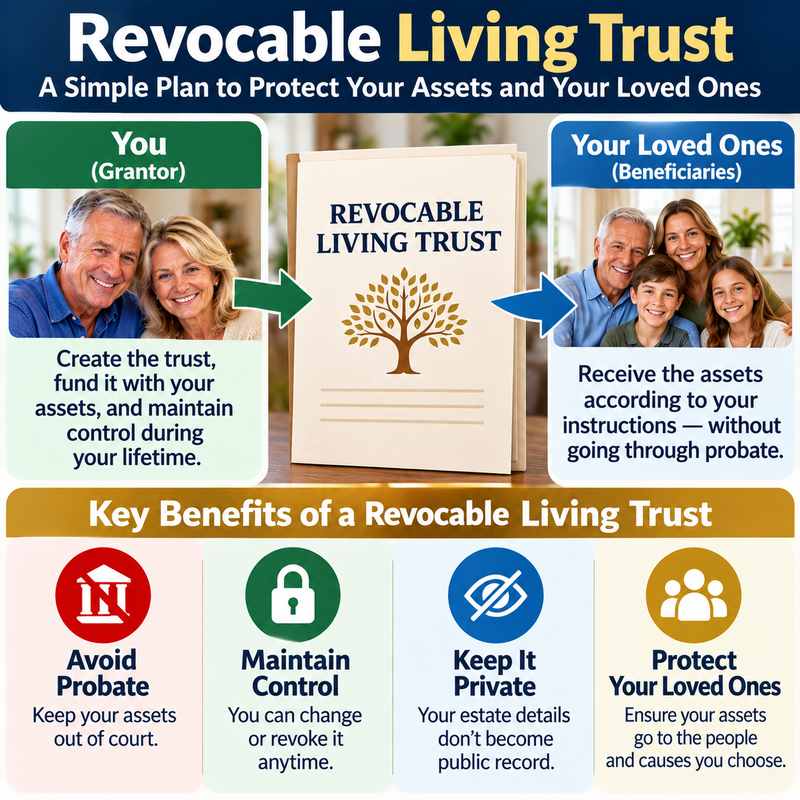
Explore how revocable living trusts work, their benefits and limitations, and how they can be used to manage assets, plan for incapacity and help simplify the transfer of property to beneficiaries.

  • What Happens to a Revocable Living Trust When the Grantor Dies?

    What Happens to a Revocable Living Trust When the Grantor Dies?

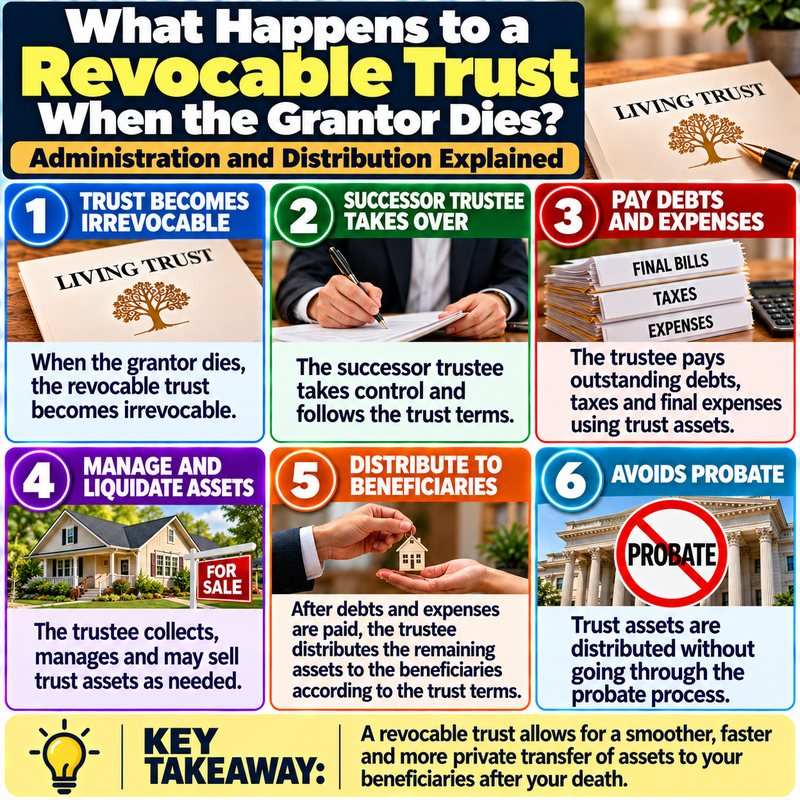
    What Happens to a Revocable Trust When the Grantor Dies? Administration and Distribution Explained

    Learn When the Trust Becomes Irrevocable, What the Successor Trustee Does, and How Assets Are Administered and Distributed

    A revocable living trust does not spring into action on its own the moment someone dies. Real people have to do real work, step by step, to carry out the grantor’s wishes.

    Setting up a revocable living trust is often celebrated as the key to avoiding probate and keeping family matters private. That part is true in many cases. But what happens after the person who created the trust passes away is a process, not an instant event, and the successor trustee carries the weight of that process on their shoulders.

    Key Takeaways

    • A revocable trust generally becomes irrevocable at the grantor’s death, which changes who controls the assets and how taxes get reported.
    • The successor trustee must identify, secure, and value every trust asset before making any distributions to beneficiaries.
    • Tax treatment shifts after death, often requiring a new EIN and possibly a Form 1041 filing, which we break down later in this guide.
    • Beneficiaries and heirs typically must receive formal written notice within a specific legal deadline, not just a phone call or family meeting.
    • Working with professionals familiar with a living trust structure can help a trustee avoid costly missteps during administration.
    What-Happens-To-A-Revocable-Trust-When-The-Grantor-Dies

    What Happens the Moment the Grantor Dies

    The instant the grantor passes away, their power to revoke, amend, or control the trust ends. Control shifts to whoever is named as successor trustee in the trust document. But having legal authority and actually exercising it are two different things. The trustee still needs death certificates, access to records, and a clear understanding of what the trust says before doing anything meaningful with the assets inside it.

    Nothing distributes itself. Bank accounts don’t automatically retitle. Real estate doesn’t transfer with a snap of the fingers. Every single step, from confirming the trustee’s authority to handing over the final asset, requires action, paperwork, and often patience.

    When Does a Revocable Trust Become Irrevocable

    A revocable trust becomes irrevocable, in whole or in part, once the grantor dies. This is one of the most important legal shifts in the entire trust lifecycle, and it affects nearly everything that follows.

    • The deceased grantor can no longer revoke, amend, or restate the trust.
    • The successor trustee gains authority to administer the trust according to its written terms.
    • Beneficiary rights that were dormant during the grantor’s lifetime often activate.
    • Tax reporting obligations can change, sometimes requiring a new taxpayer identification number.

    Exactly how and when this transition occurs can depend on the specific trust document and the state where it was created. Some trusts split into multiple sub-trusts at this point, each with its own rules. Others remain a single unified trust until final distribution. The governing document always controls the details.

    Why the Trust Can No Longer Be Changed

    Revocable trusts exist, in large part, because they let the grantor stay in control during their lifetime. They can add assets, remove assets, change beneficiaries, or cancel the whole arrangement. Death removes that flexibility permanently. Once the grantor is gone, there’s no one left with the legal standing to revoke the trust, so its terms lock into place.

    How This Shift Affects Beneficiary Rights

    Before the grantor’s death, beneficiaries named in a revocable trust typically have very limited rights, since the grantor could change their minds at any time. After death, that dynamic flips. Beneficiaries often gain the right to receive notice of the trust’s existence, request a copy of its terms, and eventually receive an accounting of how the trustee managed and distributed assets. These rights vary by state, but they generally exist to keep the trustee accountable.

    • Right to receive formal notice of the trust
    • Right to request relevant trust documents
    • Right to receive timely and accurate accountings
    • Right to pursue legal action if the trustee breaches their duties

    These protections exist precisely because beneficiaries no longer have a living grantor to answer to on their behalf. The successor trustee steps into that oversight role, and the law expects them to take it seriously.

    What Authority Does the Successor Trustee Have

    The successor trustee’s authority comes from two places: the trust document itself and the laws of the state governing the trust. Together, these sources spell out what the trustee can do, what they must do, and what they’re forbidden from doing.

    • Collecting and securing trust property
    • Paying legitimate debts and administration expenses
    • Filing necessary tax returns
    • Managing investments prudently during administration
    • Distributing assets according to the trust’s instructions

    Just because someone is named as successor trustee doesn’t mean they automatically have unlimited power. Most trust documents place conditions on major decisions, especially when it comes to selling property, investing trust funds, or making early distributions. A careful trustee reads the entire document before acting, not just the portions that seem obviously relevant.

    Where to Find the Successor Trustee’s Powers in the Trust Document

    Most trust documents include a dedicated section, often labeled “Trustee Powers” or “Administrative Provisions,” that lists exactly what the trustee is authorized to do. This might include the power to sell real estate, borrow money, hire professionals, or make discretionary distributions to beneficiaries based on need. Reading this section carefully, ideally with legal guidance, helps the trustee avoid acting outside their authority.

    Trust documents built around a comprehensive revocable living trust plan often anticipate common scenarios, like a surviving spouse needing income or a minor beneficiary requiring a continuing trust. Those anticipated scenarios shape what the trustee is allowed to do without asking a court for permission.

    How State Law Shapes Trustee Authority

    When the trust document is silent on a particular issue, state law fills the gap. Most states have adopted some version of trust administration statutes that outline default trustee powers, fiduciary duties, and notification requirements. California, for example, generally requires trustees to notify beneficiaries and heirs within 60 days after a revocable trust becomes irrevocable due to the settlor’s death. Other states have their own timelines and requirements, so a trustee should never assume the rules are identical everywhere.

    First Administrative Steps After Death

    The early days of trust administration set the tone for everything that follows. Rushing through this phase, or skipping steps entirely, tends to create problems down the road, including disputes among beneficiaries and potential personal liability for the trustee.

    Obtain Death Certificates and Review the Trust

    One of the very first things a successor trustee should do is request multiple certified copies of the death certificate. Banks, investment firms, insurance companies, and government agencies will all want their own copy before releasing information or transferring assets. Alongside this, the trustee needs to locate the complete trust document, including every amendment and restatement, since an outdated version could contain terms that no longer apply.

    It helps to also gather related estate planning documents, like a pour-over will, powers of attorney, or property schedules referenced within the trust. These documents often work together, and missing one can create confusion about what belongs in the trust versus what sits outside it.

    Identify and Secure Trust Property

    Once the trustee understands the trust’s terms, the next job is creating a full inventory of everything the trust owns. This includes bank accounts, investment accounts, real estate, vehicles, business interests, and personal property of value. Each asset needs to be checked for how it’s titled, since only property properly transferred into the trust’s name during the grantor’s lifetime typically avoids probate.

    Securing property matters just as much as identifying it. Real estate may need new locks or updated insurance. Vehicles might need to be moved or insured under the trust. Valuables, like jewelry or collectibles, should be inventoried and protected from loss or theft during the administration period.

    Obtain Tax Identification and Reporting Guidance

    Many revocable trusts use the grantor’s Social Security number for tax purposes during their lifetime. After death, the trust frequently needs its own Employer Identification Number, since the IRS treats a formerly revocable trust differently once it becomes irrevocable. Applying for this EIN early avoids delays when opening accounts or filing returns.

    According to current IRS guidance, trusts that change from grantor trust status typically need a new EIN, since the trust is treated as a separate tax entity after the triggering event. A tax professional familiar with post-death trust administration can confirm exactly which filings apply to the specific situation.

    Given how much can shift during this window, many trustees find it wise to loop in a CPA early rather than waiting until tax season arrives. Mistakes made in the first few months, like using the wrong tax ID or missing a filing deadline, can be far more expensive to fix later.

    Value Assets

    Accurate valuation matters for multiple reasons: calculating any estate tax exposure, determining basis for capital gains purposes, and ensuring fair distribution among beneficiaries. Real estate typically needs a formal appraisal. Investment accounts usually show date-of-death values on statements. Business interests and unique personal property, like art or collectibles, may require a professional appraiser.

    Skipping this step, or guessing at values, creates real risk. Beneficiaries are entitled to accurate information, and the IRS expects accurate reporting. A trustee who distributes assets based on rough guesses rather than documented values is setting themselves up for disputes.

    Free Trust Consultation Banner

    How Debts, Expenses, and Creditor Claims Get Handled

    Here’s a mistake that trips up well-meaning trustees constantly: distributing everything right away, before confirming what’s actually owed. Trust assets usually need to cover outstanding debts, funeral expenses, administration costs, and taxes before beneficiaries receive their full share.

    Creditor procedures vary significantly depending on the state and whether probate is involved in any capacity. Some states require formal creditor notice periods even for trust assets, while others handle this more informally. The trustee needs to understand which approach applies before assuming the coast is clear.

    • Funeral and burial expenses
    • Outstanding medical bills
    • Credit card balances and personal loans
    • Mortgage payments or property taxes on trust-owned real estate
    • Legal and accounting fees tied to trust administration
    • Any final income tax owed by the deceased grantor

    Why the Trustee Cannot Distribute Everything Right Away

    If a trustee distributes all trust assets and then discovers an unpaid debt or tax liability, they may be personally responsible for covering the shortfall. This is one of the clearest reasons experienced trustees wait until they’ve accounted for known obligations before writing distribution checks. Reserving a reasonable amount of cash, even after most obligations are paid, protects against surprises that surface later.

    Beneficiaries sometimes grow impatient during this waiting period, especially when they expect quick access to funds. Clear, proactive communication about why the trustee is moving carefully tends to prevent frustration from boiling over into disputes or legal challenges.

    How Creditor Procedures Can Vary

    Some states allow trustees to publish a notice to creditors, which starts a clock on how long creditors have to make claims. Other states don’t offer this option for trust-only administration, meaning the trustee may need to rely on known creditors and reasonable diligence instead. Because trust administration rules differ so much across state lines, a trustee administering a trust in an unfamiliar jurisdiction should confirm local requirements rather than assuming their home state’s rules apply.

    Taxes and Post-Death Tax Reporting

    Tax treatment is one of the areas where death changes everything. During the grantor’s lifetime, a revocable trust is typically treated as a grantor trust, meaning the grantor reports all income on their personal tax return. That simplicity disappears the moment the grantor passes away.

    After death, the trust may need to file its own tax return, pay its own taxes, or pass income through to beneficiaries depending on how it’s structured and what the trustee decides to do with distributions.

    Why Tax Treatment Changes After the Grantor’s Death

    Once the grantor dies, the trust generally stops being treated as an extension of that person for tax purposes. It becomes its own taxable entity, at least for income earned after the date of death. This shift is exactly why applying for a new EIN early in the process matters so much. Financial institutions and the IRS expect to see the trust reporting under its own identification number going forward.

    Form 1041 and Trust Income Reporting

    Form 1041, the U.S. Income Tax Return for Estates and Trusts, often becomes relevant once a revocable trust turns irrevocable. The trust may need to report income earned after death, whether that’s interest, dividends, rental income, or capital gains from asset sales. Depending on the trust’s terms, that income might get taxed inside the trust itself, or it might pass through to beneficiaries via a Schedule K-1, letting them report and pay tax on it individually.

    Whether the trust pays the tax or passes it through to beneficiaries often comes down to how much income is distributed during the tax year versus how much stays inside the trust. This is an area where professional guidance really pays off, since the choice can significantly affect the overall tax bill.

    Stepped-Up Basis and Its Effect on Capital Gains

    Here’s a silver lining many beneficiaries don’t expect: assets held in a revocable trust often receive a step-up in basis to their fair market value as of the date of death. This means if the trustee sells an asset shortly after death for close to its appraised value, there may be little or no capital gains tax owed, even if the original grantor purchased that asset decades earlier for a fraction of its current worth.

    This stepped-up basis is exactly why accurate date-of-death valuations matter so much. Without a documented value, the trustee and beneficiaries lose the ability to prove what the new basis actually was, which can create headaches if the IRS ever asks questions later.

    Who Pays the Tax: The Trust or the Beneficiaries

    Whether the trust itself pays the income tax or passes that burden to beneficiaries depends largely on how much income gets distributed during the tax year. If the trustee distributes income to beneficiaries, that income generally carries out to them via Schedule K-1, and they report it on their own returns. If the trustee retains income inside the trust instead, the trust pays tax at trust tax rates, which compress to the highest bracket far faster than individual rates. This is one more reason a knowledgeable CPA earns their fee during trust administration.

    Beneficiary Notices and Communications

    Keeping beneficiaries in the dark is one of the fastest ways a trustee invites legal trouble. Most states require some form of formal notification once a revocable trust becomes irrevocable, and skipping this step, even unintentionally, can expose the trustee to claims of breach of duty.

    Beyond the legal requirement, clear communication simply makes administration smoother. Beneficiaries who understand the timeline, the process, and the reasons behind delays tend to be far more patient than those left guessing. A trustee who sends periodic updates, even brief ones, builds trust that pays off if questions or disagreements arise later.

    What the Statutory Notice Must Include

    A proper trust notice isn’t just a casual letter announcing that someone passed away. Most states specify exactly what information must appear in this document, and missing a required element can invalidate the notice entirely.

    • The identity of the settlor and the date the trust became irrevocable
    • The name, address, and contact information of the acting trustee
    • The physical address where the trust is being administered
    • A statement explaining the recipient’s right to request a copy of the trust terms
    • A required warning about the legal deadline for contesting the trust’s validity

    This notice typically goes to every beneficiary named in the trust as well as every legal heir of the deceased settlor, even heirs who weren’t named as beneficiaries. That second group matters because heirs sometimes have standing to contest the trust, and the law wants them informed regardless of whether they inherit anything.

    In California, for example, the trustee generally must serve this notice within 60 days of the date the trust (or a portion of it) becomes irrevocable due to the settlor’s death. Missing this window doesn’t necessarily void the trust, but it can extend the period during which someone could challenge it.

    The 60-Day Notification Deadline

    Sixty days sounds like plenty of time, until a trustee is also juggling death certificates, asset inventories, and grieving family members. Building notification into the very first weeks of administration, rather than treating it as an afterthought, keeps the trustee on solid legal footing. Many trustees work with an attorney specifically to draft and send this notice correctly, since the consequences of getting it wrong can be serious.

    Why an Informal Family Announcement Isn’t Enough

    A phone call to the kids or a group text announcing “Mom’s trust is now in effect” might feel sufficient in the moment, but it doesn’t satisfy the legal requirement in states that mandate formal written notice. Courts generally want documented proof that each required recipient received specific, complete information, not just a general awareness that something changed.

    Trustees who skip formal notice sometimes find out the hard way when a beneficiary later claims they never knew about their right to contest the trust or request its terms. Sending a proper, documented notice protects the trustee just as much as it informs the beneficiary.

    Managing Real Estate and Investments During Administration

    Trust administration rarely wraps up overnight, which means someone has to manage whatever assets sit inside the trust while everything else gets sorted out. Real estate needs upkeep. Investment portfolios need attention. Bills don’t stop arriving just because the grantor passed away.

    This ongoing management responsibility is often underestimated by people stepping into the trustee role for the first time. It’s not a one-time event where assets get frozen and later released. It’s active stewardship that can stretch across many months.

    Maintaining Insurance and Property Value

    A house that sits vacant without proper insurance coverage is a liability waiting to happen. Many homeowner’s policies change or lapse when the named insured passes away, so the trustee needs to confirm coverage continues, sometimes through a vacant property policy if the home sits empty for an extended period. The same logic applies to vehicles, boats, or other insured property owned by the trust.

    Beyond insurance, physical upkeep matters too. Lawns need mowing, pipes need to be protected from freezing, and security systems need monitoring. Letting a property fall into disrepair while administration drags on can reduce its sale value and create friction with beneficiaries who expected a well-maintained asset.

    Continuing or Selling a Business Interest

    If the trust owns part or all of a business, the trustee faces a more complex decision. Some trusts include specific instructions about continuing operations, selling the interest, or transferring it to a particular beneficiary. Others leave this decision largely in the trustee’s hands, guided by general fiduciary principles.

    Running a business is a very different skill set than managing a bank account, and trustees without relevant experience often bring in outside management or a business valuation expert before making any major moves. Selling too quickly can undervalue the asset, while holding on too long without proper expertise can erode its worth just as easily.

    Outright Distributions vs. Continuing Trusts

    Not every trust ends with a simple check written to each beneficiary. Some trusts are designed to distribute everything relatively quickly once debts and taxes are settled. Others are built to continue for years, sometimes decades, managing assets on behalf of beneficiaries who aren’t ready, able, or legally permitted to receive a lump sum.

    Reading the distribution instructions carefully, rather than assuming every trust works the same way, is essential. A trustee who distributes assets outright when the document calls for a continuing trust has made a serious error, one that can be difficult or impossible to undo.

    When Beneficiaries Receive Assets Immediately

    Simpler trusts, especially those created by a single person leaving everything to adult children in equal shares, often call for outright distribution once administration wraps up. In these cases, once debts are paid, taxes are addressed, and the trustee has documented everything properly, remaining assets get transferred directly to beneficiaries and the trust terminates.

    When a Trust Continues for a Spouse, Child, or Special-Needs Beneficiary

    Many trusts, though, are built with more nuance. A surviving spouse might receive income for life while the principal eventually passes to children. A minor child’s inheritance might stay in trust until they reach a certain age, like 25 or 30. A special-needs beneficiary might need assets held in a specially designed trust that doesn’t disqualify them from government benefits.

    These continuing trusts require the trustee to keep managing assets, making distributions according to specific standards, like health, education, maintenance, or support, and filing ongoing tax returns for potentially many years after the original grantor’s death. This is a long-term commitment, not a quick wrap-up project.

    What Happens to Assets Outside the Trust

    Here’s something that surprises a lot of people: not everything the deceased owned necessarily belongs to the trust, even if they intended it to. Assets titled individually, without ever being retitled into the trust’s name, generally don’t fall under the trustee’s authority at all.

    Jointly Held Property and Beneficiary-Designated Accounts

    Property owned jointly with rights of survivorship typically passes directly to the surviving co-owner, completely outside the trust. Retirement accounts, life insurance policies, and payable-on-death bank accounts usually transfer according to their named beneficiary designations, regardless of what the trust document says. This is exactly why keeping beneficiary designations updated matters just as much as funding the trust properly.

    Why the Trustee Must Verify Ownership First

    Before a trustee lists something as a trust asset, they need actual proof of ownership, not just an assumption based on where the item sits physically. A bank account titled only in the deceased’s individual name, for example, isn’t a trust asset even if the deceased always intended to transfer it. Verifying titling on every account and piece of property prevents the trustee from mistakenly managing, or distributing, assets they have no legal authority over.

    How a Pour-Over Will Interacts With Probate

    Most comprehensive trust plans include a companion document called a pour-over will. This will acts as a safety net, directing any assets left outside the trust at death to “pour over” into the trust for distribution according to its terms.

    ScenarioWhat Happens
    Asset properly titled in trust namePasses under trust terms, no probate needed
    Asset left in individual name, pour-over will existsMay still require probate before transferring to trust
    Asset left in individual name, no will or trust referencePasses under state intestacy law through probate

    A pour-over will doesn’t eliminate probate for assets left outside the trust; it simply ensures those assets eventually end up in the right place once probate concludes. This distinction trips up a lot of people who assume having a trust automatically means no probate at all, regardless of how assets were titled.

    The real lesson here is that funding the trust properly during the grantor’s lifetime, meaning actually retitling accounts and property into the trust’s name, matters just as much as writing the trust document itself. A pour-over will is a backstop, not a substitute for proper funding.

    Why Pour-Over Property May Still Require Probate

    Probate exists specifically to transfer individually titled property, and a pour-over will doesn’t bypass that requirement. It only directs where the property goes once probate releases it. This means assets caught by a pour-over will often take longer to reach the trust, and may incur probate costs that properly funded trust assets would have avoided entirely.

    How Long Trust Administration Typically Takes

    There’s no single answer that fits every situation. Simple trusts with a single beneficiary and straightforward assets might wrap up in a matter of months. Complex trusts involving real estate sales, business interests, continuing sub-trusts, or multiple beneficiaries with competing interests can take a year or considerably longer.

    Factors That Can Extend the Timeline

    • Real estate that needs to be sold rather than simply transferred
    • Disputes or disagreements among beneficiaries
    • Complex tax situations requiring extended filing periods
    • Business interests that require ongoing management or valuation
    • Continuing sub-trusts designed to last for years
    • Delays in locating or identifying all trust assets

    When to Bring in an Attorney, CPA, or Financial Professional

    Trustees aren’t expected to know everything, and trying to handle complex administration entirely alone is often where mistakes creep in. An estate planning attorney can confirm the trustee is interpreting the trust correctly and meeting state-specific notice requirements.

    A CPA familiar with fiduciary income tax can navigate the Form 1041 decisions and stepped-up basis calculations that trip up even experienced trustees. A financial advisor can help manage investment assets prudently during the administration period, especially when a continuing trust is involved.

    Bringing in professionals isn’t a sign of failure on the trustee’s part. It’s simply a recognition that trust administration touches legal, tax, and financial disciplines that most people haven’t trained in. The cost of professional guidance is almost always smaller than the cost of a mistake made trying to save money by going it alone.

    Successor-Trustee Checklist

    1. Obtain multiple certified copies of the death certificate
    2. Locate and review the complete trust document and all amendments
    3. Confirm your authority to act as successor trustee
    4. Apply for a new EIN for the trust if required
    5. Send formal written notice to all beneficiaries and legal heirs within the applicable deadline
    6. Inventory every trust asset and confirm how each one is titled
    7. Secure real estate, vehicles, and valuables, and update insurance as needed
    8. Obtain professional valuations for real estate, business interests, and unique property
    9. Identify and address outstanding debts, taxes, and administration expenses
    10. Open a dedicated trust bank account separate from personal funds
    11. Keep detailed records of every transaction, receipt, and payment
    12. Consult an attorney, CPA, or financial advisor as needed throughout the process
    13. Distribute remaining assets according to the trust’s exact terms, whether outright or into continuing sub-trusts
    14. Provide a final accounting to beneficiaries if required

    The Bottom Line on Trust Administration After Death

    A revocable living trust doesn’t hand out assets the moment the grantor dies, and treating it as if it does is one of the most common, and costly, mistakes a successor trustee can make. Real administration takes time, careful record-keeping, and a clear understanding of what the trust document and state law actually require.

    Navigating trust administration after a loved one’s death doesn’t have to feel overwhelming when you understand each step clearly, and working with experienced guidance through resources like createalivingtrust.com can help trustees carry out their responsibilities with confidence.

    Successor-Trustee Checklist

    StepWhy It Matters
    Review the trust and confirm authorityPrevents acting outside the trustee’s legal power
    Notify beneficiaries and heirsSatisfies statutory deadlines and starts the contest clock
    Inventory and secure assetsProtects property from loss, damage, or mismanagement
    Address debts and taxesAvoids personal liability for unpaid obligations

    Every successor trustee benefits from having a clear roadmap before diving into the details of administration. Without one, it’s easy to miss a deadline, skip a required notice, or distribute assets before confirming what’s actually owed. The checklist below breaks the process into manageable steps, each building on the one before it.

    None of these steps happen in isolation. Reviewing the trust informs how assets get inventoried. Notifying beneficiaries often happens alongside securing property. Treating this as a sequence rather than a random collection of tasks keeps administration organized and defensible if anyone ever questions how the trustee handled things.

    Trustees administering a trust built around a solid revocable living trust foundation often find this process smoother, simply because the original document anticipated common scenarios and spelled out clear instructions. Trusts drafted loosely or inconsistently tend to create far more guesswork for the person stepping into the trustee role.

    1. Locate and Review the Trust Document

    Before taking any action, find the complete, signed trust document along with every amendment or restatement ever made to it. An outdated copy can lead a trustee to follow instructions the grantor later changed, which creates real problems if discovered after distributions have already occurred.

    Reading the entire document, not just skimming the distribution section, reveals powers, limitations, and conditions that shape every decision ahead. Trustees who skip this step often find themselves backtracking later once they realize a provision applies that they overlooked the first time through.

    2. Obtain Certified Death Certificates

    Order more certified copies of the death certificate than seem necessary at first glance. Banks, title companies, insurance providers, and government agencies each typically want their own original, and running out partway through administration just creates delays.

    Most county vital records offices or funeral homes can provide these certified copies for a small fee per copy. Having ten or more on hand at the start saves the trustee from repeated trips back to request additional copies as new institutions ask for one.

    3. Notify Beneficiaries and Heirs

    Formal notification isn’t optional in most states once a revocable trust becomes irrevocable due to the grantor’s death. This step protects both the beneficiaries’ right to information and the trustee’s own legal standing, since proper notice starts the clock on how long someone has to contest the trust.

    Every beneficiary named in the trust needs this notice, along with every legal heir of the deceased grantor, even heirs who aren’t named as beneficiaries at all. That second group matters because heirs generally retain standing to challenge the trust’s validity, and the law wants them formally informed regardless of what they stand to inherit.

    Missing this requirement doesn’t automatically void the trust, but it can extend how long the trust remains vulnerable to a challenge. Sending the notice correctly and on time closes that window and gives the trustee documented proof that everyone entitled to information actually received it.

    Many states, including California, generally require this notice to go out within 60 days of the date the trust becomes irrevocable. The notice must typically identify the trustee, explain the recipient’s right to request trust documents, and include a specific warning about the deadline for contesting the trust.

    4. Inventory and Secure Trust Assets

    Create a complete, written inventory of every asset the trust owns, confirming how each one is titled before listing it as trust property. Once identified, secure real estate with proper insurance, protect valuables from loss, and update account access so trust funds don’t sit exposed to unnecessary risk during the administration period.

    5. Open a Trust Bank Account and Apply for an EIN

    Setting up a dedicated trust bank account, separate from the trustee’s personal finances, keeps records clean and prevents any appearance of commingling funds. Pairing this account with a newly issued EIN, obtained once the trust becomes irrevocable, ensures income and expenses get reported under the correct tax identity from day one.

    6. Address Debts, Taxes, and Expenses Before Distributing

    Confirm every outstanding debt, pending tax liability, and administration expense before writing a single distribution check. Reserving sufficient funds to cover these obligations protects the trustee from personal liability if a bill or tax notice surfaces after assets have already gone out the door.

    The Bottom Line on Trust Administration After Death

    A revocable living trust doesn’t hand beneficiaries their inheritance the moment the grantor passes away, and assuming otherwise sets everyone up for frustration. Real administration involves locating documents, securing property, notifying the right people, settling debts and taxes, and only then distributing what remains according to the trust’s actual terms, a process that rewards patience and careful record-keeping far more than speed.

    Frequently Asked Questions

    Administering a trust after someone’s death raises plenty of specific questions, many of which don’t have one-size-fits-all answers. State law, the trust’s own language, and the complexity of the assets involved all shape the right response in any given situation.

    Below are answers to some of the most common questions successor trustees and beneficiaries ask during this process.

    • How probate interacts with trust assets
    • Whether trustees face personal liability for mistakes
    • How notice requirements differ from state to state
    • What happens when no successor trustee is available

    These questions tend to surface early in administration, often within the first few weeks after the grantor’s death. Having clear answers upfront helps trustees avoid common missteps and gives beneficiaries realistic expectations about timing and process.

    For situations that don’t fit neatly into a general answer, consulting an estate planning attorney familiar with the specific state’s trust laws remains the safest path forward.

    Does a revocable trust avoid probate entirely after death?

    Only assets that were properly retitled into the trust’s name during the grantor’s lifetime typically avoid probate. Anything left in the grantor’s individual name, even with a pour-over will pointing it toward the trust, may still need to pass through probate before reaching its intended destination.

    This is why funding the trust correctly while the grantor is alive matters just as much as drafting the trust document itself. A trust that exists on paper but holds no properly titled assets offers little practical benefit when it comes to avoiding probate.

    Can a successor trustee be held personally liable for mistakes?

    Yes, a trustee who breaches their fiduciary duties, mismanages trust property, or distributes assets improperly can face personal liability to beneficiaries or creditors. This is exactly why careful record-keeping, timely notices, and professional guidance matter so much throughout administration.

    Does every state require the same beneficiary notice rules?

    No, notification requirements vary considerably from state to state, including who must receive notice, what the notice must say, and how quickly it needs to go out. Some states impose a strict 60-day deadline, while others use different timeframes or less formal requirements altogether.

    Because of this variation, a trustee administering a trust should confirm the specific rules in the state governing the trust rather than assuming requirements are uniform nationwide. What satisfies one state’s notice statute might fall short in another.

    Trustees handling cross-state situations, such as a grantor who lived in one state but owned property in another, face an added layer of complexity here. Consulting an attorney licensed in the relevant state helps avoid a technical notice failure.

    • Deadline for sending notice after the trust becomes irrevocable
    • Required content within the notice itself
    • Who qualifies as an heir entitled to notice, even if not a named beneficiary

    What happens if there is no named successor trustee?

    Most well-drafted trusts name at least one backup or alternate trustee in case the first choice can’t or won’t serve. If no one named in the document is available, a court may need to step in and appoint a trustee, which can add time and expense to the administration process.

    Can beneficiaries contest a trust after the grantor’s death?

    Yes, beneficiaries and certain heirs generally retain a limited window to contest a trust’s validity after receiving proper notice. This window is exactly why the required warning about contest deadlines must appear in the formal notice sent out by the trustee.

    Common grounds for a contest include claims of undue influence, lack of mental capacity at the time the trust was signed, or improper execution. Once the contest period expires without a challenge, the trust’s terms generally become much harder to dispute.

    Is a new EIN always required for the trust after death?

    In most cases where a revocable trust becomes irrevocable due to the grantor’s death, a new EIN is required, since the IRS no longer treats the trust as an extension of the grantor’s personal tax identity. A tax professional can confirm whether any exceptions apply to a specific trust’s structure.

    How are trust debts different from the grantor’s personal debts?

    Trust debts are obligations tied specifically to property or liabilities held within the trust, paid using trust assets. The grantor’s personal debts, on the other hand, may need to be addressed through a separate probate process if they aren’t tied to trust property.

    Sorting out which debts belong to which category is one of the trustee’s early tasks, since paying the wrong account from the wrong source can create accounting headaches and potential disputes among beneficiaries later.

    What happens to a jointly owned home when the grantor dies?

    If the home was titled jointly with rights of survivorship, it typically passes directly to the surviving co-owner outside the trust entirely, regardless of what the trust document says about real estate. The trustee generally has no authority over this property since it never belonged to the trust in the first place.

    Confirming exactly how a property was titled, rather than assuming it falls under trust control, prevents the trustee from mistakenly including it in the trust inventory or attempting to manage an asset they have no legal claim over. For more details on the trustee’s responsibilities, you can review the trust administration basics.

    Can a trustee sell property before distributing it to beneficiaries?

    Generally yes, if the trust grants this authority, and selling is often necessary to cover expenses, pay debts, or divide value equally among multiple beneficiaries who can’t simply split a single piece of real estate.

    Do all beneficiaries get access to the full trust document?

    Most states give beneficiaries the right to request a copy of the trust terms relevant to their own interest, though the scope of what they’re entitled to see can vary depending on state law and the trust’s own provisions.

    Some trusts contain confidential provisions affecting other beneficiaries that a given individual may not have automatic access to, particularly in trusts with unequal distributions or special conditions attached to specific shares.

    When beneficiaries and trustees disagree about what information must be shared, consulting an attorney familiar with the governing state’s trust transparency laws usually resolves the question faster than letting tension build on its own.

    If you’re stepping into the role of successor trustee or simply want to understand how your own living trust will be handled someday, the team at createalivingtrust.com can help you plan ahead with confidence.
  • Revocable Living Trust vs. Will: What’s the Difference?

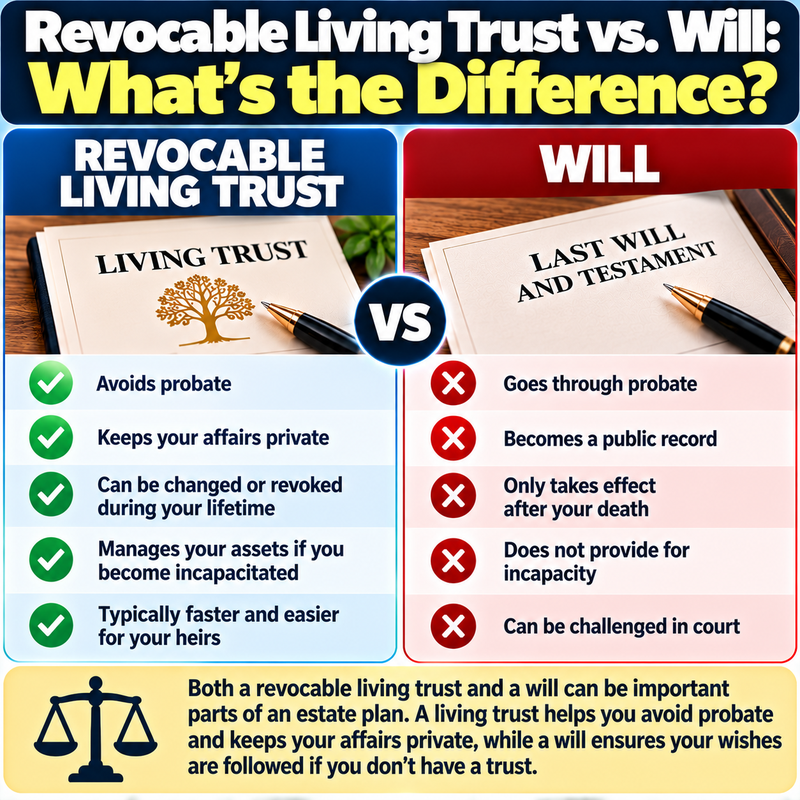
    Revocable Living Trust vs. Will: What’s the Difference?

    Revocable Living Trust vs Will: Probate, Incapacity, Privacy, and Cost Compared

    Compare Probate, Incapacity Planning, Privacy, Asset Management, Costs, and How the Two Documents Can Work Together

    Article-at-a-Glance

    • A revocable living trust and a will serve different jobs — one manages property while you’re alive and after you pass, the other mainly directs what happens to your property after death.
    • Neither document is inherently “better” — many complete estate plans use both a trust and a will working together rather than picking just one.
    • A properly funded trust can let your family skip probate entirely for the assets inside it, while a will almost always requires a probate court process.
    • Only a will can nominate a guardian for minor children, which is one reason families with young kids often need both documents regardless of trust ownership.
    • Later in this guide, you’ll see exactly how a pour-over will fits into a trust-based plan and why it’s not a backup plan — it’s often a required companion document.
    Revocable-Living-Trust-Vs-Will

    Which one actually protects your family better: a revocable living trust or a will? The honest answer is that it depends on what you’re protecting against, because these two documents solve different problems rather than competing for the same job.

    If you’re building a complete plan, resources like CreateALivingTrust.com’s guide to revocable living trusts can help you understand how trust-based planning fills gaps that a will simply wasn’t designed to cover. That said, understanding both documents side by side is the fastest way to figure out what your family actually needs.

    Quick Comparison: Trust vs. Will Side by Side

    Before diving into the details, it helps to see the core differences laid out plainly. The table below compares the two documents across the categories that matter most to families making this decision.

    FeatureRevocable Living TrustWill
    Takes effectImmediately upon signing and fundingOnly after death
    Probate required?Generally no, for funded assetsYes, for probate property
    Covers incapacity?Yes, through successor trusteeNo
    Public or private?Generally privateBecomes public during probate
    Can name a guardian?NoYes
    Upfront costHigherLower
    Requires funding?YesNo

    When Each Document Takes Effect

    Why a Will Only Works After You Die

    A will sits dormant the entire time you’re alive. It has no legal power until a probate court formally validates it after your death, which means it can’t help manage your affairs if you become seriously ill or incapacitated. Its main function is to direct how probate property gets distributed and to name an executor who carries out those instructions.

    This delayed activation is often the biggest surprise for people who assume a will handles “everything.” It doesn’t manage your bank accounts while you’re in a coma, and it doesn’t authorize anyone to sell your house if you’re unable to sign documents yourself.

    Why a Trust Works the Moment You Sign It

    A revocable living trust is different because it’s active the day you create it. You typically serve as your own trustee, meaning you keep full control over everything you place inside the trust. The structure of a living trust allows a built-in successor trustee to step into your role automatically, whether that’s because you’ve become incapacitated or because you’ve passed away.

    Probate Differences: What Really Avoids Court

    Why a Will Does Not Skip Probate

    Here’s a common misconception worth clearing up: a will does not avoid probate. It simply gives the probate court instructions on how to distribute your property once the process is complete. Everything you own that’s titled in your name alone and passes through your will generally has to go through this court-supervised process.

    How a Funded Trust Bypasses the Probate Process

    Assets that are properly titled in the name of your trust generally bypass probate entirely. Because the trust technically owns these assets rather than you personally, there’s no need for a court to transfer ownership after death — your successor trustee simply steps in and distributes according to the trust’s terms.

    The key phrase here is “properly titled.” A trust document alone doesn’t avoid probate — only assets actually retitled into the trust’s name get that benefit.

    Time and Cost Impact of Probate

    Probate can add months, sometimes over a year, onto the process of settling an estate, along with court fees and potential attorney costs. Families dealing with a will-only estate often feel this delay most acutely when they need quick access to funds for expenses like funeral costs or ongoing bills.

    Free Trust Consultation Banner

    Incapacity Planning: Who Manages Things If You Can’t

    Why a Will Offers Zero Protection During Your Lifetime

    A will provides no help whatsoever if you become incapacitated while you’re still alive. It wasn’t designed for that purpose, and courts won’t honor its instructions until after death. This gap catches a lot of families off guard, especially when a medical event happens unexpectedly.

    Without additional planning, a family facing a loved one’s incapacity may need to go through a court-supervised guardianship or conservatorship process just to manage that person’s finances. This can be:

    • Time-consuming, often taking weeks to get court approval
    • Expensive, with legal and court filing fees adding up quickly
    • Public, since guardianship proceedings typically become part of the court record
    • Stressful, adding legal hurdles on top of an already difficult family situation

    How a Successor Trustee Steps In Without Court Involvement

    A revocable living trust solves this problem directly. This is one of the many benefits of a revocable living trust. If you become unable to manage your affairs, your named successor trustee can step in immediately to manage trust assets — paying bills, handling property, and making financial decisions — without needing court approval or supervision.

    Why You Still Need a Power of Attorney

    Even with a trust in place, a financial power of attorney still matters. It covers assets and legal matters that fall outside your trustee’s authority, such as signing tax returns or handling matters related to property that was never transferred into the trust.

    Privacy: Public Record vs. Private Document

    Privacy is one of the most underrated differences between these two planning tools, and it often matters more to families than they initially expect.

    How Probate Makes Your Will Public

    Once a will enters probate, it becomes part of the public court record. That means anyone — a nosy neighbor, a distant relative, or even a stranger — can request and view the document, including details about who inherits what.

    Why Trust Details Usually Stay Private

    Trust administration generally happens outside of court, which keeps the terms private. Your beneficiaries, asset values, and distribution instructions typically stay out of the public record. That said, it’s worth being accurate here: a trust isn’t an absolute privacy guarantee in every circumstance, but it does avoid the automatic public exposure that comes with probate.

    Asset Ownership and Trust Funding

    This is where a lot of the real-world difference between these two documents comes down to action, not just paperwork.

    DocumentAsset Requirement
    WillNo retitling needed; assets stay in your name until death
    Living TrustAssets must be retitled into the trust’s name to gain its benefits

    A will doesn’t require you to do anything with your property while you’re alive. Your house, car, and bank accounts can all stay titled exactly as they are, and the will simply becomes the instruction manual once probate opens.

    A trust works completely differently. It only controls the assets that are actually transferred — or “funded” — into its name. This step is non-negotiable if you want the probate-avoidance and incapacity-management benefits a trust is known for.

    What “Funding a Trust” Actually Means

    Funding a trust means retitling ownership of your assets from your individual name into the name of the trust. For a house, that typically means recording a new deed. For a bank account, it might mean changing the account title with your financial institution. Reviewing the full costs involved in setting up and funding a living trust can help you budget for this step, since funding work is part of what separates a trust that actually avoids probate from one that technically exists but doesn’t function as intended.

    Common Mistakes That Leave Assets Unprotected

    The single biggest trust mistake isn’t in the drafting — it’s in the follow-through. Families sometimes sign a beautiful trust document and then never get around to retitling their house, car, or investment accounts. When that happens, those unfunded assets still have to go through probate, defeating one of the trust’s biggest advantages.

    Assets That Typically Don’t Need Retitling for a Will

    A will skips this funding requirement entirely, which is part of its appeal for families who want simplicity. Life insurance policies, retirement accounts, and jointly owned property with rights of survivorship generally pass outside the will through beneficiary designations or automatic survivorship rules, regardless of whether a trust exists.

    This means a will can work as a catch-all for anything you own individually, without requiring the ongoing maintenance a trust demands. For some families, that lower-maintenance approach is exactly what fits their situation, especially when the estate is straightforward and the assets are modest in value.

    Free Consultation Banner 2

    Beneficiary and Distribution Planning

    How you want your assets handed over matters just as much as who receives them, and this is one area where the two documents genuinely diverge in capability.

    Setting Conditions on Inheritance Through a Trust

    • Distributing funds gradually at ages 25, 30, and 35 instead of all at once
    • Withholding a large inheritance until a beneficiary finishes college
    • Protecting assets for a beneficiary with special needs without disqualifying them from government benefits
    • Setting spending restrictions or requiring funds be used for specific purposes, like education or a first home

    A revocable living trust allows you to build in these kinds of staged or conditional distributions because the trust can continue operating after your death, with your successor trustee managing the terms you’ve laid out.

    This flexibility is especially valuable for parents worried about handing a large sum of money to a young adult all at once. It’s also useful for blended families who want to balance support for a current spouse with inheritance protection for children from a previous relationship.

    None of this structure is available through a will. A will can specify who gets what, but it generally can’t dictate ongoing conditions once the inheritance is distributed.

    For families with complex dynamics or beneficiaries who need extra protection, this single difference often tips the scale toward trust-based planning.

    Simple Outright Gifts Through a Will

    A will works best for straightforward, one-time gifts. If your plan is simply “my house and savings go to my spouse, and if something happens to both of us, everything is split evenly among our kids,” a will can usually accomplish that without needing the added structure a trust provides.

    Guardian Nominations for Minor Children

    This is one of the most important reasons nearly every parent with minor children needs a will, regardless of whether they also have a trust.

    Why Only a Will Can Nominate a Guardian

    A revocable living trust has no mechanism for naming a guardian for your children. Guardian nominations are a function reserved specifically for wills, which makes a will a non-negotiable document for parents even if they’ve built out a full trust-based estate plan.

    Court Approval and State Law Requirements

    Naming a guardian in your will tells the court who you’d want raising your children, but the court still makes the final legal appointment. Judges generally give significant weight to parental wishes stated in a will, but state law and the child’s best interests ultimately guide the final decision.

    Costs and Implementation

    Cost is often the first question families ask, and it’s a fair one — but the full picture requires looking beyond just the upfront price tag.

    Upfront Price of a Simple Will

    A basic will is generally the less expensive option to draft initially. It’s a shorter, simpler document that doesn’t require the additional funding work a trust needs.

    • Lower attorney fees for drafting
    • No deed transfers or account retitling required
    • Faster to execute, often in a single signing appointment

    That lower upfront cost can shift significantly once probate enters the picture, since court fees, executor compensation, and attorney involvement during probate can add up over the following months.

    Why Trusts Cost More to Set Up

    A revocable living trust typically costs more upfront because of its added complexity. This leads some people to wonder if a revocable living trust is worth the cost. And depending on their situation it may or may not make sense to have one. Drafting the trust is only part of the expense; funding it — preparing new deeds, retitling accounts, and coordinating with banks or financial institutions — adds both time and cost to the process.

    Long-Term Savings From Avoiding Probate

    Despite the higher starting cost, many families find that trust-based planning saves money in the long run. Avoiding probate means skipping court fees, reducing the need for probate attorneys, and sidestepping the months-long delays that can rack up administrative costs.

    Amendments and Updates

    Life changes — marriages, divorces, new grandchildren, moves to a new state — and your estate plan needs to be able to keep up. Both documents allow updates, but the process looks different for each.

    How to Revise a Will

    You can revise a will at any point during your lifetime, as long as you’re mentally competent to do so. Updates are typically made through a formal amendment called a codicil or by drafting an entirely new will that revokes the old one.

    Most estate planning professionals recommend reviewing your will every few years or after any major life event, such as:

    • Marriage or divorce
    • The birth or adoption of a child
    • A significant change in assets or net worth
    • Moving to a different state
    • The death of a named executor or guardian

    Skipping these reviews is one of the most common ways a will ends up outdated and misaligned with a family’s current situation.

    How to Amend or Revoke a Living Trust

    Because it’s revocable, you retain full authority to amend, restate, or completely revoke your trust at any point while you’re alive and mentally competent. This might mean adding a new beneficiary, removing an asset, or changing successor trustee instructions.

    Amendments to a trust are typically handled through a formal document called a trust amendment, while more significant changes might call for a full restatement of the trust terms. Either way, the process keeps the trust flexible to match your life as it evolves.

    Why a Trust-Based Plan Commonly Still Includes a Pour-Over Will

    Here’s something that surprises a lot of people: even a well-funded trust usually still needs a will. This is called a pour-over will, and it plays a specific backup role rather than duplicating the trust’s function.

    A pour-over will is designed to work alongside your trust, not replace it. It directs any assets that were never formally transferred into your trust to “pour over” into the trust after your death, ensuring they’re ultimately distributed according to the same instructions as everything else.

    Catching Assets You Forgot to Transfer

    Even the most organized person can forget to retitle an asset, open a new account without adding the trust as owner, or inherit property shortly before passing away. A pour-over will acts as a safety net for these overlooked items, directing them into the trust rather than letting them pass according to generic state intestacy laws.

    Why Pour-Over Assets May Still Face Probate

    It’s important to understand what a pour-over will does not do: it doesn’t avoid probate for those forgotten assets. Property that passes through a pour-over will generally still needs to go through probate first, before it’s transferred into the trust. The benefit is that it ensures those assets end up distributed under your trust’s terms — not that it eliminates the court process for them.

    Free Consultation Banner 3

    What Happens to Assets Outside the Trust

    Unfunded assets don’t disappear from your estate plan, but they do lose the trust’s probate-avoidance advantage. If you own a asset that was never retitled, that property typically needs to pass through probate before it can be distributed, whether that happens through a pour-over will or, in the absence of any will at all, through state intestacy laws.

    This is why trust funding isn’t a one-time task to check off and forget. It requires periodic review, especially after buying new property, opening new financial accounts, or receiving a sizable inheritance or gift.

    A reasonable system for staying on top of funding includes:

    • Reviewing account titling annually alongside other financial check-ins
    • Confirming new real estate purchases are deeded directly into the trust
    • Updating beneficiary designations on retirement accounts and life insurance to align with the overall plan
    • Keeping a simple asset inventory that notes which accounts and properties are titled in the trust’s name

    When a Will-Centered Plan May Be Sufficient

    Not every family needs the full complexity of a funded trust, and it’s worth being honest about that. A will-centered plan can be entirely reasonable for someone with a smaller estate, minimal real estate holdings, and straightforward distribution wishes — especially if probate costs and timelines in their state aren’t a major concern.

    Families with young children who primarily need a guardian nomination, a simple distribution plan, and basic peace of mind often find that a well-drafted will covers their needs without the added cost and maintenance of trust funding. The right choice always comes down to your specific assets, family situation, and how much complexity you’re willing to manage.

    When a Revocable Living Trust May Provide Additional Value

    On the other end of the spectrum, certain situations make a funded trust worth the extra upfront effort. These scenarios tend to share one thing in common: added complexity that a simple will wasn’t built to handle.

    Owning Property in Multiple States

    If you own real estate in more than one state, a trust can prevent a headache most families don’t see coming. Without a trust, your estate could end up facing probate in every state where you own property — a process called ancillary probate.

    • A vacation home in another state generally triggers its own separate probate proceeding
    • Each state’s probate court has its own rules, timelines, and fees
    • Multiple probate cases mean multiple attorneys and multiple sets of court costs

    Placing out-of-state property into a revocable living trust sidesteps this entirely, since the trust — not the probate court — holds legal title to the property regardless of which state it’s located in.

    For families with a second home, inherited land, or rental property across state lines, this single benefit alone often justifies the cost of setting up a trust.

    Planning Ahead for Possible Incapacity

    If you’re concerned about cognitive decline, a serious illness, or an unexpected accident, a trust offers a layer of protection a will simply can’t provide. The built-in successor trustee mechanism means someone you’ve chosen can step in immediately, without a court-supervised guardianship process slowing things down during an already stressful time.

    Wanting Privacy or Managing Complex Family Dynamics

    Blended families, estranged relatives, or simply a personal preference for keeping financial matters private are all common reasons families lean toward trust-based planning. A trust keeps distribution details out of the public record and allows for more nuanced control over how and when beneficiaries receive their inheritance.

    None of this means a trust is the “correct” answer for every family — it means these specific circumstances tend to benefit the most from the added structure a trust provides. The right call always comes back to your own assets, family makeup, and planning goals.

    Decision Checklist: 7 Questions to Ask Before Choosing

    Rather than guessing which document fits your situation, running through a short checklist can clarify things quickly. Ask yourself the following questions as you weigh a will-only plan against a trust-based approach.

    Be honest with your answers here — there’s no right or wrong response, only what’s true for your family’s circumstances right now.

    Once you’ve worked through these, patterns usually emerge pointing you toward one approach or a combination of both.

    1. Do I own real estate in more than one state?
    2. Am I concerned about who would manage my finances if I became incapacitated?
    3. Do I have minor children who need a named guardian?
    4. Is privacy around my financial affairs important to me?
    5. Do I want to set conditions on when and how beneficiaries receive their inheritance?
    6. Is my estate relatively simple, with modest assets and straightforward wishes?
    7. Am I comfortable with the ongoing task of funding and maintaining a trust?

    Frequently Asked Questions

    Here are quick, direct answers to the questions families ask most often when comparing these two documents.

    Can I Have Both a Will and a Revocable Living Trust?

    Yes, and in most trust-based estate plans, you actually should. A pour-over will typically accompanies a revocable living trust to catch any assets that weren’t transferred into the trust before death, while the trust handles the bulk of your asset management and distribution. There are various differences between revocable living trusts and wills and they each have their place in estate planning.

    Does a Revocable Living Trust Protect Assets From Creditors?

    Generally, no. Because you retain control over a revocable living trust and can change or revoke it at any time, the law typically treats those assets as still belonging to you for creditor purposes.

    Irrevocable trusts offer different creditor protections, but that’s a separate planning tool with its own tradeoffs, since you give up the ability to amend or revoke it once it’s created.

    What Happens If I Don’t Fund My Trust Properly?

    An unfunded trust doesn’t do much good. Assets left outside the trust typically still have to go through probate, regardless of how well-drafted the trust document itself is.

    • Real estate not retitled into the trust may require a separate probate proceeding
    • Bank accounts still in your individual name bypass the trust entirely
    • Investment accounts without the trust listed as owner don’t receive the trust’s benefits

    This is precisely why a pour-over will exists — it’s a safety net for assets you forgot to transfer, not a replacement for proper funding.

    If you’re unsure whether your trust is fully funded, reviewing your account titles and deeds periodically is the most reliable way to catch gaps before they become a problem for your family.

    Funding isn’t a one-time task you complete and forget — it’s an ongoing habit tied to every major financial decision you make going forward. To learn more about estate planning, you might consider exploring the differences between a revocable living trust and a will.

    Can I Be My Own Trustee?

    Yes. Most people who create a revocable living trust name themselves as the initial trustee, which means you keep full control over the assets inside it during your lifetime.

    Do I Still Need a Will If I Have a Trust?

    Almost certainly, yes. A will handles things a trust can’t, like nominating a guardian for minor children, and a pour-over will specifically directs any forgotten assets into your trust after death.

    How Long Does Probate Typically Take Without a Trust?

    Timelines vary significantly by state and estate complexity, but probate commonly takes several months to over a year to fully resolve, particularly if there are disputes among heirs or complicated assets involved.

    Can a Revocable Living Trust Be Changed After It’s Created?

    Yes, that flexibility is built right into its name. You can amend, restate, or completely revoke a revocable living trust at any point while you’re alive and mentally competent to do so.

    This makes it a living document that can grow and change alongside your family, rather than something locked in place the day you sign it.

    Who Should I Choose as Successor Trustee?

    Choose someone you trust to handle financial matters responsibly, whether that’s an adult child, a sibling, a close friend, or a professional fiduciary. The best successor trustee is organized, trustworthy, and willing to take on the administrative responsibility if you become incapacitated or pass away.

    Is a Revocable Living Trust Only for Wealthy People?

    No, that’s a common misconception. Families with modest estates often benefit from trusts too, particularly if they own property in multiple states, want to avoid probate costs, or have concerns about incapacity planning.

    What Happens to a Revocable Living Trust After I Die?

    Upon your death, the trust generally becomes irrevocable, and your named successor trustee steps in to manage and distribute the trust assets according to the terms you laid out — without needing probate court involvement for those funded assets.

    This transition is typically far faster and more private than the probate process a will-only estate would need to go through.

    The Bottom Line on Choosing Between a Trust and a Will

    So, which one wins — a revocable living trust or a will? Neither, really, because the smartest estate plans typically use both documents working in tandem rather than picking one and discarding the other.

    A will handles guardian nominations and acts as a pour-over safety net, while a properly funded trust manages your property during incapacity, avoids probate, and allows for more detailed control over how and when beneficiaries receive their inheritance.

    Your family size, the states where you own property, your comfort with ongoing trust maintenance, and your desire for privacy should all factor into which combination of documents makes the most sense for you.

    There’s no universal right answer here — only the plan that genuinely fits your life, your assets, and the people you’re trying to protect.

    If you’re ready to map out which combination of documents makes sense for your situation, a conversation with an estate planning professional can help turn these concepts into a concrete, personalized plan — and a team like Bulletproof Legacy can walk you through building a trust and will that actually work together for your family.

  • Disadvantages of a Revocable Living Trust: Costs, Limits, and Responsibilities

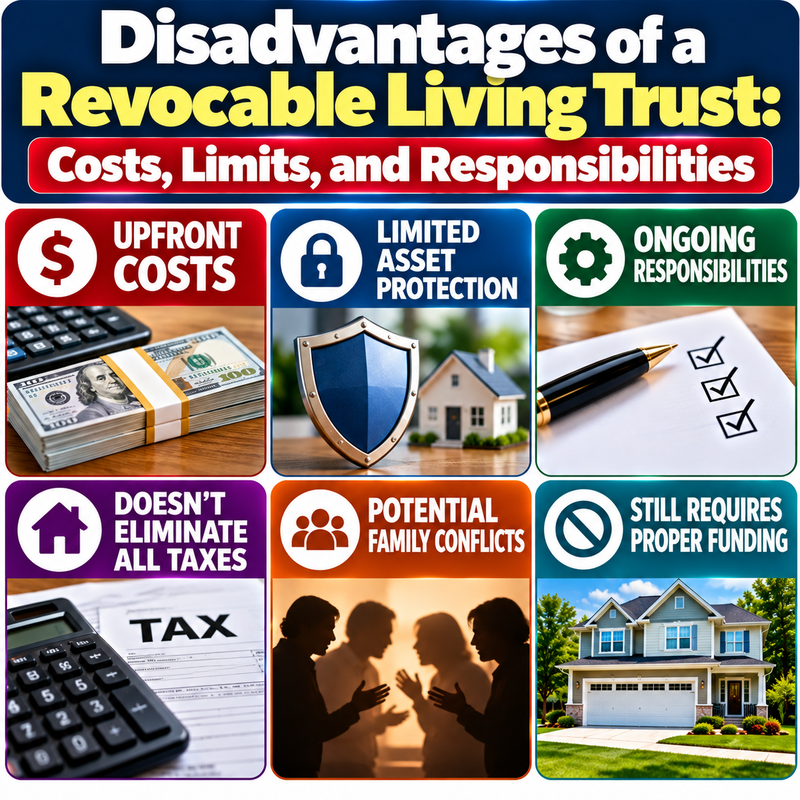
    Disadvantages of a Revocable Living Trust: Costs, Limits, and Responsibilities

    There are a Few Disadvantages of a Revocable Living Trust, Let’s Take a Closer Look at Them

    Understand Setup and Funding Work, Ongoing Maintenance, Costs, and the Protections a Revocable Trust Does Not Provide

    A revocable living trust can simplify your estate, but it also comes with real costs, ongoing work, and limits that sales-focused content rarely mentions.

    Key Takeaways

    • A revocable living trust involves upfront costs, funding work, and ongoing maintenance that a simple will typically does not require.
    • Trusts offer no meaningful creditor protection or automatic tax savings because you retain full control over the assets during your lifetime.
    • Every asset must be individually retitled into the trust’s name, or it may still be forced through probate.
    • Platforms like Bulletproof Legacy can reduce some implementation friction through funding support and digital tools, though they can’t eliminate every tradeoff discussed here.
    • Later in this article, we break down how attorney-drafted, DIY, and supported digital trusts compare when it comes to these specific disadvantages.
    Disadvantages-Of-A-Revocable-Living-Trust-Costs-Limits-And-Responsibilities

    Quick Answer: Common Disadvantages and Tradeoffs

    The most commonly cited disadvantages of a revocable living trust include higher upfront costs compared to a will, the manual work of funding the trust with your assets, ongoing maintenance obligations, limited creditor protection, no automatic tax benefits, and the fact that a trust doesn’t replace every other estate-planning document you need. None of these points mean a trust is a bad choice. They just mean the decision deserves an honest look at what a trust actually does and doesn’t do, rather than a pitch that skips the fine print.

    The Core Tradeoff: Convenience Now for Work Upfront

    Trusts trade a little more effort today for a smoother process for your family later. That’s the honest version of the pitch. Instead of a court validating your will after you pass, a properly funded trust can let your successor trustee manage and distribute assets without probate court involvement. But “properly funded” is doing a lot of heavy lifting in that sentence, and it’s where most of the disadvantages live.

    • Setting up a trust typically takes more time and paperwork than signing a basic will.
    • Assets must be retitled or reassigned into the trust’s name one by one.
    • The trust needs periodic review as your life and assets change.
    • You still need supporting documents like a pour-over will and powers of attorney.

    Each of these tradeoffs is manageable, but they’re not optional extras. Skip them, and the trust may not function the way you expect when it matters most.

    What a Revocable Trust Does Not Do

    A revocable trust does not shield your assets from creditors or lawsuits, because you retain the right to revoke it and take the assets back at any time. It does not reduce your federal income tax bill, since the IRS treats it as a grantor trust and taxes the income as if it were earned directly by you. It does not automatically manage assets you forget to transfer into it. And it does not replace a will, a financial power of attorney, or health-care directives. Understanding these limits upfront prevents the kind of disappointment that happens when someone assumes a trust does more than it legally can.

    Higher Upfront Effort Than a Simple Will

    Compared to a basic will, a revocable trust asks more of you at the start. That’s not a flaw in the trust itself, it’s simply the nature of a more comprehensive planning tool. A will names an executor and states who gets what, then a probate court steps in to enforce it. A trust, by contrast, requires you to build a working structure that holds title to your property while you’re alive, which takes more documentation and more decisions upfront.

    Drafting Time and Document Complexity

    A trust package usually bundles together the trust document itself, a pour-over will, financial and medical powers of attorney, and sometimes a certification of trust for use with banks and title companies. Each document has its own purpose, and getting them all coordinated correctly takes more attention than filling out a single-page will template. This doesn’t mean it’s complicated to the point of being unmanageable, but it is more involved than the simplest estate-planning options.

    Why a Will Alone Can Be Faster to Set Up

    If your estate is small, your beneficiary designations are current, and you live in a state with a simple small-estate probate process, a will alone might get the job done with less initial effort. The tradeoff is that your estate could still go through probate, which takes time and is a matter of public record. Whether that tradeoff is worth avoiding depends on your family’s situation, your state’s probate rules, and how much privacy and speed matter to you.

    Free Trust Consultation Banner

    Creation and Professional-Service Costs

    Cost is one of the first disadvantages people run into, and it varies more than most people expect. A revocable trust can be created online for as little as a few hundred dollars, while an attorney-drafted trust commonly runs $1,000 to $3,000 depending on complexity and location. Irrevocable trusts, which serve different purposes, almost always require an attorney and often cost $3,000 to $10,000 or more. For a deeper breakdown of what drives these numbers, our guide on living trust cost walks through pricing by provider type and complexity level.

    Online Platforms vs. Estate Planning Attorneys

    Online platforms tend to be less expensive and faster, which works well for straightforward estates. Attorneys cost more but bring judgment for complicated situations, like blended families, business ownership, or state-specific quirks that a template can’t anticipate. Neither option is universally “better.” The right choice depends on how complex your assets and family situation actually are.

    What Drives Price Differences

    Price differences usually come down to a few factors: whether an attorney reviews or drafts the documents personally, how many supporting documents are bundled in, whether the provider offers funding assistance, and how much ongoing support or updates are included after the initial purchase. A lower price isn’t automatically a worse deal, and a higher price isn’t automatically better protection. It depends on what’s actually included and whether it matches what your estate needs.

    Funding Requires Asset-by-Asset Work

    Here’s the disadvantage that catches the most people off guard: creating the trust document is only step one. The trust has to be “funded,” meaning ownership of your property has to actually be transferred into the trust’s name. Skip this step, and the trust exists on paper but doesn’t control anything. The ongoing trust costs of amending and updating the trust can add up over time depending on how the trust was created, who created it and what type of access you have to making changes to it.

    Retitling Real Estate Deeds

    Real estate typically requires a new deed that transfers the property from your individual name into the name of the trust. This deed then has to be recorded with the county. It’s not a difficult process, but it is a distinct legal step that has to happen for every property you own, and it’s easy to overlook if you buy a new home after your trust is already set up.

    Updating Bank and Brokerage Accounts

    Bank accounts, brokerage accounts, and other financial holdings each have their own retitling procedures set by the institution. Some banks handle this quickly with a simple form; others require in-person visits or additional documentation. Because every institution does it a little differently, funding a trust often means several separate phone calls or visits rather than one universal process.

    Handling Retirement Accounts and Beneficiary Designations

    Retirement accounts like 401(k)s and IRAs are usually handled differently. Rather than retitling the account itself, these assets are typically coordinated through beneficiary designation forms. This distinction matters because people sometimes assume “funding the trust” means moving every asset into it, when in reality, some assets pass more effectively through designated beneficiaries instead.

    What Happens If Property Is Never Transferred

    If an asset is never properly transferred into the trust, it doesn’t automatically become part of the trust just because you have one. In many states, that asset may still have to go through probate, defeating one of the main reasons people set up a trust in the first place. A pour-over will is usually included as a backup, directing any leftover assets into the trust after death, but that pour-over will still has to go through probate to do its job. Funding isn’t a one-time task you can skip and rely on someone else to fix later.

    Ongoing Maintenance as Assets and Life Circumstances Change

    A trust isn’t a “set it and forget it” document. It needs periodic attention as your financial life and family circumstances shift, and neglecting that upkeep is one of the more common ways a trust ends up underperforming.

    Titling New Purchases in the Trust’s Name

    Every time you buy a new home, open a new investment account, or acquire a significant asset, that asset needs to be titled in the trust’s name to be covered by it. This is easy to forget in the excitement of a big purchase, but it’s a necessary step for the trust to keep functioning as intended.

    Updating Successor Trustees and Beneficiaries

    Life changes, divorces, deaths, falling-outs, moves, and shifting relationships can all affect who you’d want serving as your successor trustee or receiving specific assets. A trust that reflects your wishes from ten years ago may no longer reflect your wishes today, and it won’t update itself.

    Reviewing the Trust After Major Life Events

    Marriage, divorce, the birth of a child, a significant change in net worth, or a move to a new state are all reasonable triggers for a trust review. State laws around trusts and property can differ, so relocating is a particularly common reason a trust needs a second look, even if nothing else in your life has changed.

    None of this maintenance work is overwhelming on its own, but it does add up over the years. Choosing a provider that makes updates simple, rather than treating the initial purchase as the finish line, can meaningfully reduce how burdensome this ongoing responsibility feels.

    A Trust Does Not Automatically Control Unfunded Assets

    It’s worth repeating because it trips up so many people: a trust only controls what’s actually inside it. Anything left outside the trust at the time of death is governed by other rules entirely, regardless of what the trust document says.

    Why Assets Outside the Trust May Still Face Probate

    If a bank account, a piece of property, or an investment account was never retitled into the trust’s name, it typically doesn’t skip probate just because you happen to have a trust. Courts look at how the asset is actually titled, not what your broader estate plan intended. This is one of the most common gaps between what people believe a trust does and what it actually accomplishes in practice.

    The Role of a Pour-Over Will as a Safety Net

    Because unfunded assets are such a common issue, most trust packages include a pour-over will. This document acts as a catch-all, stating that anything you own outside the trust at your death should “pour over” into it. It’s a helpful backstop, but it’s not a shortcut around probate. Assets named in a pour-over will still typically go through the probate process before they can be transferred into the trust, so it’s a safety net rather than a substitute for proper funding.

    Think of the pour-over will as insurance against forgetting something, not as a replacement for doing the retitling work in the first place. The goal is to fund the trust thoroughly enough that the pour-over will rarely, if ever, needs to be used.

    Free Consultation Banner 2

    No Automatic Income-Tax or Estate-Tax Savings

    One of the most persistent myths about revocable trusts is that they come with built-in tax advantages. They don’t. Because you retain full control over a revocable trust, including the ability to change or cancel it entirely, the IRS doesn’t treat it as a separate taxpayer. Everything that happens inside the trust is treated, for tax purposes, as if it happened to you personally.

    This distinction matters because some people choose a revocable trust specifically hoping to lower their tax bill, only to find out later that this was never how the tool was designed to work. If tax reduction is your primary goal, a revocable trust isn’t the mechanism for it.

    How the IRS Treats a Revocable Trust

    The IRS classifies a revocable living trust as a “grantor trust.” In plain terms, that means the trust is invisible to the IRS as long as you retain the power to revoke it or change its terms. There’s no separate tax entity, no separate tax filing requirement tied to the trust’s existence, and no special tax rate that applies just because assets sit inside a trust rather than in your own name.

    This is different from how the IRS treats certain irrevocable trusts, which can be recognized as separate taxpayers depending on their structure. If you’re weighing the differences between trust types, our comparison of revocable vs. irrevocable trust options breaks down exactly where those tax treatments diverge.

    None of this means a revocable trust is a poor tool. It just means its main value lies in probate avoidance, privacy, and incapacity planning, not tax reduction.

    Reporting Trust Income on Your Personal Return

    Any income generated by trust assets, whether from dividends, interest, or rental property, gets reported on your personal tax return using your own Social Security number as the trust’s tax identification number. You won’t file a separate tax return for the trust itself while you’re alive and serving as trustee. This is one of the simpler aspects of trust ownership, but it also underscores that the trust isn’t providing any tax shelter you wouldn’t already have.

    Federal Estate Tax Exemption and Why Most Estates Aren’t Affected

    Assets held in a revocable trust are still considered part of your taxable estate when you die. If your total estate exceeds the federal estate tax exemption, currently set at $13.99 million per individual for 2025 and 2026, the amount above that threshold could be subject to federal estate tax. That said, this exemption is high enough that fewer than 1 percent of estates in the country actually owe federal estate tax. For the vast majority of families, estate tax simply isn’t a deciding factor when choosing between a will and a trust, or between a revocable and irrevocable structure.

    Limited Creditor and Asset-Protection Benefits for the Grantor

    Another disadvantage worth stating plainly: a revocable living trust offers little to no protection from creditors or lawsuits while you’re alive. This surprises people who assume that moving assets into a trust automatically shields them, the way it might with certain irrevocable structures.

    Why Retained Control Means Retained Exposure

    The reason comes down to control. Because you can revoke the trust and reclaim the assets whenever you want, the law generally treats those assets as still belonging to you for purposes of creditor claims and lawsuits. If you’re sued or owe a debt, assets sitting inside a revocable trust are typically just as reachable as assets held in your own name. The trust doesn’t add a legal barrier between you and a creditor, because legally, you never gave up control.

    How This Differs From Irrevocable Trust Planning

    Irrevocable trusts work differently because you give up the right to change or cancel them, and often give up direct control over the assets as well. That surrendered control is precisely what can create stronger creditor protection in some cases, depending on state law and how the trust is structured. It’s also why irrevocable trusts tend to cost more to set up and require more careful, permanent decision-making upfront.

    This tradeoff is worth sitting with. A revocable trust gives you flexibility and control, but that same flexibility is what limits its protective power. An irrevocable trust can offer more protection, but only by asking you to give up the very control that makes a revocable trust convenient in the first place. Neither option is objectively better. It depends on what you’re trying to accomplish.

    A Living Trust Does Not Replace Every Estate-Planning Document

    A trust is a powerful tool, but it’s not a complete estate plan on its own. This is one of the most important disadvantages to understand, because it directly contradicts the way trusts are sometimes marketed as an all-in-one solution.

    Even a fully funded revocable trust leaves gaps that other documents are specifically designed to fill. Think of the trust as handling one job extremely well, managing and distributing property, while other documents handle jobs the trust was never built to do.

    A complete estate plan built around a revocable trust typically still includes:

    • A pour-over will to catch any assets left outside the trust
    • A financial power of attorney for decisions the trust doesn’t cover
    • A health-care directive and medical power of attorney
    • Updated beneficiary designations on retirement accounts and life insurance

    Financial Power of Attorney

    A trust only controls property that’s titled in its name. If you become incapacitated, your successor trustee can step in to manage trust assets, but they generally have no automatic authority over things like your personal bank accounts that weren’t transferred into the trust, tax filings, or other financial matters outside the trust’s scope. A durable financial power of attorney fills that gap by naming someone to act on your behalf for anything the trust doesn’t cover.

    Without this document, a family could find itself in the frustrating position of having a fully funded trust for property, but no legal authority to handle other financial matters if you’re unable to act for yourself.

    This is a common blind spot. People assume “I have a trust” means “I’m covered,” when in reality the trust and the power of attorney are meant to work together, each handling a different slice of the picture.

    Health-Care Directives

    A trust has nothing to do with medical decision-making. A health-care directive, sometimes called a living will, along with a medical power of attorney, is what allows someone you trust to make medical decisions on your behalf if you can’t communicate them yourself. These documents are separate from the trust entirely and need to be created alongside it.

    Beneficiary Designations Still Matter

    Retirement accounts, life insurance policies, and certain payable-on-death accounts typically pass through beneficiary designations rather than through the trust itself. If those designations are outdated or point to an estate rather than a person, those assets could bypass the trust’s instructions entirely, regardless of how well the trust document was written. Reviewing these designations periodically is just as important as funding the trust in the first place.

    Trustee and Successor-Trustee Responsibilities

    Choosing a successor trustee is one of the more consequential decisions in setting up a trust, and it’s a responsibility that shouldn’t be underestimated. This person steps into a fiduciary role, meaning they’re legally required to act in the best interests of the beneficiaries, not their own convenience.

    Fiduciary Duties After Incapacity or Death

    If you become incapacitated, your successor trustee may need to step in and manage trust property on your behalf, paying bills, managing investments, and handling day-to-day financial matters tied to the trust. After death, the responsibilities expand further. The successor trustee typically needs to inventory trust assets, keep accurate records, notify and communicate with beneficiaries, address any outstanding debts or final taxes, and eventually distribute assets according to the trust’s terms.

    This isn’t necessarily difficult work, but it is real work, and it takes time. A trustee who ignores their duties or mismanages assets can be held personally liable in some situations, which is part of why the role shouldn’t be handed to just anyone.

    It’s also worth noting that avoiding probate doesn’t mean avoiding administration altogether. Someone still has to do the work of managing and distributing the estate. A trust simply moves that work outside the courtroom and into the hands of your chosen trustee.

    Here’s a quick comparison of what a successor trustee typically handles versus what a probate-appointed executor handles:

    A successor trustee manages funded trust assets privately, without court supervision, following the instructions written into the trust. An executor, by contrast, manages probate assets under court oversight, often with public filings and court approval required at multiple stages. Both roles carry fiduciary duties, but the trustee’s work generally moves faster and stays out of public record.

    Qualities to Look for When Choosing a Trustee

    A good successor trustee is organized, trustworthy, and willing to communicate clearly with beneficiaries, even during emotionally difficult times. Financial savvy helps, but it’s not strictly required if the trustee is willing to work with an accountant or financial professional when needed. What matters most is someone who will follow your instructions faithfully and treat the role with the seriousness it deserves.

    Possible Complexity for Banks, Real Estate, Businesses, and Unusual Assets

    Not every asset moves into a trust with the same ease. Some categories of property come with their own procedural hurdles that can add friction to the funding process.

    Business Interests and Operating Agreement Restrictions

    If you own a business, transferring your ownership interest into a trust isn’t always as simple as filling out a form. Operating agreements or partnership agreements sometimes include transfer restrictions that require consent from other owners before an interest can be assigned to a trust. Skipping this step, or assuming it’s automatically allowed, can create complications down the line. For a deeper understanding of these issues, you might explore what constitutes a revocable living trust agreement.

    Financial Institution Retitling Procedures

    Every bank, credit union, and brokerage firm has its own internal process for retitling an account into a trust’s name. Some institutions make this straightforward with a short form; others require in-person appointments, notarized documents, or additional verification steps. Because there’s no universal standard, funding a trust across multiple institutions often means navigating several different sets of paperwork, which adds up in time even when each individual step is simple.

    When a Living Trust May Be More Planning Than Someone Needs

    Not every estate benefits equally from a revocable trust, and it’s worth being honest about that. Someone with a modest estate, effective beneficiary designations already in place, and minimal probate exposure under their state’s rules might find that a simpler plan does the job just fine.

    Simple Estates With Effective Beneficiary Designations

    If most of your assets already pass outside of probate, through joint ownership, payable-on-death designations, or retirement account beneficiaries, the probate-avoidance benefit of a trust shrinks considerably. In states with generous small-estate probate procedures, a simple will paired with updated beneficiary forms might accomplish nearly everything a trust would, with less upfront cost and less ongoing maintenance. This doesn’t apply to everyone, but it’s worth evaluating honestly before assuming a trust is the right fit by default.

    Every disadvantage covered here, cost, funding work, maintenance, limited tax and creditor benefits, and trustee responsibilities, is real, but none of them are unique to poorly built trusts. Good implementation, clear instructions, and ongoing support can meaningfully reduce the friction involved, which is where a resource like Bulletproof Legacy fits in: through funding assistance, digital account access, and ongoing document maintenance, it’s built to help you manage these responsibilities rather than pretend they don’t exist. If you’re weighing whether a revocable living trust fits your situation, a conversation with Bulletproof Legacy can help you look at the tradeoffs clearly before you decide.

    State Small-Estate Probate Alternatives

    Many states also offer simplified probate procedures for estates below a certain dollar threshold, sometimes called small-estate affidavits. If your state’s threshold is generous and your estate falls under it, the probate process could be short, inexpensive, and far less burdensome than the horror stories that trust marketing often leans on. It’s worth checking your specific state’s threshold before assuming a trust is the only way to avoid a lengthy court process.

    Free Consultation Banner 3

    How Disadvantages Compare Across Attorney, DIY, and Supported Digital Approaches

    The disadvantages discussed throughout this article don’t hit everyone the same way. How much cost, funding work, and ongoing maintenance actually burden you depends heavily on which path you take to create the trust in the first place. An attorney, a do-it-yourself template, and a supported digital platform each shift these tradeoffs in different directions.

    It helps to think of this less as “which option is best” and more as “which option matches how much guidance and support you actually want.” Some people prefer handling every detail themselves. Others want a professional double-checking each step. Many fall somewhere in between, wanting structure and support without the full cost of hourly attorney fees.

    Here’s a side-by-side look at how each approach tends to handle the core disadvantages covered in this article:

    DisadvantageAttorney-DraftedDIY TemplateSupported Digital Platform
    Upfront costHighest, often $1,000–$3,000+Lowest, but limited guidanceModerate, often includes support
    Funding assistanceSometimes included, often extraRarely includedOften included or guided
    Ongoing updatesUsually billed separatelySelf-managedOften included via digital access
    Personalized legal judgmentHighestLowestModerate, template-based with support

    What an Attorney-Drafted Trust Addresses

    An attorney brings judgment to situations a template can’t anticipate, blended families, business succession, out-of-state property, or unusual family dynamics. That judgment comes at a price, both in dollars and in time, since attorney-drafted trusts typically take longer to finalize and often bill separately for updates down the road.

    What a DIY Trust Leaves on Your Shoulders

    A DIY trust is the least expensive option upfront, but it also puts nearly all the funding and maintenance responsibility on you, with little to no built-in guidance if you get stuck. For a simple estate with straightforward assets, this can work fine. For anything more complex, the lack of support can turn small mistakes into bigger problems later.

    What Supported Digital Platforms Can and Cannot Fix

    A supported digital platform sits between these two extremes. Bulletproof Legacy, for example, pairs the affordability of a digital trust with funding assistance, secure digital document access, and professional resources meant to reduce the friction of getting assets properly retitled and keeping the plan updated over time.

    This kind of support can meaningfully lower the odds of an unfunded asset or a forgotten update, but it doesn’t eliminate every disadvantage discussed in this article. Costs, tax treatment, and creditor exposure remain the same regardless of which provider you choose, because those limitations come from how trusts work under the law, not from who drafted the paperwork.

    Questions to Ask Before Deciding

    Before committing to a revocable living trust, it helps to run through a short set of honest questions. These aren’t meant to talk you out of a trust, they’re meant to make sure you go in with clear eyes about what you’re taking on. They illustrate some the pros and cons of a revocable living trust to help you be better informed.

    Does Your Estate Size and Complexity Justify a Trust?

    • Do you own real estate, especially in more than one state?
    • Do your assets exceed your state’s small-estate probate threshold?
    • Do you have a blended family, business interests, or beneficiaries with special needs?

    If you answered yes to any of these, a trust likely earns its keep. If your estate is modest and your beneficiary designations are already in order, the case for a trust becomes less automatic.

    It’s also worth considering privacy. Wills go through probate, which is a public record. Trusts generally keep the details of your estate private, which matters more to some families than others.

    There’s no universal right answer here. The goal is matching the tool to your actual situation, not defaulting to whatever option sounds the most sophisticated.

    Who Will Serve as Your Successor Trustee?

    Before you finalize anything, have a real conversation with the person you’re considering as successor trustee. Make sure they understand the responsibility, are willing to accept it, and have a way to get support if they run into something unfamiliar. A trust is only as strong as the person managing it after you’re gone.

    Can You Commit to Funding and Updating It?

    • Are you prepared to retitle real estate deeds and financial accounts after signing?
    • Will you review the trust after major life events like a move, marriage, or new purchase?
    • Do you have a plan for keeping beneficiary designations current alongside the trust?

    If the honest answer to these questions is “probably not,” that’s worth acknowledging now rather than after the trust is signed and sitting unfunded in a drawer. Choosing a provider with built-in funding support or ongoing reminders can help close this gap, but the commitment still ultimately rests with you. For more information on whether a trust might be suitable for your needs, you can explore what a revocable living trust agreement entails.

    Frequently Asked Questions

    These are some of the most common questions people ask once they understand the tradeoffs involved in setting up a revocable living trust.

    Each answer below stays short and direct, since the goal here is clarity, not more sales copy.

    Is a revocable living trust worth the cost for a small estate?

    It depends on your state’s small-estate probate rules and how many assets already pass outside probate through beneficiary designations. If those factors already minimize probate exposure, a trust may add cost without adding much practical benefit.

    Does a revocable trust protect my assets from lawsuits?

    No. Because you retain full control and the ability to revoke the trust, creditors and lawsuit judgments can generally still reach assets held inside it, the same as if you owned them in your own name.

    Will a revocable trust reduce my estate taxes?

    No. The IRS treats a revocable trust as a grantor trust, meaning its assets are still part of your taxable estate. Reducing estate tax liability typically requires different planning tools, especially since the current federal exemption already excludes the vast majority of estates.

    If estate tax reduction is a specific goal, it’s worth discussing irrevocable options separately rather than assuming a revocable trust will accomplish it.

    What happens if I forget to transfer an asset into my trust?

    That asset generally isn’t controlled by the trust and may still be subject to probate. A pour-over will can direct it into the trust after death, but the asset typically still has to pass through probate first.

    This is why funding, not just signing, is the step that determines whether a trust actually delivers on its main benefit.

    Can Medicaid count assets held in my revocable trust?

    Yes. Assets in a revocable trust are counted as your resources for Medicaid eligibility purposes, since you retain control over them. A revocable trust does not shield assets from nursing home costs or Medicaid spend-down requirements.

    Do I still need a will if I have a revocable trust?

    Yes. A will compliments a trust. A pour-over will is typically still needed to catch any assets that weren’t transferred into the trust, ensuring they eventually get directed to it rather than passing through unrelated intestacy rules.

    Who should I choose as my successor trustee?

    Someone organized, trustworthy, and willing to communicate clearly with beneficiaries during a difficult time. Financial expertise helps but isn’t required if they’re willing to bring in professional help when needed.

    How often should I update my revocable living trust?

    Review it after any major life event, marriage, divorce, a new child, a significant asset purchase, or a move to a new state. Even without a major event, a periodic check every few years helps catch anything that’s drifted out of sync.

    The trust doesn’t update itself, so building this review into your regular financial habits matters more than most people expect. The cost to update a trust varies depending on how it was created, who created it and what type of control you have over it.

    Is a revocable trust more expensive to maintain than a will?

    Generally, yes, in terms of ongoing effort. A will typically just sits until it’s needed, while a trust requires funding upfront and periodic updates as your assets and life circumstances change.

    Can creditors still reach assets in a revocable trust?

    Yes. Since you retain the power to revoke the trust and reclaim its assets, the law generally treats those assets as still belonging to you for purposes of debts, judgments, and lawsuits.

    This is one of the clearest limitations of a revocable trust compared to certain irrevocable structures, which can offer stronger protection in exchange for giving up direct control.

    Understanding this distinction upfront helps set realistic expectations about what a revocable trust can and can’t do for your financial protection.

    None of these limitations mean a revocable trust is the wrong choice, they simply mean it’s a tool built for probate avoidance, privacy, and incapacity planning rather than tax reduction or creditor protection.

  • Benefits of a Revocable Living Trust: What It Can and Cannot Do

    Benefits of a Revocable Living Trust: What It Can and Cannot Do

    Revocable Living Trust Benefits: Control, Probate Planning, Privacy, and Incapacity Protection

    Understand Probate Planning, Incapacity Management, Privacy, Control, and the Important Limits of a Revocable Trust

    A revocable living trust lets you control your assets while you’re alive, avoid probate for what you actually put into it, and hand off management smoothly if you become incapacitated—but it does none of that automatically just because you signed the paperwork.

    That single distinction—between what a trust can do and what it does the moment you fund it—is where most confusion about revocable living trusts begins. People hear “avoids probate” and assume every asset they own is protected the day the trust is signed. They hear “keep control” and think that also means keeping creditors away. Neither assumption is accurate, and getting the details right matters more than getting the marketing pitch memorized.

    This guide walks through what a revocable living trust actually accomplishes, the conditions that make each benefit real, and the limitations that responsible estate planning should always disclose upfront.

    Article-at-a-Glance: Key Takeaways

    • A revocable living trust gives you ongoing control over your assets and lets you amend, restate, or revoke it at any time while you’re mentally competent.
    • Probate avoidance only applies to assets that are actually retitled into the trust’s name—the trust document alone doesn’t move anything.
    • Because you retain control as grantor, the trust is generally treated as a grantor trust for federal income tax purposes, meaning it isn’t an automatic tax shelter.
    • Retained control also means an ordinary revocable trust should not be marketed as automatic creditor protection—that’s a different legal tool entirely.
    • Later in this article, we’ll break down exactly which assets slip through probate, which ones don’t, and how supported digital models like Bulletproof Legacy’s help close that gap through funding assistance.
    Revocable-Living-Trust-Benefits

    Quick Answer: The Major Benefits of a Revocable Living Trust

    At its core, a revocable living trust is a legal arrangement where you transfer ownership of assets into a trust you control, name yourself as trustee, and designate who takes over management if you can’t act or after you pass away. The “revocable” part means you can change your mind—add beneficiaries, remove them, swap trustees, or unwind the whole thing—right up until you lose capacity or die.

    The practical upside shows up in several places: continuity of asset management if you’re incapacitated, private administration instead of public probate filings, streamlined transfers for properly funded property, and the flexibility to build in detailed instructions for beneficiaries, including minors or family members with special needs. Some people also use a living trust structure specifically to simplify how out-of-state property gets handled after death, since real estate titled correctly in the trust generally avoids a second probate proceeding in that state.

    None of these benefits are automatic guarantees, though. Each one depends on proper drafting, correct titling, and ongoing maintenance—details this article covers section by section.

    Retaining Control While You Are Alive

    One of the most underappreciated features of a revocable living trust is how little actually changes for you day-to-day. You’re not signing away ownership or handing your finances to someone else. You’re simply restructuring how your assets are titled, while keeping the same access and authority you had before.

    You Can Serve as Your Own Trustee

    In most revocable trust arrangements, you name yourself as the initial trustee. That means you continue managing your bank accounts, investment portfolios, and real estate exactly as you did before—buying, selling, refinancing, or spending as you see fit. The trust simply becomes the titled owner, with you at the controls.

    You Keep Access to Trust Assets and Income

    Because you retain beneficial access to everything inside the trust, there’s no loss of income or liquidity. Rental property income still flows to you. Dividends still hit your account. Nothing about daily financial life changes just because the title on an account reads “John Smith, Trustee of the John Smith Revocable Living Trust” instead of just “John Smith.”

    Free Trust Consultation Banner

    Ability to Amend or Revoke the Trust

    Life changes—marriages happen, families grow, relationships shift—and your estate plan should be able to keep up. A revocable living trust is designed for exactly that kind of flexibility, which is part of what separates it from an irrevocable structure.

    Changing Beneficiaries and Successor Trustees

    You can update who inherits what, in what proportions, and under what conditions, generally at any time while you’re competent to do so. The same goes for successor trustees—if the person you originally named to step in after you is no longer the right fit, you can name someone else. This is one of the biggest reasons people choose a revocable structure over an irrevocable one; for a deeper look at how those two approaches differ in terms of control and flexibility, see our comparison of revocable vs. irrevocable trust planning.

    Revoking the Trust Entirely if Your Situation Changes

    If your circumstances shift dramatically—say, a major change in family structure or a decision to pursue a different planning strategy—you can revoke the trust altogether, subject to your state’s laws and the terms of your specific trust document. That flexibility is a defining feature, but it also means the trust offers none of the asset-protection benefits associated with giving up control permanently.

    Probate Planning for Properly Funded Assets

    This is where a lot of the confusion around living trusts starts, so it’s worth being precise. A revocable living trust can allow assets to be administered by your successor trustee outside of ordinary probate court proceedings after your death—but only for assets that were actually transferred into the trust’s name while you were alive.

    Why Funding Is Essential

    Signing a trust document doesn’t move your house, your brokerage account, or your business interest into the trust automatically. You—or whoever helps you set it up—have to retitle each asset, one by one. A house needs a new deed. A bank account needs new ownership paperwork. A trust that looks great on paper but was never funded properly still sends those unfunded assets through probate, the same as if no trust existed at all.

    This is also why a pour-over will typically accompanies a revocable living trust. It acts as a safety net, directing any assets accidentally left outside the trust to be transferred into it after death—though those specific assets would still need to go through probate first.

    Assets That May Transfer Outside Probate for Other Reasons

    Not every asset needs a trust to skip probate. Some assets pass outside probate regardless of whether a trust exists, because of how they’re titled or designated. Common examples include:

    • Retirement accounts and life insurance policies with a named beneficiary
    • Bank or brokerage accounts held as joint tenants with right of survivorship
    • Payable-on-death or transfer-on-death accounts
    • Property held in joint tenancy or as community property with survivorship rights, depending on state law

    Understanding this distinction matters because it prevents both overconfidence and unnecessary duplication—there’s no need to fund a trust with an asset that already has a clear beneficiary designation doing the same job.

    Incapacity Planning and Successor-Trustee Management

    Nobody likes thinking about becoming incapacitated, but it happens—strokes, accidents, advancing dementia—and when it does, someone needs authority to keep paying bills and managing property without waiting on a judge. This is one of the most practical, day-to-day useful benefits of a revocable living trust, and it doesn’t require anyone to guess what you would have wanted.

    How a Successor Trustee Steps In Without Court Involvement

    Your trust document names a successor trustee and spells out the circumstances under which that person can step in—often triggered by a written incapacity determination from one or more physicians, as defined in the trust itself. Once that trigger is met, your successor trustee can immediately begin managing trust assets: paying the mortgage, handling investment accounts, covering medical expenses, whatever the situation calls for. There’s no need to petition a court or wait for a guardianship hearing, which can otherwise take weeks and cost thousands of dollars in legal fees.

    Limits: Assets Outside the Trust Still Need a Power of Attorney

    Here’s the catch that trips people up: your successor trustee’s authority only extends to assets actually titled in the trust. If you own a car in your own name, or a bank account you never got around to retitling, your successor trustee has no legal standing over those assets just because they’re managing your trust. That’s why a revocable living trust is typically paired with:

    • A durable financial power of attorney, covering assets and accounts left outside the trust
    • A pour-over will, to catch anything unfunded at the time of death
    • Beneficiary designations reviewed and coordinated with the trust’s terms

    Skipping the power of attorney is a common gap. Someone assumes the trust covers everything, then discovers during a health crisis that a forgotten checking account or a vehicle title sits completely outside their successor trustee’s reach.

    The fix isn’t complicated, but it does require follow-through: a complete asset inventory, matched against what’s actually titled in the trust, reviewed periodically as new accounts get opened or old ones get closed.

    Health-Care Decisions Require Separate Documents

    A revocable living trust has nothing to do with medical decision-making. It’s a financial and property management tool. If you want someone authorized to make health-care choices on your behalf, or to have your wishes about life support and treatment options honored, you need a separate health-care power of attorney and, in many states, a living will or advance directive. These documents work alongside your trust, not as part of it.

    Privacy Compared With Probate Administration

    Estate settlement doesn’t have to become public record, and for a lot of families, that privacy matters as much as the time saved. Probate is a court process, and court processes generally involve filings that become part of the public record—anyone can walk into a courthouse, look up a probate file, and see what someone owned, who inherited it, and how much it was worth.

    Trust administration, by contrast, generally happens privately between the trustee and the beneficiaries. There’s no court filing announcing the contents of the trust to the world, no public docket listing asset values or beneficiary names.

    What Stays Private Versus What Becomes Public

    With a properly funded revocable living trust, the terms of distribution, the value of assets, and the identity of beneficiaries typically remain outside public court records. That’s a meaningful difference for anyone who values discretion—business owners who don’t want competitors seeing valuation figures, blended families who’d rather not air inheritance details to extended relatives, or simply people who consider their financial affairs nobody else’s business.

    Situations That Can Still Require Disclosure

    Privacy isn’t absolute, though, and no honest estate planning discussion should suggest otherwise. If beneficiaries dispute the trust’s terms and the matter ends up in litigation, court records can become public. Financial institutions, the IRS, and other regulatory bodies may still require certain disclosures during administration. And if trust assets get distributed to another entity—say, retitled into a beneficiary’s own revocable trust—that new arrangement has its own disclosure rules. Privacy is a genuine benefit, but it’s a relative one, not an ironclad guarantee.

    Free Consultation Banner 2

    Continuity for Real Estate and Financial Assets

    When assets are properly funded into a revocable living trust, the transition after death tends to be smoother and faster than probate administration for the same assets. Your successor trustee already has legal authority to act—there’s no waiting period for a court to appoint an executor or issue letters testamentary before anyone can access funds or manage property.

    This continuity matters most in the weeks immediately following a death, when bills still need paying and households still need functioning income.

    Faster Access for a Surviving Spouse or Family Member

    Consider a surviving spouse who needs to keep making mortgage payments and cover everyday living expenses. If assets are tied up in probate, that spouse may face months of restricted access while the court process plays out. With a funded revocable trust, the successor trustee can typically access trust accounts and begin distributions or bill payments almost immediately, based on the terms already spelled out in the trust document.

    Planning for Beneficiaries and Distribution Instructions

    A revocable living trust isn’t just about avoiding court—it’s also a flexible instruction manual for how and when your beneficiaries receive what you leave them. Unlike a simple will, which typically hands over assets outright, a trust lets you build in conditions, timelines, and safeguards. See how a revocable living trust compares to a will to see the differences.

    This level of control becomes especially valuable when beneficiaries are minors, financially inexperienced, or dealing with circumstances that make an outright lump-sum inheritance risky.

    Staggered Distributions for Minor Children

    Instead of handing an eighteen-year-old a six-figure inheritance the day they legally become an adult, many trusts stagger distributions across several ages and milestones.

    Example: A trust might direct that a child receive one-third of their share at age 25, another third at 30, and the remainder at 35—giving them time to mature financially before gaining full control of the inheritance.

    This kind of staged approach doesn’t require ongoing court supervision the way a guardianship arrangement for a minor’s inheritance often does. The successor trustee simply follows the instructions already written into the trust.

    Special Needs Trust Provisions

    For beneficiaries with disabilities who rely on government benefits like Supplemental Security Income or Medicaid, an outright inheritance can actually cause more harm than good—it can disqualify them from need-based programs entirely. A properly drafted special needs provision within a revocable trust allows assets to be held for that beneficiary’s benefit without counting against eligibility limits, provided the trust language meets specific state and federal requirements.

    This is a highly technical area of trust drafting, and getting the language wrong can undo the entire purpose of the provision. It’s not a do-it-yourself section of estate planning—professional drafting matters here more than almost anywhere else in the trust.

    Reducing Family Conflict With Clear Instructions

    Ambiguity breeds disputes. When a trust clearly states who gets what, under what conditions, and how disagreements should be resolved, there’s simply less room for family members to argue over interpretation.

    Naming a neutral, capable successor trustee—rather than defaulting to whichever sibling is oldest or most assertive—also tends to reduce friction. A trustee who has no personal stake in favoring one beneficiary over another can administer the trust according to its terms, rather than according to family politics.

    Potential Advantages for Property in More Than One State

    Owning real estate in more than one state creates a planning wrinkle that catches a lot of people off guard: without proper planning, each property can potentially be subject to its own separate probate proceeding, filed in the state where it’s located, in addition to the probate proceeding in your home state.

    Avoiding Ancillary Probate on Out-of-State Real Estate

    When real estate is properly titled in the name of your revocable living trust, it generally avoids that second, out-of-state probate proceeding—known as ancillary probate—because the trust, not you personally, holds legal title. Instead of your estate needing separate legal representation and court filings in two or more states, your successor trustee can typically handle the transfer according to the trust’s terms.

    Title, Deed, and State-Law Details That Still Apply

    None of this happens automatically, and state law variation makes it important to get details right. Real estate transfers into a trust typically require a new deed, properly executed and recorded with the county where the property sits. Mortgage lenders sometimes have their own notification requirements, even though federal law generally protects borrowers from being forced to accelerate a loan simply because title moved into a revocable trust they control.

    Homestead exemptions, property tax reassessment triggers, and transfer tax rules also vary significantly from state to state, so what works cleanly in one jurisdiction may require extra steps in another. This is exactly the kind of detail where working with someone familiar with your specific state’s requirements pays off—get the deed language wrong, and the ancillary probate you were trying to avoid can end up happening anyway.

    What a Revocable Living Trust Generally Does NOT Do

    Every genuine benefit of a revocable living trust comes with a limitation worth understanding upfront. Overselling what a trust accomplishes doesn’t just create disappointment later—it can lead people to skip other planning tools they actually need.

    • It does not automatically reduce your income taxes while you’re alive
    • It does not automatically remove assets from your taxable estate
    • It does not protect your assets from your own creditors
    • It does not guarantee every asset avoids probate—only the ones properly funded into it
    • It does not replace the need for a power of attorney or health-care directive

    Understanding these boundaries isn’t a reason to avoid a revocable living trust—it’s simply what allows you to build a complete plan instead of relying on one document to do a job it was never designed for.

    A trust that’s marketed as solving every estate planning problem at once is usually oversimplifying something important.

    No Automatic Income-Tax Reduction

    For federal income-tax purposes, a revocable living trust is generally treated as a grantor trust while you retain the powers described under the grantor trust rules. In plain terms, that means the IRS looks straight through the trust and treats the income as yours, reported on your own individual tax return, using your own Social Security number. There’s no separate trust tax return required during your lifetime in the typical arrangement, and there’s no tax-saving magic happening simply because assets sit inside the trust instead of your own name.

    This matters because some people are told, incorrectly, that moving assets into a revocable trust creates income-tax advantages. It doesn’t. The trust is a probate-planning and management tool first—tax treatment during your lifetime stays essentially unchanged.

    No Automatic Estate-Tax Reduction

    Because you retain the ability to revoke the trust, change beneficiaries, and access the assets, those same assets generally remain part of your taxable estate for federal estate tax purposes. Simply retitling your home, brokerage account, or business interest into a revocable trust doesn’t remove it from estate tax calculations.

    • Estate tax exposure depends on the total value of your estate, not on whether assets are titled in a trust or your own name
    • More advanced strategies—like irrevocable trusts, gifting strategies, or specific marital deduction planning—address estate tax exposure directly, but they involve giving up control in ways a revocable trust does not
    • Step-up in basis rules for capital gains purposes can still apply to appreciated assets held in a properly structured revocable trust at death, which matters more for reducing future capital gains tax for heirs than for reducing estate tax itself

    If minimizing estate tax exposure is a genuine concern based on your net worth, that’s a conversation for an estate planning attorney familiar with current exemption thresholds and the more advanced planning tools designed specifically for that purpose.

    No Automatic Protection of the Grantor’s Assets From Creditors

    Here’s a limitation that deserves direct language: because you retain control over the trust and beneficial access to its assets, an ordinary revocable living trust generally does not protect those assets from your own creditors during your lifetime. Courts have consistently treated self-settled revocable trusts as reachable by creditors precisely because the grantor never gave up meaningful control.

    This differs sharply from certain irrevocable trust structures, which do involve giving up control specifically in exchange for creditor protection benefits, subject to state-specific rules and look-back periods.

    • If asset protection from creditors is a priority, that requires a different, more specialized planning conversation—often involving an irrevocable trust structure and state-specific legal guidance

    No Guarantee That Every Asset Avoids Probate

    This bears repeating because it’s the single most common misunderstanding about revocable living trusts: only assets actually transferred into the trust benefit from probate avoidance. A trust sitting in a drawer, fully signed but never funded, provides essentially the same probate exposure as having no trust at all.

    Funding isn’t a one-time task, either. New accounts opened after the trust is signed, property purchased later, or assets received through inheritance all need to be retitled or otherwise coordinated with the trust to keep the plan intact.

    Free Consultation Banner 3

    Costs, Funding Work, and Maintenance Responsibilities

    A revocable living trust generally costs more to set up initially than a simple will, largely because of the funding work involved. That upfront investment of time and money is often recovered later through faster, less expensive estate administration—but only if the funding step actually gets done and stays current.

    Retitling Accounts and Property Into the Trust

    Every asset you want covered by the trust needs its ownership changed. That means new deeds for real estate, updated account ownership forms for bank and brokerage accounts, and sometimes assignment documents for business interests or personal property. Financial institutions each have their own paperwork requirements, and the process can take real time and follow-up to complete correctly across every account you own.

    This is precisely where a lot of otherwise well-drafted trusts fall short in practice—not because the legal document was wrong, but because the funding process stalled out partway through. Supported digital models, including the one Bulletproof Legacy Financial offers, are built around closing that specific gap. Rather than handing someone a trust document and leaving the retitling work entirely up to them, the model includes funding assistance, professional resources, and digital access designed to help make sure assets actually get transferred—not just documented.

    Reviewing the Trust After Major Life Changes

    A trust isn’t a “set it and forget it” document. Marriage, divorce, births, deaths, moving to a new state, buying or selling significant property, or a substantial change in net worth are all good reasons to revisit your trust and make sure it still reflects your actual wishes and current asset picture. Some planning models build in periodic plan reviews specifically so this maintenance step doesn’t fall through the cracks over the years.

    Who May Benefit Most From Considering a Revocable Living Trust

    People who own real estate in more than one state, want privacy around their financial affairs, have concerns about incapacity planning, or want detailed control over how and when beneficiaries receive an inheritance tend to get the most practical value from a revocable living trust. Blended families managing complex beneficiary relationships, parents of minor children, and anyone caring for a family member with special needs often find the added structure worth the setup effort.

    When a Simpler Estate Plan May Be Adequate

    Not everyone needs a revocable living trust. Someone with a modest, straightforward estate, no out-of-state property, few or no minor beneficiaries, and no particular concern about privacy or incapacity planning may find that a simple will, paired with proper beneficiary designations and a financial power of attorney, covers their needs adequately. The right answer depends on your specific assets, family situation, and goals—not on a one-size-fits-all rule.

    Practical Decision Checklist

    Learn more about what a revocable living trust does and doesn’t do before deciding whether a revocable living trust fits your situation, it helps to walk through a few honest questions rather than relying on general assumptions about what trusts do.

    • Do you own real estate in more than one state, or significant assets that would benefit from continuity if you became incapacitated?
    • Do you have minor children, beneficiaries with special needs, or family dynamics that would benefit from clear, staged distribution instructions?
    • Are you prepared to complete the funding process—retitling accounts and property—rather than leaving a signed trust document unfunded?
    • Do you understand that the trust won’t reduce your income taxes, estate taxes, or protect assets from your own creditors while you’re alive?
    • Are you willing to revisit and update the trust after major life changes, rather than treating it as a permanent, unchangeable document?

    If most of these resonate with your situation, a revocable living trust is worth a serious look—ideally with guidance that includes actual funding support, not just a document.

    Frequently Asked Questions About Revocable Living Trust Benefits

    1. What are the main benefits of a revocable living trust?

    The primary benefits of a revocable living trust include avoiding probate for properly funded assets, maintaining control of your property during your lifetime, protecting your family’s privacy, and providing continuity if you become incapacitated. A revocable trust also allows you to establish detailed instructions for distributing assets to your beneficiaries after your death. However, these benefits depend on proper trust creation, funding, and ongoing maintenance.

    2. Does a revocable living trust avoid probate?

    Yes, a properly funded revocable living trust can help your assets avoid probate after your death. However, simply signing a trust document does not automatically prevent probate. Assets generally must be legally transferred into the trust or otherwise arranged to pass outside probate. Property left outside the trust may still require probate proceedings, even if you have a pour-over will.

    3. Can I still control my assets after creating a revocable living trust?

    Yes. One of the biggest advantages of a revocable living trust is that you generally retain control over your assets while you’re alive and mentally competent. You can typically serve as your own trustee, manage investments, buy or sell property, receive income, change beneficiaries, and amend or revoke the trust. Creating a revocable living trust does not ordinarily mean surrendering control of your finances.

    4. Does a revocable living trust protect my assets from creditors or lawsuits?

    Generally, no. Because you retain control over the assets in a revocable living trust, those assets typically remain accessible to your creditors during your lifetime. A standard revocable trust is primarily an estate planning and asset management tool, not an automatic creditor-protection strategy. More specialized planning, potentially involving irrevocable trusts, may be necessary when creditor protection is a primary objective.

    5. Does a revocable living trust reduce estate taxes or income taxes?

    A standard revocable living trust does not automatically reduce your income taxes or federal estate taxes. While you’re alive, income from assets held in the trust is generally reported on your personal income tax return. Because you retain control over the assets, they also typically remain part of your taxable estate. Additional estate planning strategies may be appropriate for individuals concerned about estate tax exposure.

    6. What happens to my revocable living trust if I become incapacitated?

    A revocable living trust can provide continuity in managing your finances if you become incapacitated. Your designated successor trustee may be able to step in and manage trust-owned assets according to the trust’s instructions, potentially avoiding the need for a court-appointed conservator. However, the trustee’s authority generally extends only to assets held in the trust. A durable financial power of attorney and appropriate healthcare documents remain important parts of a complete estate plan.

    7. What assets should be transferred into a revocable living trust?

    Common assets that may be transferred into a revocable living trust include real estate, certain bank and brokerage accounts, and some business interests. The appropriate funding process depends on the asset and applicable law. Retirement accounts such as IRAs and 401(k)s generally should not be retitled into a living trust during your lifetime. Instead, their beneficiary designations should be reviewed as part of your estate plan. Proper funding is essential because assets left outside the trust may not receive its intended probate-avoidance benefits.

    8. Does a revocable living trust keep my estate and beneficiaries private?

    A revocable living trust can provide greater privacy than a will administered through probate. Unlike probate proceedings, which generally involve public court records, trust administration typically occurs outside the public court system. This can help keep information about your assets, beneficiaries, and distribution instructions private. However, privacy is not absolute. Litigation, legal reporting requirements, and other circumstances may still require disclosure of certain trust information.

    9. Can a revocable living trust protect my children and control when they receive their inheritance?

    Yes. A revocable living trust can establish specific instructions for how and when beneficiaries receive their inheritance. For example, you might direct that a child receive portions of an inheritance at certain ages rather than receiving everything at once. Trust provisions may also address beneficiaries with special needs, although specialized drafting is important to avoid interfering with eligibility for government benefits. These features can provide more flexibility than leaving assets outright.

    10. Do I need to update or maintain my revocable living trust after creating it?

    Yes. A revocable living trust should be reviewed periodically and after significant life changes, such as marriage, divorce, births, deaths, changes in beneficiaries, or major property transactions. New assets may need to be transferred into the trust, and beneficiary designations should remain coordinated with your estate plan. Although not every life change requires a formal trust amendment, ongoing maintenance helps ensure the trust continues to reflect your wishes and that your assets are properly positioned to receive its intended benefits.