What Happens If You Die Without a Will? How Intestate Succession Determines Inheritance
Learn How State Law Determines Who Inherits, Who Administers the Estate, and What Happens When There Is No Valid Will
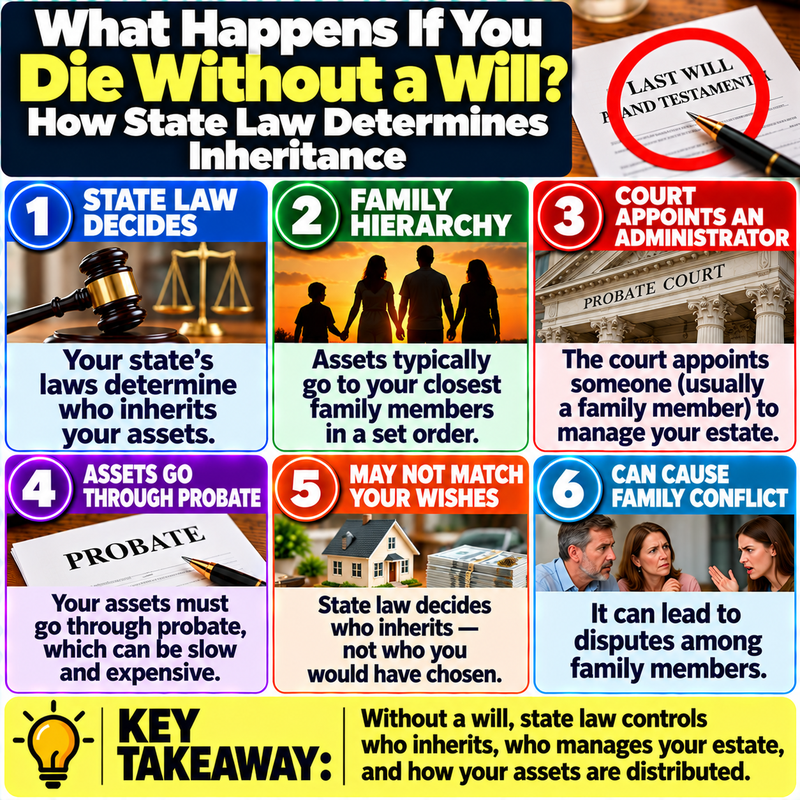
If you die without a will, your state’s default inheritance laws—not your personal wishes—decide who gets your house, your bank accounts, and even who raises your kids.
That single sentence sums up why so many people panic when they realize they’ve put off estate planning. Dying without a will doesn’t mean chaos, exactly, but it does mean you’re handing the steering wheel over to a set of rules written by lawmakers who never met your family. Those rules, called intestate succession laws, exist in every state and they’re designed to distribute property in a predictable, one-size-fits-most way.
The problem is that “predictable” and “what you actually wanted” are often two very different things. Resources like CreateALivingTrust.com exist precisely because so many families discover this gap too late, after a loved one has already passed.
Key Takeaways: What Really Happens Without a Will
- When someone dies without a valid will, state intestate-succession law—not personal preference—determines who inherits probate property.
- There’s no single nationwide formula for spouses and children; every state has its own percentages and priority order.
- Beneficiary designations, joint ownership, and trust-held property can still pass outside intestacy rules even without a will.
- Unmarried partners, stepchildren, friends, and charities often receive nothing under default intestacy laws unless specific legal steps were taken in advance.
- A living trust or other planning tools can override these default outcomes, but the right approach depends on your specific family and assets—something we’ll break down further below.
What Dying Intestate Really Means
“Intestate” is just a legal word for dying without a valid will in place. The term traces back to Latin roots meaning “without testimony” or “without witness,” which fits—there’s no document bearing witness to what you actually wanted done with your property. When this happens, probate courts don’t get to guess or improvise. They turn to a specific statute, often called the “law of intestate succession,” that lays out exactly who inherits and in what order. It’s a formula, not a judgment call, and it applies the same way whether the deceased was wealthy, broke, married fifty years, or never married at all.
Who Controls Your Inheritance Without a Will
Once someone dies intestate, control shifts almost entirely to the probate court and the state legislature. Neither of these parties has any idea who your favorite niece is, whether you were estranged from a sibling, or that you’d promised your coin collection to a lifelong friend. They only know what the intestate succession statute says, and they apply it mechanically.
State Intestate Succession Laws Take Over
Every state has its own intestate succession statute, and these laws differ significantly from one another. Some states give a surviving spouse the entire estate if there are no children; others split everything between the spouse and children regardless. Because the formulas vary so much by state—and sometimes even by the type of property involved—there’s no accurate “national average” to quote here. What matters is finding out exactly how your specific state ranks spouses, children, parents, and more distant relatives, because that ranking is what will govern your estate if you never sign a will.
The Probate Court’s Role in Distributing Assets
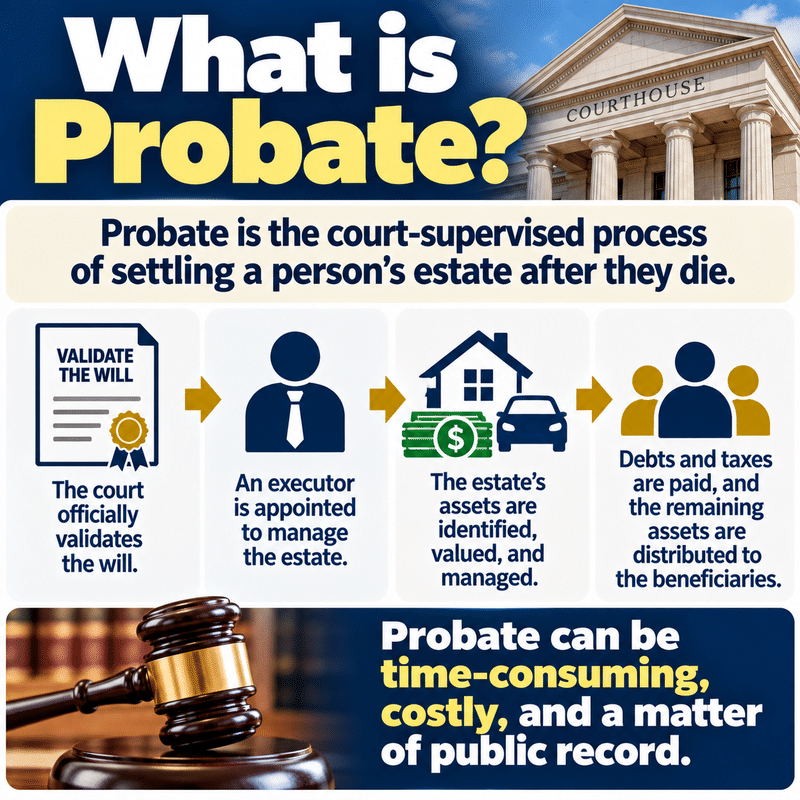
Probate court doesn’t just rubber-stamp paperwork—it actively oversees the entire process of identifying heirs, valuing assets, paying debts, and distributing what’s left. Without a will naming an executor, the court appoints what’s usually called an administrator or personal representative to handle these duties. That person follows the same intestate succession statute the court does, meaning they have little to no discretion in deciding who gets what. Their job is administrative, not creative: find the heirs the law recognizes, then distribute accordingly.

How Intestate Succession Prioritizes Family Relationships
Intestate succession statutes are built like a ladder, and each state decides who stands on which rung. Spouses and children usually occupy the top rungs, with parents, siblings, and more distant relatives stacked below them. If you don’t fall into a category with living relatives higher up the ladder, inheritance passes down to whoever is standing on the next rung instead.
Closest Relatives Inherit First
Picture a family tree where the closest branches get served first. A surviving spouse and children typically sit at the top. If none exist, the estate usually flows to parents, then to siblings, and only after that to nieces, nephews, grandparents, aunts, uncles, and cousins. Here’s a simplified example of how one state—Mississippi—structures this ladder when there’s no will:
Under Mississippi’s intestate succession law: if there’s no surviving spouse, the estate is split equally among surviving children. If there’s both a spouse and children, they share the estate equally. If there’s a spouse but no children, the spouse receives everything. If there’s no spouse or children, the estate passes equally to parents and siblings. And if none of those relatives survive, equal shares pass to surviving aunts, uncles, grandparents, and cousins.
That’s just one state’s approach—plenty of states calculate these shares differently, especially when it comes to how much a spouse receives compared to children.
How Degrees of Kinship Affect Your Estate
If a child who would have inherited dies before the parent, most states don’t just skip that child’s share entirely—they pass it down to that child’s own children instead, a concept lawyers call “per stirpes” distribution.
For example, if someone has three surviving children and two grandchildren from a child who passed away earlier, an $80,000 estate might be divided so each surviving child gets $20,000, while the two grandchildren split their deceased parent’s $20,000 share, taking $10,000 each. This “representation” principle keeps bloodlines connected even when a direct heir isn’t alive to collect their share personally.
What Happens to a Surviving Spouse and Children
Spouses and children almost always occupy the highest priority tier in intestate succession, but exactly how much each receives is where state laws diverge sharply. Some states favor the surviving spouse heavily; others split assets more evenly between spouse and children, regardless of how many kids survive.
Generally, intestate succession formulas consider factors like:
- Whether the marriage produced children, or whether children came from a previous relationship
- Whether property was acquired before or during the marriage (relevant in community property states)
- How many children survive the deceased
- Whether any children predeceased the parent and left their own children behind
A Spouse’s Share Depends on State Law
There’s genuinely no way to state a single accurate percentage here, because the laws aren’t remotely uniform. Some states grant 100% of the estate to a surviving spouse when there are no children. Others immediately split assets between spouse and children the moment children exist, even if those children are also the surviving spouse’s biological kids. If you want to know your spouse’s actual share under intestacy, you have to check your specific state’s statute—generic percentages floating around online are frequently wrong or oversimplified.
How Children’s Inheritance Rights Are Calculated
Children’s shares typically get divided equally among themselves once the spouse’s portion (if any) is set aside. So if three children survive and the formula gives them an equal split of the remaining estate, each receives one-third. Complications arise quickly, though, when children come from different relationships, when a child was legally adopted, or when a child predeceased the parent and left grandchildren behind who step into their place.
Blended Families and Stepchildren Complications
Blended families often run into unpleasant surprises here. Under many intestate succession statutes, children from a first marriage and children from a second marriage are treated identically—equal shares, regardless of which marriage produced them.
But stepchildren who were never legally adopted are usually treated as legal strangers entirely, meaning they can be left with nothing even if the deceased raised them for decades. This particular gap catches a lot of blended families off guard, and it’s one of the clearest examples of why relying on default intestacy rules can produce results nobody in the family actually wanted.

Who Gets Left Out: Partners, Friends, and Charities
Intestate succession laws were written with traditional family structures in mind—spouses, children, parents, siblings. That means anyone outside those bloodlines is usually invisible to the statute, no matter how close the relationship actually was.
This gap catches people off guard more often than you’d think. Long-term partners who never married, close friends who functioned like family, and favorite charities typically receive absolutely nothing under default intestacy rules. The law doesn’t ask who you loved or who took care of you—it only recognizes legally defined categories of kinship.
Unmarried and Domestic Partners Have No Automatic Rights
If you’re not legally married, your partner generally has zero inheritance rights under intestate succession law, regardless of how many years you were together or how intertwined your finances became. Some states recognize domestic partnerships or civil unions with limited inheritance rights, but many don’t extend any protection at all. Without a will, a trust, or beneficiary designations naming your partner directly, everything you own could pass to blood relatives—even ones you barely spoke to—while your partner walks away with nothing.
Stepchildren Without Legal Adoption
Stepchildren occupy a particularly painful blind spot in intestate law. Unless legally adopted, a stepchild typically has no inheritance rights whatsoever under intestate succession, even if that child called you “mom” or “dad” their entire life and had no relationship with their other biological parent. This surprises a lot of blended families who assumed love and daily presence counted for something legally. It doesn’t, unless adoption paperwork was filed.
Charities and Close Friends Are Excluded by Default
The same blind spot applies to charitable causes and close friendships. If you wanted to leave a portion of your estate to a cancer research organization, your church, or the neighbor who drove you to chemo appointments every week, intestate succession law simply won’t make that happen. These relationships and intentions only get honored through deliberate planning—a will, a trust, or a beneficiary designation that names them specifically.
Who Administers an Estate When There’s No Will
Someone still has to collect your assets, pay your debts, and distribute what’s left—even without a will naming that person. Courts handle this by appointing what’s usually called an administrator, sometimes called a personal representative depending on the state.
Court-Appointed Administrator vs. Named Executor
When you have a will, you choose your executor—the person you trust to carry out your wishes. Without one, the court picks an administrator instead, and that selection follows a priority list set by state law rather than personal preference. Surviving spouses are typically first in line, followed by adult children, then parents, then more distant relatives.
How the Court Chooses Who Manages Your Estate
If multiple people qualify under the priority list and none of them volunteer or agree, the court resolves the dispute itself, sometimes appointing a neutral third party like a professional fiduciary. This process adds time, cost, and occasionally family tension that a named executor in a will could have avoided entirely.

What Happens to Minor Children Without a Will
- The probate court decides who becomes guardian, not the surviving family automatically
- Judges prioritize the child’s best interests over family convenience or assumption
- Competing relatives can petition for guardianship, leading to court battles
- A parent’s wishes carry weight only if documented, such as in a will
- Without written guidance, courts rely entirely on state guardianship statutes and judicial discretion
Losing both parents is devastating enough for a child without adding legal uncertainty about who raises them next. Yet that’s exactly the position many families find themselves in when no will exists. The court doesn’t automatically hand custody to the closest living relative—it opens a guardianship proceeding and evaluates who’s actually fit to raise the child.
This process can take weeks or months, during which the child’s living situation may remain unsettled. Extended family members sometimes disagree about who should step in, especially in blended families or when grandparents on both sides want custody. Courts try to move quickly, but the absence of clear direction from the parents makes everything slower and more contentious.
The Court Decides Guardianship, Not Automatically a Relative
Judges apply a “best interests of the child” standard, weighing factors like emotional bonds, stability, financial capability, and the child’s own preference if they’re old enough to express one. Blood relation matters, but it’s not automatic or decisive. A grandparent in poor health might lose out to an aunt with a stable home, for example, even if the grandparent technically has priority under state law.
Without any documentation of parental wishes, the court has nothing to anchor its decision beyond state statute and its own judgment. That’s a significant gap, especially when family members disagree about what’s best.
Why Naming a Guardian in a Will Still Matters
Naming a guardian in a will doesn’t guarantee the court’s final decision, but it carries real legal weight and is typically honored unless there’s a compelling reason not to. Courts generally defer to a parent’s documented wishes because they assume the parent knew their child and their extended family better than anyone else. Skipping this step leaves that judgment entirely in the hands of a judge who’s meeting your family for the first time.

Do Debts Disappear If You Die Without a Will?
No—debts don’t vanish just because there’s no will. Creditors still have a legal right to be paid from the estate, and that obligation gets handled before any heirs receive their inheritance, with or without a will in place.
How Creditors Get Paid From the Estate
During probate, the estate administrator identifies outstanding debts, notifies creditors, and pays valid claims using estate assets. This typically includes funeral expenses, medical bills, credit card balances, and any other legitimate debt the deceased owed at the time of death. Only after these obligations are settled does whatever remains get distributed to heirs under the intestate succession formula.
What Happens If Debts Are Larger Than Assets
If the estate doesn’t have enough assets to cover all debts, state law dictates the order in which creditors get paid, and some may receive partial payment or nothing at all. Heirs generally aren’t personally responsible for covering the shortfall out of their own pockets—inheriting nothing is the worst-case outcome for them, not inheriting debt. This is one of the few areas where intestate succession and traditional will-based estates function almost identically.
Nonprobate Assets Follow Their Own Rules
| Asset Type | How It Transfers Without a Will |
|---|---|
| Life insurance policy | Pays directly to named beneficiary |
| 401(k) or IRA | Pays directly to named beneficiary |
| Jointly owned home with survivorship | Passes automatically to surviving co-owner |
| POD/TOD bank account | Transfers directly to named recipient |
| Assets held in a trust | Distributed according to trust terms |
Not everything you own actually goes through probate, and that distinction matters enormously when there’s no will. Intestate succession laws only govern probate property—assets titled solely in the deceased’s name with no other transfer mechanism attached. Anything with a built-in beneficiary designation or survivorship feature bypasses intestacy entirely and goes straight to whoever is named, regardless of what state law would otherwise dictate.
This is actually good news for anyone worried about default inheritance rules overriding their wishes. You don’t necessarily need a will or trust to control who gets your life insurance payout or your retirement account—you just need accurate, up-to-date beneficiary designations on file with each institution.
Beneficiary Designations on Retirement Accounts and Life Insurance
Retirement accounts and life insurance policies ask you to name a beneficiary when you open them, and that designation legally controls who receives the funds when you die—no matter what your will says, and no matter what intestate succession law would otherwise dictate. This is why updating these forms after major life events like divorce or remarriage is so critical; an outdated beneficiary designation can send money to an ex-spouse instead of your current family.
Jointly Owned Property and Survivorship Rights
Property titled as “joint tenants with right of survivorship” automatically passes to the surviving co-owner the moment the other owner dies, completely outside of probate and intestate succession law. This commonly applies to homes owned jointly by married couples, but it can apply to other relationships too, depending on how the title was set up.
Married couples frequently use this titling method for their primary residence specifically to avoid probate court involvement. The surviving spouse simply becomes the sole owner, often with nothing more than a death certificate and a straightforward filing.
It’s worth checking exactly how your property is titled, because “joint ownership” doesn’t always mean survivorship rights are included. Some states default to “tenants in common” instead, which doesn’t carry the same automatic transfer feature and would send the deceased’s share through probate instead.
- Joint tenancy with right of survivorship transfers automatically, bypassing probate
- Tenancy in common does not include survivorship rights and goes through probate
- Community property states have their own additional rules for married couples
Payable-on-Death and Transfer-on-Death Accounts
| POD (Payable-on-Death) | Typically used for bank accounts and CDs |
| TOD (Transfer-on-Death) | Typically used for brokerage and investment accounts |
POD and TOD designations work almost identically to beneficiary forms on retirement accounts. You name a recipient directly with your bank or brokerage firm, and when you die, that person simply presents a death certificate to claim the funds. No probate, no intestate succession formula, no court involvement required.
These tools are often underused simply because people don’t realize they exist or don’t get around to filling out the paperwork. Setting one up typically takes a single form and a few minutes at your bank—a remarkably low-effort way to guarantee a specific person receives specific funds, regardless of what your broader estate plan looks like.
If you’re unsure whether your accounts already have these designations filled out, it’s worth calling your bank or brokerage directly to check. Accounts opened years ago sometimes never had a beneficiary named at all, which means they’d default to probate and intestate succession law despite your original intentions.

What Happens When No Legal Heirs Can Be Found
It’s rare, but occasionally someone dies without any identifiable spouse, children, parents, siblings, or other relatives recognized under state law. When this happens, the estate doesn’t just sit in limbo—the state eventually takes ownership through a process called escheat.
Before reaching that point, though, courts and administrators typically make a genuinely thorough effort to track down any qualifying relative, no matter how distantly related. Intestate succession statutes are intentionally written broadly for this exact reason—to give even remote cousins or long-lost aunts a chance to inherit before the state steps in.
Genealogical researchers, sometimes called “heir hunters,” are occasionally hired specifically to locate these distant relatives, especially when an estate involves significant assets. Their job is to comb through records, family trees, and public documents to find anyone who might legally qualify as an heir.
Extended Family Members Who Might Still Qualify
Most state intestate succession laws extend inheritance rights surprisingly far down the family tree before giving up. Grandparents, aunts, uncles, cousins, and even more distant relatives can sometimes qualify if closer relatives don’t exist or can’t be located. This layered approach means escheat is genuinely a last resort, not a quick default.
Because the net is cast so wide, it’s unusual for an estate to have absolutely no qualifying heir anywhere in the family tree. Most of the time, someone—however distantly related—eventually surfaces to claim the inheritance.
Escheat: When Property Passes to the State
When no heir can be found after a reasonable search, the state takes legal ownership of the remaining property through escheat. This outcome is uncommon precisely because intestate succession laws are built to prevent it, casting such a wide net across extended family. Still, it’s a real possibility for anyone who has genuinely no living relatives and never completed any estate planning naming other beneficiaries.
Why Intestate Succession Outcomes Differ by State
It bears repeating because it trips people up constantly: there is no single, uniform set of intestate succession rules across the United States. Each state legislature writes its own statute, which means moving across state lines can change your family’s entire inheritance outcome without you doing anything differently at all. A formula that gives a surviving spouse everything in one state might split assets evenly between spouse and children in another. If you’ve recently relocated, it’s worth double-checking how your new state’s intestate succession law would actually apply to your specific family situation.
Also, owning property in multiple states can trigger ancillary probate and often laws vary between state to state.
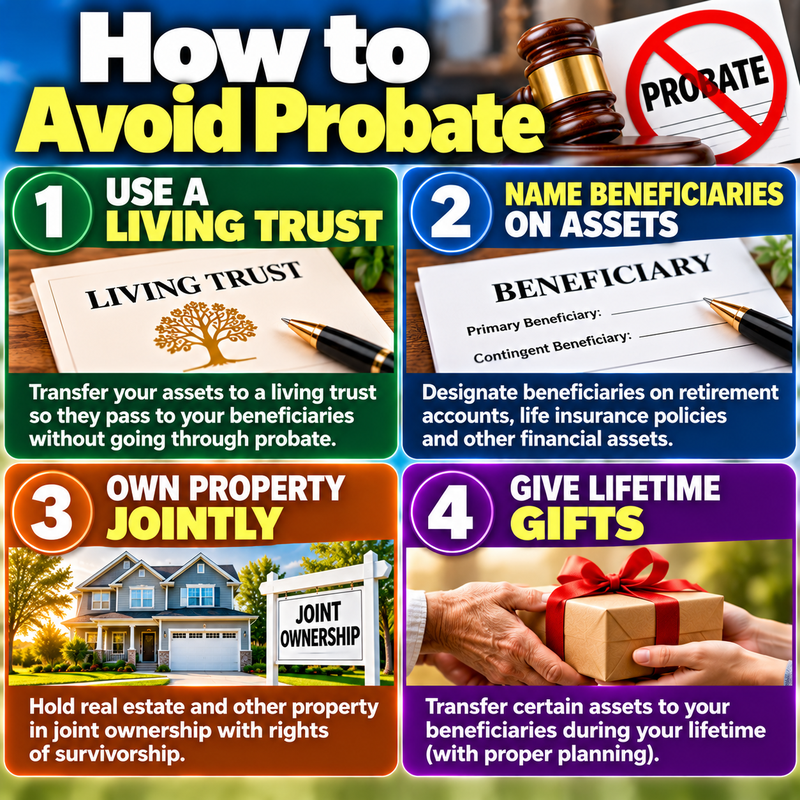
Will vs. Living Trust vs. Beneficiary Designations
These three tools solve overlapping but distinct problems, and understanding the difference helps clarify which one—or which combination—actually fits your situation. A will controls probate property and lets you name an executor and guardian, but it still has to go through court. Beneficiary designations bypass probate entirely but only work for specific accounts and policies.
A living trust sits somewhere in between, letting you control a wide range of assets while potentially avoiding probate court altogether. If you’re curious about what happens when you die without a will, it’s important to understand how each tool can impact your estate planning.
None of these tools are inherently “better” in every situation—they solve different problems, and most solid estate plans end up using more than one simultaneously.
How a Revocable Living Trust Avoids Probate Entirely
A revocable living trust works by having you transfer ownership of your property into the trust while you’re still alive, though you retain full control over it during your lifetime. Because the trust—not you personally—technically owns the property, it doesn’t become part of your probate estate when you die, meaning intestate succession law never applies to it in the first place.
If a home, investment account, or other asset is properly retitled into a revocable living trust, that asset passes directly to the trust’s named beneficiaries according to the trust document—completely bypassing both probate court and intestate succession statutes.
This is why trusts get recommended so often for people with more complex families, significant assets, or a strong desire for privacy, since trust administration typically happens outside the public probate process entirely.
Why a Living Trust Still Needs a Pour-Over Will
Even a well-funded living trust usually gets paired with what’s called a pour-over will—a simple backup document that catches any assets accidentally left outside the trust and directs them into it after death. It’s not a contradiction; it’s a safety net. People occasionally forget to retitle a newly purchased asset, or they acquire something shortly before death without time to transfer it properly. A pour-over will ensures those stray assets still end up exactly where intended, rather than falling back under intestate succession law by accident.
Comparing Control, Privacy, and Cost Between Each Option
Each tool comes with tradeoffs worth weighing honestly rather than assuming one is automatically superior. A will is generally cheaper and simpler to create but still requires probate, which means court costs, public records, and a timeline that can stretch for months.
A living trust costs more upfront and requires ongoing maintenance as you acquire new assets, but it offers privacy and typically a faster, cheaper transfer process after death. Beneficiary designations are essentially free and instant to set up, but they only work for specific account types and can’t handle complex instructions like staggered distributions or conditions.
Most comprehensive estate plans don’t pick just one of these tools—they layer them together, using beneficiary designations for retirement accounts, a trust for real estate and investments, and a will to catch anything left over and name guardians for minor children.

Estate-Planning Steps That Prevent Unintended Results
Knowing how intestate succession works is useful, but the real value comes from actually putting something in place that overrides it where you want something different. Here’s a practical sequence worth working through:
- Draft a will that names your heirs and a guardian — Even if you also set up a trust, a will fills in the gaps and formally nominates who should raise your minor children if something happens to you.
- Set up a revocable living trust for key assets — This is especially worthwhile if you own real estate, have a blended family, or simply want to avoid probate court’s delays and public record exposure.
- Review and update your beneficiary designations — Check retirement accounts, life insurance policies, and any POD/TOD accounts to make sure they reflect your current relationships, not decisions made decades ago.
- Title property with survivorship rights where it makes sense — For married couples especially, confirming your home is titled correctly can prevent it from unexpectedly landing in probate.
- Talk to your family about your plan now — A quiet conversation today can prevent confusion, hurt feelings, or outright legal disputes among relatives after you’re gone.
None of these steps require overhauling your entire financial life overnight. Even completing one or two of them meaningfully reduces the chances that a state formula—rather than your actual wishes—ends up deciding what happens to your family and your property.
Take Control Before the State Decides for You
Dying intestate hands enormous decisions to a formula you had no hand in writing. The good news is that reclaiming control doesn’t require a complicated overhaul—just a handful of documents, updated beneficiary forms, and honest conversations with the people you love.
Estate-Planning Steps That Prevent Unintended Results
Understanding how intestate succession works is only half the battle—the other half is actually doing something to override it where your wishes differ from the state’s default formula. None of this requires a complicated legal overhaul or a huge upfront cost. It usually comes down to five concrete steps, each one closing a specific gap that intestacy law leaves wide open.
1. Draft a Will That Names Your Heirs and a Guardian
Even if you eventually set up a trust, a will still does two things nothing else can: it names a guardian for your minor children and formally states who you want to inherit anything that falls outside your other planning. Without it, a judge who’s never met your family decides both of those questions using nothing but statute and best-interest guesswork.
2. Set Up a Revocable Living Trust for Key Assets
If you own real estate, have a blended family, or simply want to keep your financial affairs out of the public probate process, a living trust is worth serious consideration. Property properly transferred into a trust bypasses intestate succession law entirely, since it’s no longer considered part of your probate estate when you die. You keep full control over the assets while you’re alive—you can buy, sell, or spend from the trust just as you would normally—and the transfer to your chosen beneficiaries happens according to the trust’s terms rather than a courtroom formula.
3. Review and Update Your Beneficiary Designations
Retirement accounts, life insurance policies, and payable-on-death bank accounts transfer based entirely on whatever beneficiary form is currently on file, regardless of what your will or intestate succession law would otherwise say. It’s worth pulling up these forms at least once every few years, especially after a divorce, remarriage, or the birth of a child, since an outdated form can send money to an ex-spouse or an estranged relative by accident.
4. Title Property With Survivorship Rights Where It Makes Sense
For married couples especially, confirming that your home and major joint accounts are titled with right of survivorship can prevent those assets from ever touching probate court. Not every state defaults to survivorship automatically, so it’s worth double-checking the actual title documents rather than assuming.
This single step is often overlooked simply because people assume joint ownership automatically means automatic transfer—and that’s not always true, depending on how the title was originally set up.
5. Talk to Your Family About Your Plan Now
A short, honest conversation today can prevent a lot of confusion and hurt feelings after you’re gone. Family members who understand your reasoning—why one child is named executor, why a stepchild was specifically included in your will, why certain assets went into a trust—are far less likely to contest your wishes later.
This step costs nothing and takes maybe twenty minutes, yet it’s one of the most commonly skipped parts of estate planning. Silence tends to breed assumptions, and assumptions are exactly what cause family disputes once someone has passed.
Take Control Before the State Decides for You
Every piece of this comes down to one simple choice: either you decide who inherits your property and raises your children, or a statute written for the general public decides it for you. A little planning now is the difference between the two.

Frequently Asked Questions
These are the questions that come up most often once people realize how much is actually at stake without a will in place.
What does it mean to die intestate?
Dying intestate simply means dying without a valid will in place, which triggers your state’s default intestate succession statute to determine who inherits your probate property.
Does the state automatically take everything if there’s no will?
No, and this is one of the most common misconceptions about intestacy. The state only takes full ownership of an estate—a process called escheat—when absolutely no qualifying heir can be located anywhere in the family tree.
Intestate succession statutes are deliberately written to cast a wide net before that ever happens. Spouses and children are first in line, but if none exist, the law keeps working down the family tree.
Here’s roughly how that search typically unfolds, in order of priority:
- Surviving spouse and children
- Parents
- Siblings
- Grandparents, aunts, uncles, and cousins
- The state, only if no qualifying relative can be found
Can an unmarried partner inherit without a will?
Generally, no. Most intestate succession statutes don’t recognize unmarried partners as legal heirs, no matter how long the relationship lasted or how combined the finances became.
Some states extend limited rights to registered domestic partners or those in civil unions, but this protection isn’t universal and shouldn’t be assumed.
A partner of twenty years with no legal marriage and no will in place could legally receive nothing, while a distant cousin the deceased never met inherits the entire estate instead.
The only reliable way around this is proactive planning—naming the partner directly in a will, a trust, or as a beneficiary on specific accounts.
Who becomes guardian of my children if I don’t have a will?
A probate court decides guardianship based on the child’s best interests, applying state guardianship law rather than automatically defaulting to the nearest living relative.
This process can take weeks, and competing relatives sometimes petition the court simultaneously, which adds delay and potential conflict during an already difficult time for the child.
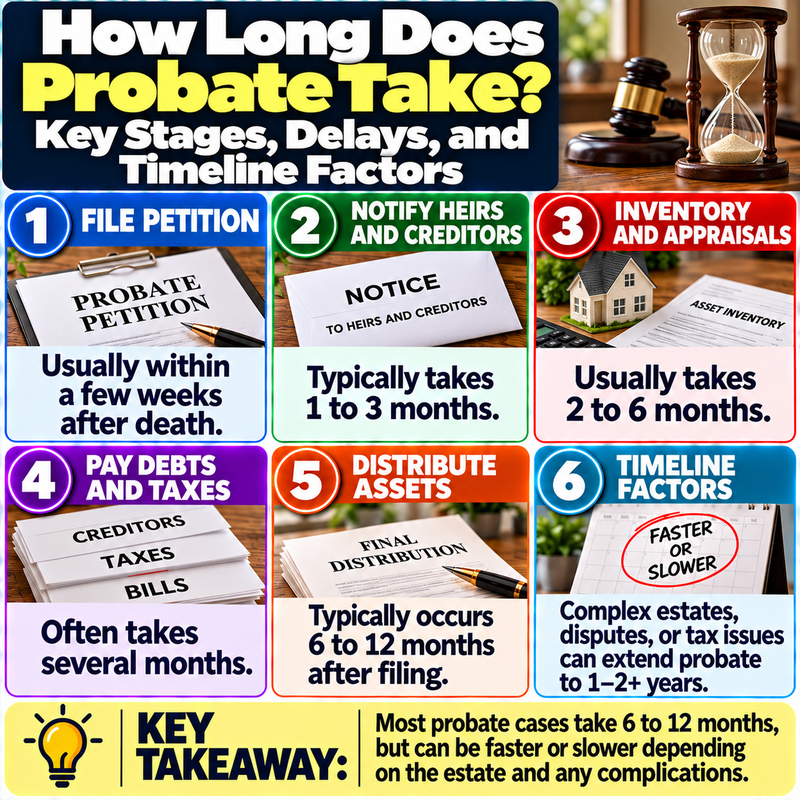
How long does probate take without a will?
Timelines vary significantly by state and by how complicated the estate is, but intestate probate often runs longer than a will-based estate because the court has to formally identify and locate every legal heir first.
Simple estates with few assets and easily located heirs might wrap up in several months, while estates with disputed heirs or hard-to-value property can stretch well over a year.
Can stepchildren inherit under intestate succession laws?
Typically not, unless the stepchild was legally adopted by the deceased. Biological and legally adopted children usually have clear inheritance rights, while unadopted stepchildren are generally treated as legal strangers under most state statutes.
What happens to jointly owned property if I die without a will?
If the property is titled as joint tenants with right of survivorship, it passes automatically to the surviving co-owner the moment the other owner dies, completely bypassing probate and intestate succession law.
Property titled as tenants in common doesn’t carry this same feature, meaning the deceased’s share would go through probate and be distributed according to the state’s intestate succession formula instead.
Community property states add another layer of rules specifically for married couples, which can affect how jointly acquired assets are treated.
| Title Type | What Happens at Death |
|---|---|
| Joint tenancy with right of survivorship | Passes automatically to surviving co-owner |
| Tenancy in common | Deceased’s share goes through probate |
| Community property (where applicable) | Follows state-specific marital property rules |
Does a living trust replace the need for a will?
Not entirely. Most trust-based plans still include what’s called a pour-over will, which catches any assets accidentally left outside the trust and directs them into it after death.
A revocable living trust handles the bulk of your property and generally avoids probate for those specific assets, but the will still serves as a backup and is typically the only place where guardianship for minor children gets formally nominated.
Who is responsible for paying my debts if I die without a will?
The estate itself is responsible for paying valid debts before any assets are distributed to heirs, regardless of whether a will exists. An appointed administrator handles this process, using estate assets to settle funeral costs, medical bills, and other outstanding obligations first. For more information on what happens when you die without a will, you can read further insights from legal experts.
Heirs generally aren’t personally liable if the estate’s debts exceed its assets—the worst outcome for them is inheriting nothing, not inheriting the shortfall.
Can I avoid intestate succession laws entirely?
Yes, and it doesn’t require choosing just one tool. A will, a living trust, and properly updated beneficiary designations working together can cover nearly every asset you own, leaving little to nothing for intestate succession law to actually govern.
The key is making sure each piece of the plan actually gets completed and kept current. A will that’s never signed, a trust that’s never funded, or a beneficiary form that’s twenty years out of date won’t protect anyone, no matter how good the intentions were.
Life changes—marriage, divorce, a new child, a move to another state—are the moments that most often make an old plan outdated or create new gaps that didn’t exist before. Revisiting your documents after any of these events is a simple habit that keeps your plan actually matching your life.
There’s no single “right” combination that works for every family. Someone with a modest estate and no minor children might only need a will and updated beneficiary forms, while someone with real estate, a blended family, or a desire for privacy might lean more heavily on a trust.
Whatever combination fits your situation, the goal stays the same: make sure your own documented wishes—not a generic state formula—are what ultimately decides who inherits your property and who raises your children.
If you’re ready to put a plan in place instead of leaving these decisions to state law, CreateALivingTrust.com can help you build one that actually fits your family.